. 2025 Sep 1;57(9):1866-1876.
doi: 10.1249/MSS.0000000000003723. Epub 2025 Apr 18.

Postexercise Cooling Lowers Skeletal Muscle Microvascular Perfusion and Blunts Amino Acid Incorporation into Muscle Tissue in Active Young Adults

Affiliations

Postexercise Cooling Lowers Skeletal Muscle Microvascular Perfusion and Blunts Amino Acid Incorporation into Muscle Tissue in Active Young Adults

Milan W Betz et al. Med Sci Sports Exerc. .

Abstract

Purpose: Cold-water immersion lowers muscle protein synthesis rates during postexercise recovery. Whether this effect can be explained by lower muscle microvascular perfusion and a subsequent decline in postprandial amino acid incorporation into muscle tissue after cooling is currently unknown.

Methods: Twelve young males (24 ± 4 yr) performed a single resistance exercise session followed by water immersion for 20 min with one leg immersed in cold water (8°C: COLD) and the contralateral leg in thermoneutral water (30°C: CON). After immersion, a beverage was ingested containing 20 g free amino acids, 0.25 g L-[ring- 13 C 6 ]-phenylalanine, and 45 g carbohydrates. Microvascular perfusion of the vastus lateralis muscle was assessed for both legs using contrast-enhanced ultrasound at rest, immediately after exercise and water immersion, and at t = 60 and t = 180 min after beverage ingestion. A muscle biopsy sample ( vastus lateralis ) was collected from both legs ( t = 240 min) to determine amino acid tracer incorporation.

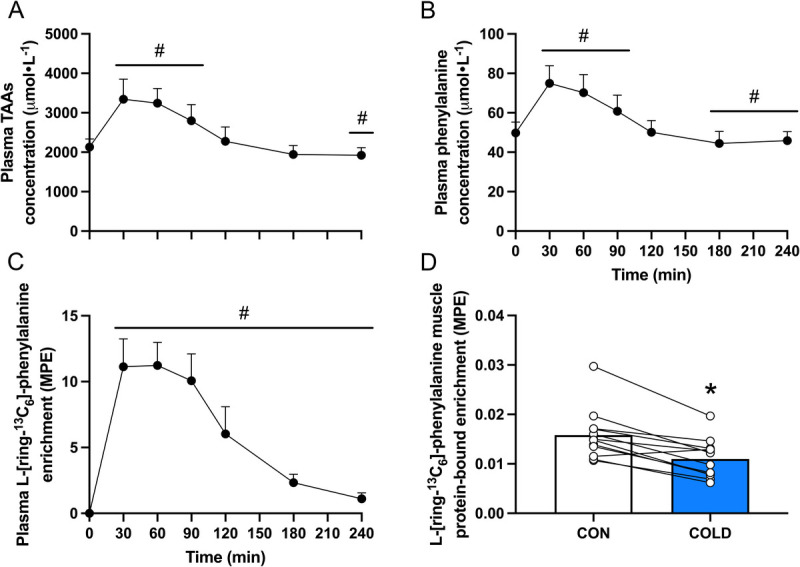
Results: Microvascular blood volume was significantly lower in the COLD versus CON leg immediately after water immersion (1.24 ± 0.82 vs 3.13 ± 1.64 video intensity, respectively, P < 0.001) and remained lower at t = 60 and t = 180 min after beverage ingestion (0.90 ± 0.84 vs 1.53 ± 0.98, and 2.10 ± 2.53 vs 2.77 ± 2.81 video intensity, respectively, both P < 0.05). Exogenous amino acid incorporation into muscle protein was lower in the COLD versus CON leg (0.011 ± 0.004 vs 0.016 ± 0.005 mole percent excess, respectively, P < 0.001). The difference in postprandial amino acid incorporation into muscle protein between the COLD and the CON legs was strongly associated with the difference in microvascular blood volume between the two legs during recovery ( r = 0.65, P < 0.05).

Conclusions: Cold-water immersion during postexercise recovery greatly reduces muscle microvascular perfusion and blunts postprandial amino acid incorporation in muscle.

Keywords: BLOOD FLOW; CEU; CEUS; CRYOTHERAPY; CWI; MICROCIRCULATION.


Figures

FIGURE 1
FIGURE 1
Schematic overview of the experimental test day. Participants performed a single bout of resistance exercise followed by water immersion of both legs (one leg was immersed in 8°C, COLD; the other leg was immersed in 30°C, CON) for 20 min. A recovery beverage consisting of 45 g carbohydrate with a mixture of 20 g free amino acids enriched with L-[ring-13C6]-phenylalanine was ingested after water immersion. Muscle biopsies were collected from both legs at t = 240 min to determine amino acid tracer incorporation. Blood samples were collected, and muscle microvascular perfusion, femoral artery blood flow, and skin temperature measurements were performed throughout the experimental test day.
FIGURE 2
FIGURE 2
Skin temperature during and after 20 min of cold (8°C: COLD) or thermoneutral water (30°C: CON) immersion in recreationally active young adult males (n = 12). The blue rectangle represents water immersion from t = −50 to t = −30 min. The shaker icon represents beverage ingestion at t = 0 min. Data were analyzed with the use of two-factor repeated-measures ANOVA. * Significant difference between the COLD and the CON legs, P < 0.05.
FIGURE 3
FIGURE 3
Femoral artery diameter (A), blood velocity (B), and blood flow (C) during the experimental test day in the COLD and CON leg in recreationally active young adult males (n = 12). The blue dotted line represents water immersion. COLD, cold-water immersion (8°C); CON, thermoneutral water immersion (30°C); Post-ex, postexercise; Post-im, postimmersion; Data were analyzed with the use of two-factor repeated-measures ANOVA. * Significant difference between the COLD and the CON legs, P < 0.05.
FIGURE 4
FIGURE 4
Muscle microvascular blood volume (A), velocity (B), and flow (C), assessed by CEUS, during the experimental test day in the COLD and CON leg in recreationally active young adult males (n = 12). The blue dotted line represents water immersion. COLD, cold-water immersion (8°C); CON, thermoneutral water immersion (30°C); Post-ex, postexercise; Post-im, postimmersion. Data were analyzed with the use of two-factor repeated-measures ANOVA. * Significant difference between the COLD and the CON legs, P < 0.05.
FIGURE 5
FIGURE 5
Plasma total amino acid (TAA, A), phenylalanine (B) concentration, L-[ring-13C6]-phenylalanine enrichment (C), and L-[ring-13C6]-phenylalanine muscle protein-bound enrichment (D) after beverage ingestion (t = 0) in recreationally active young adult males (n = 12). MPE, mole percent excess; COLD, cold-water immersion (8°C); CON, thermoneutral water immersion (30°C). Plasma data were analyzed with the use of one-factor repeated-measures ANOVA. Amino acid tracer incorporation into muscle tissue was analyzed with the use of a Student’s paired t-test. # Significantly different from t = 0 min, P < 0.05. * Significantly different from CON, P < 0.05.
FIGURE 6
FIGURE 6
Pearson correlations (r) between amino acid tracer incorporation into mixed-muscle protein and femoral artery diameter (A), blood velocity (B), blood flow (C), microvascular blood volume (D), velocity (E), and flow (F) in recreationally active young adult males (n = 12). Straight lines represent linear regression and bands represent the 95% confidence interval. COLD, cold-water immersion (8°C); CON, thermoneutral water immersion (30°C); AUC, area under the curve; calculated using the postimmersion, t = 60 and t = 180 min time points. All values used for correlated analyses were expressed as % difference between the COLD and the CON legs.

References

    1. Allan R Akin B Sinclair J, et al. Athlete, coach and practitioner knowledge and perceptions of post-exercise cold-water immersion for recovery: a qualitative and quantitative exploration. Sport Sci Health. 2022;18(3):699–713.
    1. Leeder J, Gissane C, van Someren K, Gregson W, Howatson G. Cold water immersion and recovery from strenuous exercise: a meta-analysis. Br J Sports Med. 2012;46(4):233–40. - PubMed
    1. Roberts LA, Nosaka K, Coombes JS, Peake JM. Cold water immersion enhances recovery of submaximal muscle function after resistance exercise. Am J Physiol Regul Integr Comp Physiol. 2014;307(8):R998–1008. - PubMed
    1. Hohenauer E, Taeymans J, Baeyens JP, Clarys P, Clijsen R. The effect of post-exercise cryotherapy on recovery characteristics: a systematic review and meta-analysis. PLoS One. 2015;10(9):e0139028. - PMC - PubMed
    1. Yanagisawa O, Kudo H, Takahashi N, Yoshioka H. Magnetic resonance imaging evaluation of cooling on blood flow and oedema in skeletal muscles after exercise. Eur J Appl Physiol. 2004;91(5–6):737–40. - PubMed

MeSH terms