


Analog to Digital Diagnosis and Planning in Orthognathic Surgery: A Narrative Review
- PMID: 40255697
- PMCID: PMC12008023
- DOI: 10.7759/cureus.80858
Analog to Digital Diagnosis and Planning in Orthognathic Surgery: A Narrative Review
Abstract
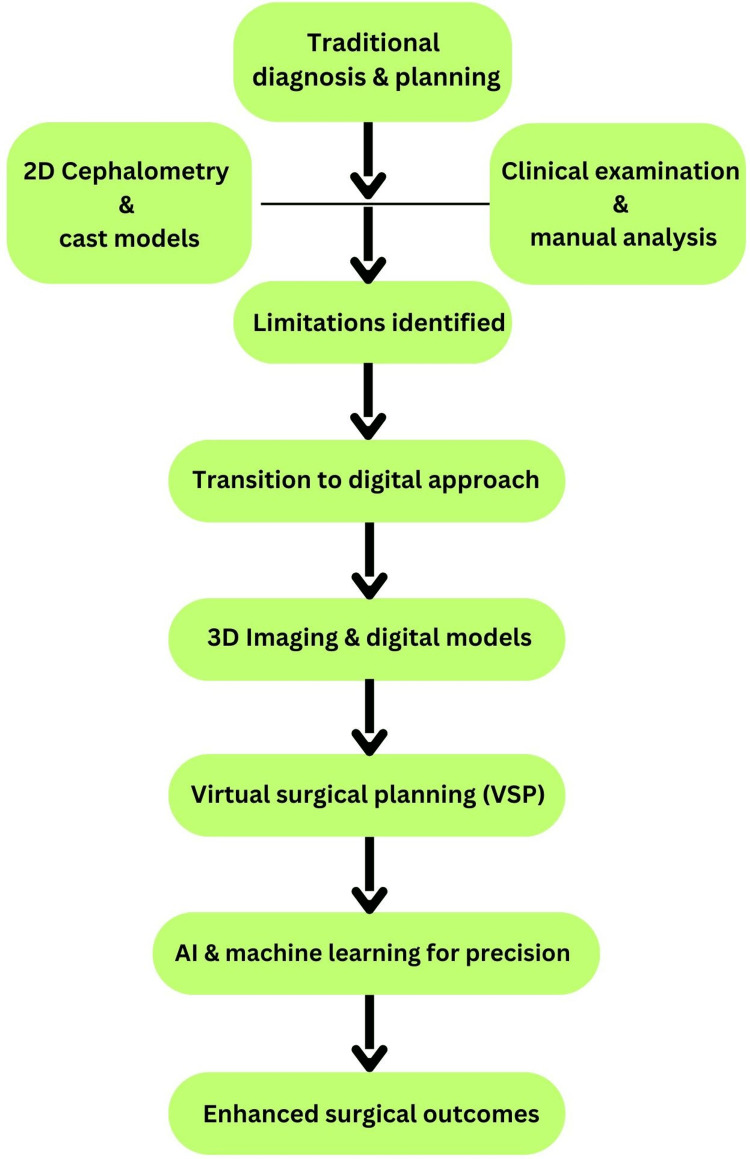
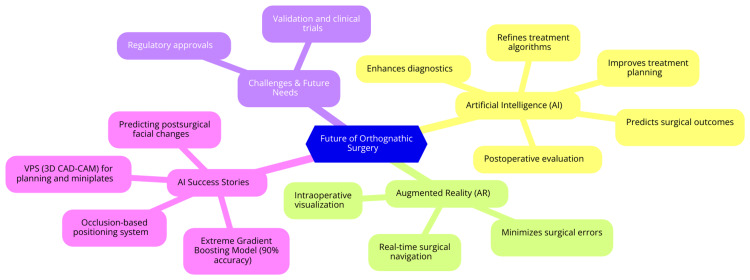
Orthognathic surgery is a transformative procedure for correcting skeletal and dental discrepancies and enhancing facial aesthetics, functionality, and quality of life. Patients with dentofacial deformities often experience mastication, speech, and respiration challenges. Advances in diagnostic tools, treatment planning, and surgical methodologies have significantly improved surgical precision and predictability. Accurate diagnosis relies on clinical assessments, cephalometric analysis, and advanced imaging techniques such as cone beam computed tomography and three-dimensional facial scanning. Traditional surgical planning using two-dimensional cephalometry and plaster models has been largely replaced by virtual surgical planning, which enables precise simulations, computer-aided design/computer-aided manufacturing-assisted surgical splint fabrication, and improved postoperative stability. Achieving a balance between function and aesthetics is crucial. Contemporary approaches emphasize both skeletal correction and soft tissue response, with airway management being a key consideration, particularly in cases of obstructive sleep apnea. The treatment pathway includes presurgical orthodontics, maxillary or mandibular repositioning, and postoperative rehabilitation. Artificial intelligence and augmented reality-assisted surgery drive future innovations to enhance surgical accuracy and treatment customization. Despite these advancements, challenges such as treatment duration, patient compliance, psychological readiness, and costs remain. Predicting soft tissue behavior and ensuring long-term stability require further research. This review aims to provide a comprehensive overview of advancements in orthognathic surgery, from diagnostic innovations to modern treatment planning and emerging technologies, highlighting their impact on surgical precision, efficiency, and patient outcomes. With continuous technological progress and interdisciplinary collaboration, orthognathic surgery is moving toward greater precision, efficiency, and improved patient outcomes.
Keywords: diagnosis; digital planning; maxillofacial imaging; orthognathic surgery; treatment plan.
Copyright © 2025, Shetty et al.
Conflict of interest statement
Conflicts of interest: In compliance with the ICMJE uniform disclosure form, all authors declare the following: Payment/services info: All authors have declared that no financial support was received from any organization for the submitted work. Financial relationships: All authors have declared that they have no financial relationships at present or within the previous three years with any organizations that might have an interest in the submitted work. Other relationships: All authors have declared that there are no other relationships or activities that could appear to have influenced the submitted work.
Figures
References
-
- The clinical relevance of orthognathic surgery on quality of life. Murphy C, Kearns G, Sleeman D, Cronin M, Allen PF. Int J Oral Maxillofac Surg. 2011;40:926–930. - PubMed
-
- Simultaneous repositioning of the maxilla, mandible, and chin. Treatment planning and analysis of soft tissues. Bell WH, Jacobs JD, Quejada JG. Am J Orthod. 1986;89:28–50. - PubMed
-
- Current status of surgical planning and transfer methods in orthognathic surgery. Pascal E, Majoufre C, Bondaz M, Courtemanche A, Berger M, Bouletreau P. J Stomatol Oral Maxillofac Surg. 2018;119:245–248. - PubMed
Publication types
LinkOut - more resources
Full Text Sources