Potential relationship of the gut microbiome with testosterone level in men: a systematic review
- PMID: 40256744
- PMCID: PMC12007503
- DOI: 10.7717/peerj.19289
Potential relationship of the gut microbiome with testosterone level in men: a systematic review
Abstract
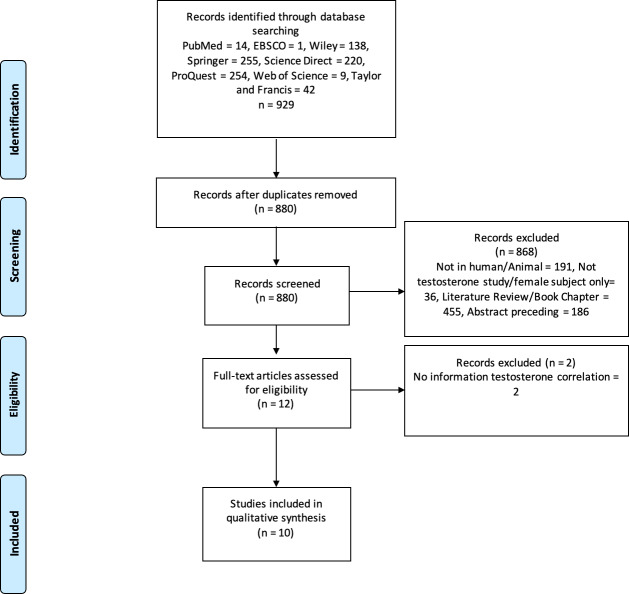
The gut microbiome influences the metabolism and health of several organs beyond the gut and has recently gained considerable attention. The gut plays a central role in food digestion, absorption, nutrition, and general health. Hence, the gut microbiome has become a research subject for almost all health conditions. Imbalance or dysbiosis in the gut microbiome can cause different health issues in men, including reproductive and sexual health issues associated with testosterone levels. Several studies have investigated the relationship between the gut microbiome and testosterone levels. In this systematic review, we aimed to examine the relationship between the gut microbiome and testosterone levels in men. Literature searches were conducted by scanning PubMed, ProQuest, EBSCO, Taylor & Francis Online, Wiley Online, Springer Link, Web of Science, Google Scholar, and Science Direct databases for relevant keywords following the preferred reporting items for the systematic review guidelines. This review included cross-sectional, case-control, retrospective, and prospective cohort studies. Quality assessment was conducted using the Newcastle-Ottawa Scale. We found a significant positive correlation between the gut microbiome and testosterone levels in men. Several microbes play substantial roles in testosterone production. Mechanisms have been proposed as factors that contribute to testosterone levels, namely the hypothalamus-pituitary-gonad axis modulation, androgen metabolism, and intestinal homeostasis, by balancing the bone morphogenic protein (BMP) and the Wnt diverse microbiome. Ruminococcus showed a stronger correlation with testosterone levels than other microorganisms. The gut microbiome has complex correlations with testosterone metabolism. However, the microbiome with the most significant influence on testosterone levels cannot be easily identified and requires further research.
Keywords: Gut microbiome; Reproductive health; Sexual health; Testosterone.
©2025 Pakpahan et al.
Conflict of interest statement
The authors declare there are no competing interests.
Figures
References
Publication types
MeSH terms
Substances
LinkOut - more resources
Full Text Sources