Transcranial Pulsed Current Stimulation and Social Functioning in Children With Autism: A Randomized Clinical Trial
- PMID: 40257798
- PMCID: PMC12013354
- DOI: 10.1001/jamanetworkopen.2025.5776
Transcranial Pulsed Current Stimulation and Social Functioning in Children With Autism: A Randomized Clinical Trial
Abstract
Importance: Transcranial pulsed current stimulation (tPCS) may improve social functioning and sleep disorders in children with autism spectrum disorder (ASD). Prior trials have been limited by small sample sizes, single-center designs, and often a lack of sham controls.
Objective: To examine the safety and efficacy of tPCS in improving social functioning and sleep disorders in children with ASD.
Design, setting, and participants: This multicenter, double-blind, 2-armed, sham-controlled randomized clinical trial, conducted from May 1, 2022, through November 30, 2023, assessed children aged 3 to 14 years with ASD at 8 medical centers in China.
Interventions: Participants underwent daily 20-minute sessions of active tPCS (0.7 mA) or sham tPCS (brief 0.7 mA ramp-up and ramp-down) for 20 sessions over 4 weeks with anode over the right cerebellar hemisphere and cathode over the left dorsolateral prefrontal cortex (12.56-cm2-circular, 4-cm-diameter circular electrodes). Each day after tPCS, all participants received 1 hour of standard therapy.
Main outcomes and measures: Social functioning was assessed using the Autism Treatment Evaluation Checklist as the primary outcome. Secondary outcomes included the Autism Behavior Checklist and the Childhood Sleep Habits Questionnaire.
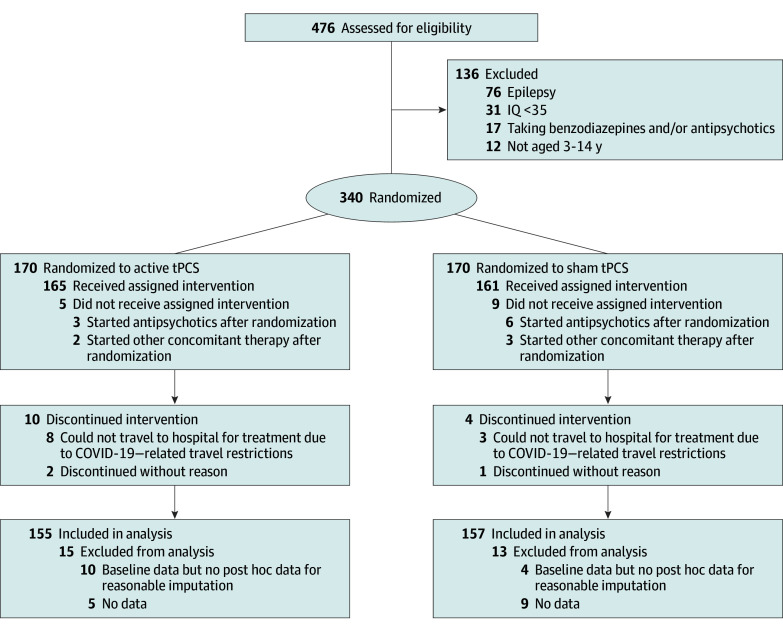
Results: A total of 312 participants (155 in the active group and 157 in the sham group; 248 [79.5%] boys; mean [SD] age, 5.1 [1.6] years; 276 [88.5%] aged 3-6 years and 36 [11.5%] aged 7-14 years) completed the trial. After 20 sessions, the mean Autism Treatment Evaluation Checklist total score improved by 4.13 points (5.8%) in the sham tPCS group and 7.17 points (10.7%) in the active tPCS group. Analysis of covariance showed significantly greater improvement in the active tPCS group (difference, -3.50; 95% CI, -5.56 to -1.43; P < .001). Both treatments were well tolerated.
Conclusions and relevance: In this randomized clinical trial of prefrontal-cerebellar tPCS in children aged 3 to 14 years with ASD, 20 sessions over 4 weeks improved social functioning and sleep. These findings suggest that tPCS may serve as a viable nonpharmacologic alternative for ASD.
Trial registration: Chinese Clinical Trial Registry Identifier: ChiCTR2200059118.
Conflict of interest statement
Figures
Similar articles
-
Repetitive Transcranial Magnetic Stimulation and Tai Chi Chuan for Older Adults With Sleep Disorders and Mild Cognitive Impairment: A Randomized Clinical Trial.JAMA Netw Open. 2025 Jan 2;8(1):e2454307. doi: 10.1001/jamanetworkopen.2024.54307. JAMA Netw Open. 2025. PMID: 39792383 Clinical Trial.
-
Transcranial Direct Current Stimulation Combined With Repetitive Transcranial Magnetic Stimulation for Depression: A Randomized Clinical Trial.JAMA Netw Open. 2024 Nov 4;7(11):e2444306. doi: 10.1001/jamanetworkopen.2024.44306. JAMA Netw Open. 2024. PMID: 39535797 Free PMC article. Clinical Trial.
-
Repetitive transcranial magnetic stimulation in children and adolescents with autism spectrum disorder: study protocol for a double-blind, sham-controlled, randomized clinical trial.Trials. 2025 Jul 7;26(1):240. doi: 10.1186/s13063-025-08946-z. Trials. 2025. PMID: 40619411 Free PMC article.
-
Acupuncture for autism spectrum disorders (ASD).Cochrane Database Syst Rev. 2011 Sep 7;2011(9):CD007849. doi: 10.1002/14651858.CD007849.pub2. Cochrane Database Syst Rev. 2011. PMID: 21901712 Free PMC article.
-
Methylphenidate for children and adolescents with autism spectrum disorder.Cochrane Database Syst Rev. 2017 Nov 21;11(11):CD011144. doi: 10.1002/14651858.CD011144.pub2. Cochrane Database Syst Rev. 2017. PMID: 29159857 Free PMC article.
References
-
- American Psychiatric Association . Diagnostic and Statistical Manual of Mental Disorders. 5th ed. American Psychiatric Association; 2013.
-
- Maenner MJ, Warren Z, Williams AR, et al. . Prevalence and characteristics of autism spectrum disorder among children aged 8 years—Autism and Developmental Disabilities Monitoring Network, 11 sites, United States, 2020. MMWR Surveill Summ. 2023;72(2):1-14. doi:10.15585/mmwr.ss7202a1 - DOI - PMC - PubMed