


The effects and post-exercise energy metabolism characteristics of different high-intensity interval training in obese adults
- PMID: 40259013
- PMCID: PMC12012042
- DOI: 10.1038/s41598-025-98590-z
The effects and post-exercise energy metabolism characteristics of different high-intensity interval training in obese adults
Abstract
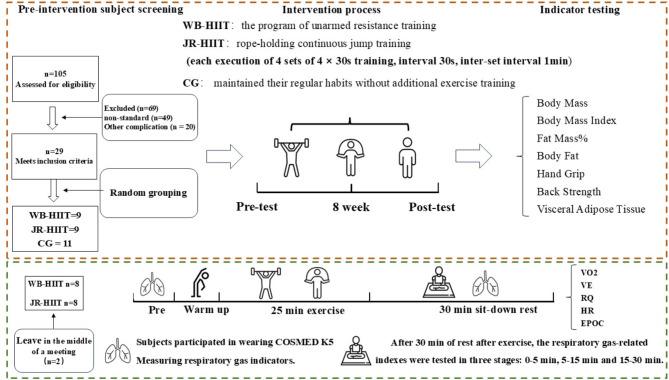
This study aimed to compare the effects of two high-intensity interval training modalities on body composition and muscular fitness in obese young adults and examined the characteristics of energy expenditure (EE) after training. Thirty-six obese young adults (eleven female, age: 22.1 ± 2.3 years, BMI: 25.1 ± 1.2 kg/m2) were to Whole-body high-intensity interval training group (WB-HIIT) (n = 12), jump rope high-intensity interval training group (JR-HIIT) (n = 12), or non-training control group (CG) (n = 12). WB-HIIT and JR-HIIT groups performed an 8-week HIIT protocol. WB-HIIT, according to the program of unarmed resistance training, JR-HIIT use rope-holding continuous jump training, each execution of 4 sets of 4 × 30 s training, interval 30 s, inter-set interval 1min, and the control group maintained their regular habits without additional exercise training. Body composition and muscular strength were assessed before and after 8 weeks. Repeated measures analysis of variance and clinical effect analysis using Cohen's effect size were used, with a significance level of p < 0.05. In comparison with the CG group in both experimental groups, Body Mass and BMI significantly reduced (p < 0.05), and Muscular strength significantly improved (p < 0.05).WB-HIIT versus JR-HIIT: Fat Mass (- 1.5 ± 1.6; p = 0.02 vs - 2.3 ± 1.2; p < 0.01) and % Body Fat (- 1.3 ± 1.7; p = 0.05 vs - 1.9 ± 1.9; p < 0.01) the effect is more pronounced in the JR-HIIT group; Muscle Mass (1.5 ± 0.7; p < 0.01 vs - 0.8 ± 1.1; p = 0.07) the effect is more pronounced in the WB-HIIT group. Estimated daily energy intake (122 ± 459 vs 157 ± 313; p > 0.05). Compared to the CG, body composition was significantly improved in both intervention groups. All three groups had no significant changes in visceral adipose tissue (p > 0.05). Significant differences in Lipid and Carbohydrate oxidation and energy output were observed between the two groups, as well as substantial differences in WB-HIIT and JR-HIIT VO2, ventilation, and energy consumption minute during the 0-5 min post-exercise period (p > 0.05). WB-HIIT and JR-HIIT interventions effectively improve the body composition of young adults with obesity, while WB-HIIT additionally improves muscular fitness. After exercise, WB-HIIT produces higher excess post-exercise oxygen consumption and associated lipid and carbohydrate metabolism than JR-HIIT.
Keywords: Body composition; EPOC; Jump rope HIIT; Muscle fitness; Obese adults; Whole-body HIIT.
© 2025. The Author(s).
Conflict of interest statement
Declarations. Competing interests: The authors declare no competing interests.
Figures


References
-
- https://www.who.int/news-room/fact-sheets/detail/obesity-and-overweight#%20. Accessed 2010. 14. 21.
-
- Donnelly, J. E. et al. Appropriate physical activity intervention strategies for weight loss and prevention of weight regain for adults. Med. Sci. Sports Exerc.41, 459–471 (2009). - PubMed
MeSH terms
Grants and funding
LinkOut - more resources
Full Text Sources
Medical
