


The Effect of Tissue Stretching and Release Strategies on Neck Muscles Fatigue and Pain Intensity in Office Workers Affected by Chronic Neck Pain: A Rater-Blind, Semi-Experimental Study
- PMID: 40260041
- PMCID: PMC12010563
- DOI: 10.1002/hsr2.70748
The Effect of Tissue Stretching and Release Strategies on Neck Muscles Fatigue and Pain Intensity in Office Workers Affected by Chronic Neck Pain: A Rater-Blind, Semi-Experimental Study
Abstract
Background and aims: Nonspecific chronic neck pain (ns-CNP) is a common cause of disability among office workers. However, the effectiveness of tissue release and stretching strategies in managing pain and fatigue of neck muscles in employees affected by ns-CNP has not been assessed.
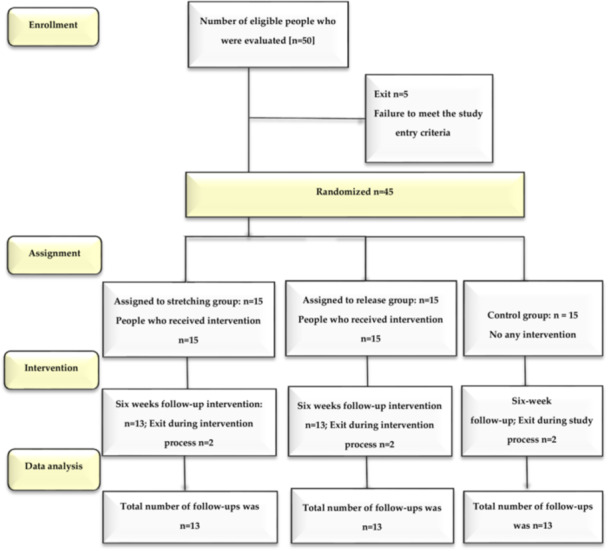
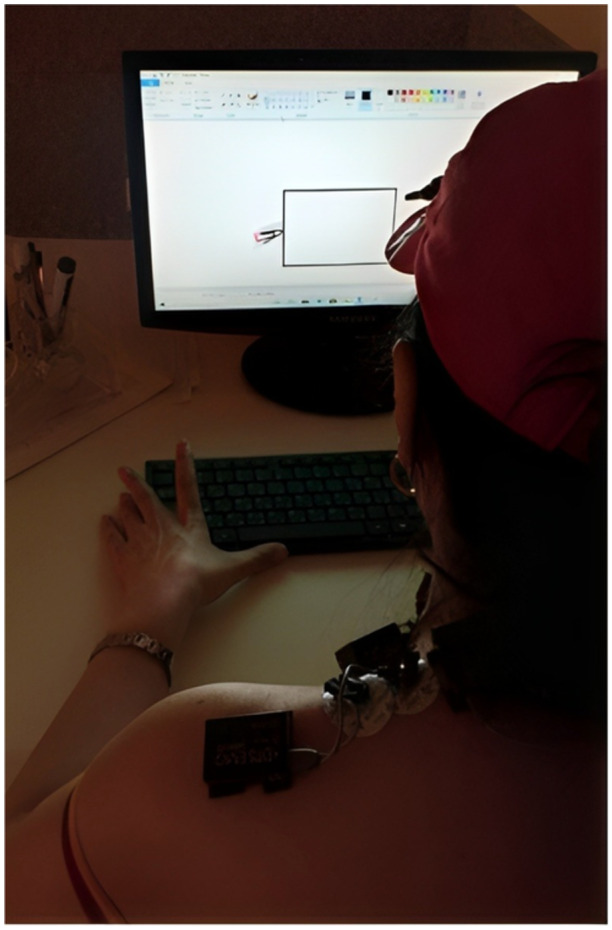
Methods: Thirty-nine employees who suffered from ns-CNP were randomly assigned to stretching, tissue release interventions or control group (n = 13). Neck pain and fatigue in neck extensors, upper trapezius, and sternocleidomastoid muscles were measured during 40 min of typing with a 45-degree head flexion at baseline and immediately after a 6-week intervention using visual analog scale and surface electromyography.
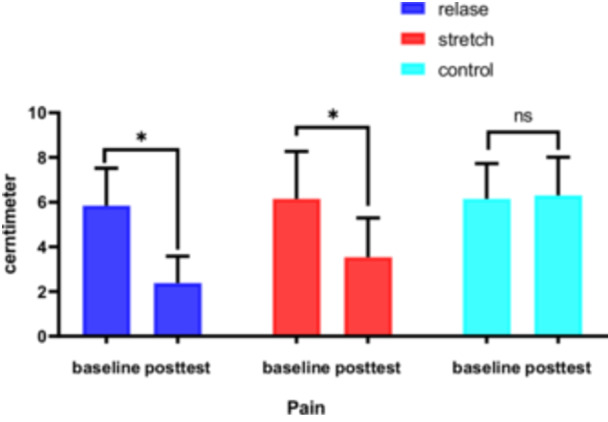
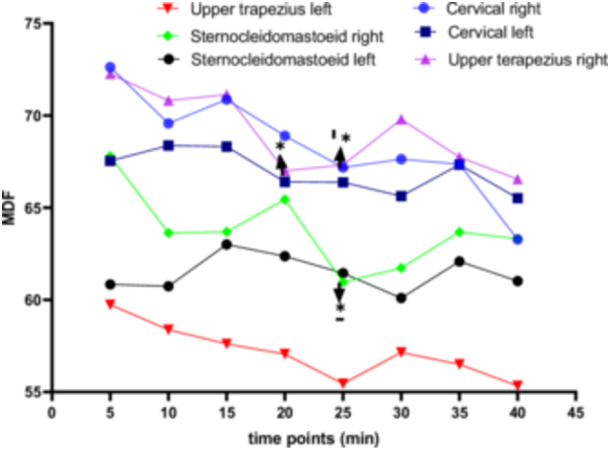
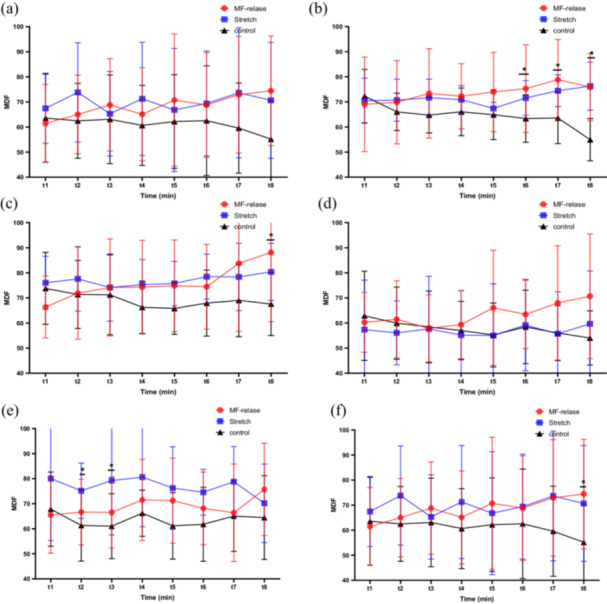
Results: Pain significantly decreased after 6 weeks of both interventions (p < 0.05). There were no significant within-group differences for right cervical muscle fatigue in the intervention groups, but a significant difference was noted in the control group at the 25th and 40th minutes (p < 0.05). Additionally, a significant difference was observed between the release and control group at the 30th, 35th, and 40th minutes (p < 0.05). Left cervical muscle fatigue significantly decreased at the 25th and 40th minutes only for the release group (p < 0.05). A significant difference was observed between the release and control groups at the 40th minute for the right upper trapezius (p < 0.05).
Conclusion: Only the stretching group showed a significant difference with the control in the left sternocleidomastoid at the 10th and 15th minutes, and the release group with the control in the last 5-min. Stretching and release interventions could control neck pain and muscle fatigue in the 45-degree head flexion position.
Keywords: fatigue; foam roller; musculoskeletal dysfunction; neck; pain; trigger points.
© 2025 The Author(s). Health Science Reports published by Wiley Periodicals LLC.
Conflict of interest statement
The authors declare no conflicts of interest.
Figures
References
-
- Castellini G., Pillastrini P., Vanti C., et al., “Some Conservative Interventions Are More Effective Than Others for People With Chronic Non‐Specific Neck Pain: A Systematic Review and Network Meta‐Analysis,” Journal of Physiotherapy 68, no. 4 (2022): 244–254. - PubMed
-
- Hirsch T., Wahl U., and Rabe E., “Venous Disorders as an Occupational Disease–A Systematic Review on Epidemiology, Pathophysiology, and Modification Strategies,” Vasa. Zeitschrift fuer Gefaesskrankheiten 53 (2024): 172–184. - PubMed
-
- Collins J. D. and O'Sullivan L. W., “Musculoskeletal Disorder Prevalence and Psychosocial Risk Exposures by Age and Gender in a Cohort of Office Based Employees in Two Academic Institutions,” International Journal of Industrial Ergonomics 46 (2015): 85–97.
LinkOut - more resources
Full Text Sources
Miscellaneous
