


Investigating the interplay of stressors and health in horses through fecal cortisol metabolite analysis
- PMID: 40264993
- PMCID: PMC12013657
- DOI: 10.3389/fvets.2025.1545577
Investigating the interplay of stressors and health in horses through fecal cortisol metabolite analysis
Abstract
Introduction: Horses are highly sensitive to stress, which can affect their wellbeing and lead to various health issues. Effective and objective stress assessment is therefore crucial for improving their care and management. The production of the glucocorticoid cortisol is increased in response to stressful stimuli and its metabolites can be measured non-invasively in feces. Therefore, this study aimed to explore the impact of different environmental and physiological stressors on fecal cortisol metabolite (FCM) concentrations in horses, with a particular focus on the relationship between stress, health, and welfare. We hypothesized that increased FCM levels may be indicative of disease and thus improve early detection and subsequent intervention.
Methods: Fresh fecal samples of N = 41 horses (20 geldings and 21 mares) from the same herd were collected once weekly for 1 year. Horses had been housed in the same stable for at least a month and were accustomed to the habitat, daily routine, and social groups. Environmental conditions, health data, and potentially stressful events were recorded. Fecal concentrations of 11,17-dioxoandrostanes were measured via 11-oxoetiocholanolone enzyme immunoassay.
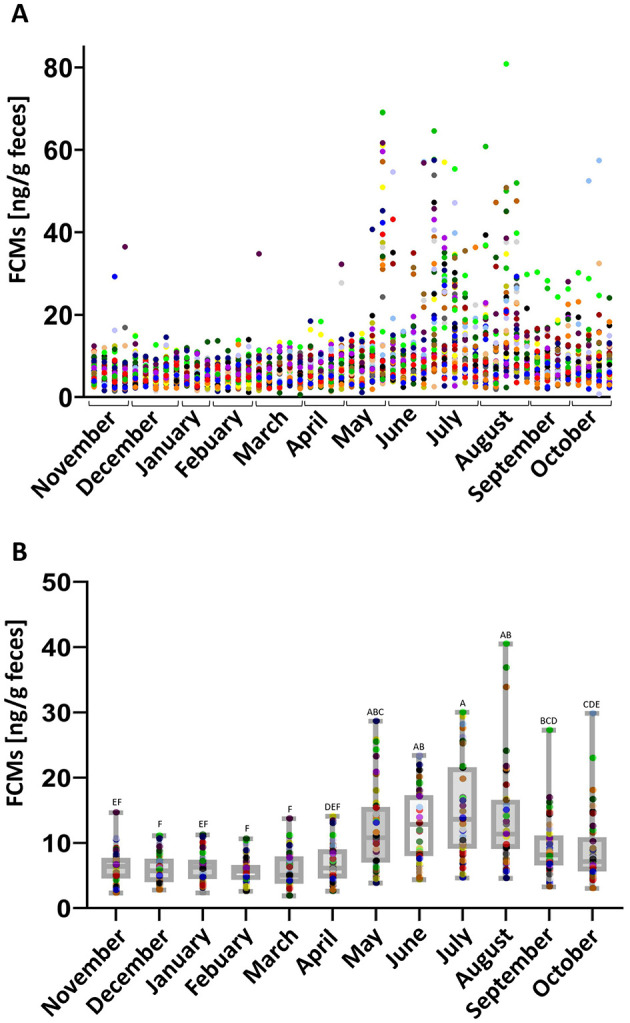
Results: We showed stable baseline FCM concentrations of 6.3 ng/g feces (range 0.6-28.1 ng/g feces). During the summer months, median FCM concentrations increased significantly (p < 0.05; One Way RM ANOVA), and this increase correlated with higher ambient temperatures (p < 0.0001, adj r 2 = 0.669, Pearson Product Moment correlation). Additionally, other factors such as breed, coat color, and housing conditions influenced the FCM concentrations. Stressful events, such as riding exams and some painful conditions, also resulted in elevated FCM levels, although the magnitude of these responses varied across individual horses. However, not all diseases were associated with increased FCMs.
Discussion: Our findings emphasize the complexity of the hypothalamic-pituitary-adrenal axis in horses, suggesting that while high FCM levels can indicate stress, they may not be reliable biomarkers for early disease detection. Particularly in the light of climate change, the impact of heat stress in the summer months should not be neglected and measures to improve the housing conditions accordingly should become an essential part of equine health management.
Keywords: disease; glucocorticoids; heat; horse/equine; pain; stress.
Copyright © 2025 Nowak, Macho-Maschler, Biermann, Palme and Dengler.
Conflict of interest statement
The authors declare that the research was conducted in the absence of any commercial or financial relationships that could be construed as a potential conflict of interest.
Figures


References
-
- Leal BB, Alves GE, Douglas RH, Bringel B, Young RJ, Haddad JPA, et al. Cortisol circadian rhythm ratio: a simple method to detect stressed horses at higher risk of colic? J Equine Vet Sci. (2011) 31:188–90. 10.1016/j.jevs.2011.02.005 - DOI
-
- Keadle TL, Pourciau SS, Melrose PA, Kammerling SG, Horohov DW. Acute exercises stress modulates immune function in unfit horses. J Equine Vet Sci. (1993) 13:226–31. 10.1016/S0737-0806(06)81019-1 - DOI
LinkOut - more resources
Full Text Sources
