Management Practice for Hordeolum and Chalazion: A Survey of the Korean Society of Ophthalmic Plastic and Reconstructive Surgery (KSOPRS) Members
- PMID: 40267992
- PMCID: PMC12178684
- DOI: 10.3341/kjo.2025.0024
Management Practice for Hordeolum and Chalazion: A Survey of the Korean Society of Ophthalmic Plastic and Reconstructive Surgery (KSOPRS) Members
Abstract
Purpose: To determine the current management pattern for hordeolum and chalazion among members of the Korean Society of Ophthalmic Plastic and Reconstructive Surgery (KSOPRS).
Methods: An anonymous web-based survey was emailed to 260 current members of the KSOPRS. The survey comprised five sections: differential diagnosis, treatment strategies for hordeolum, treatment strategies for chalazion, postsurgical care, and pediatric-specific approaches.
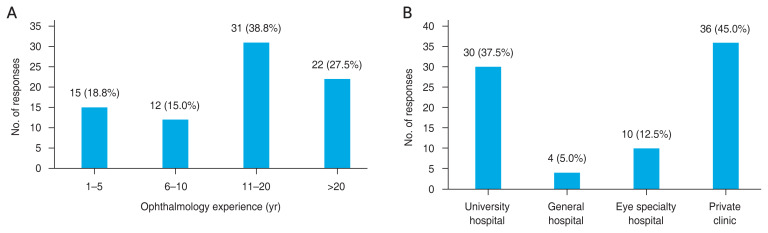
Results: Eighty KSOPRS members participated in this study (response rate, 30.8%). Redness, swelling, and pain were the most important factors for differentiating hordeolum from chalazion. For hordeolum, topical antibiotics are preferred by 59 respondents (73.8%), with 49 (83.7%) considering them effective. Most (62 respondents, 77.6%) pursue nonsurgical treatment for 5 to 14 days before considering incision and curettage. For chalazion, treatment practices are split between conservative management and invasive methods. Intralesional steroid injections are recommended by 55 respondents (68.8%), with a preference for diluted triamcinolone acetonide. Relative to hordeolum, chalazion treatment involves less frequent antibiotic use, with only 21 respondents (26.3%) always recommending antibiotic ointments. Tissue biopsy is considered for abnormal changes in the surrounding tissues (72 respondents, 90.0%) and frequent recurrence (46 respondents, 57.5%). The practices differ between pediatric and adult cases among 38 respondents (47.5%), with 31 (81.4%) extending conservative management and delaying surgical interventions in pediatric cases. Anesthesia preferences for pediatric cases varied, with 40 respondents (50.0%) favoring local anesthesia, 19 (23.8%) opting for monitored anesthesia care, and 13 (16.2%) choosing general anesthesia.
Conclusions: This survey of the management of hordeolum and chalazion by KSOPRS members has revealed several interesting common practices that are considered valuable by current practitioners.
Keywords: Chalazion; Hordeolum; Korean Society of Ophthalmic Plastic and Reconstructive Surgery (KSOPRS); Patient care management; Surveys and questionnaires.
Conflict of interest statement
None.
Figures



References
-
- Carlisle RT, Digiovanni J. Differential diagnosis of the swollen red eyelid. Am Fam Physician. 2015;92:106–12. - PubMed
-
- Cosar CB, Rapuano CJ, Cohen EJ, Laibson PR. Chalazion as a cause of decreased vision after LASIK. Cornea. 2001;20:890–2. - PubMed
-
- Akkucuk S, Kaya OM, Aslan L, et al. Prevalence of Demodex folliculorum and Demodex brevis in patients with blepharitis and chalazion. Int Ophthalmol. 2023;43:1249–59. - PubMed
-
- Goawalla A, Lee V. A prospective randomized treatment study comparing three treatment options for chalazia: triamcinolone acetonide injections, incision and curettage and treatment with hot compresses. Clin Exp Ophthalmol. 2007;35:706–12. - PubMed
MeSH terms
Substances
LinkOut - more resources
Full Text Sources