. 2025 Jun:96:102152.
doi: 10.1016/j.molmet.2025.102152. Epub 2025 Apr 21.

Prolonged fasting promotes systemic inflammation and platelet activation in humans: A medically supervised, water-only fasting and refeeding study

Affiliations

Prolonged fasting promotes systemic inflammation and platelet activation in humans: A medically supervised, water-only fasting and refeeding study

Serena Commissati et al. Mol Metab. 2025 Jun.

Abstract

Objective: Prolonged fasting (PF), defined as abstaining from energy intake for ≥4 consecutive days, has gained interest as a potential health intervention. However, the biological effects of PF on the plasma proteome are not well understood.

Methods: In this study, we investigated the effects of a medically supervised water-only fast (mean duration: 9.8 ± 3.1 days), followed by 5.3 ± 2.4 days of guided refeeding, in 20 middle-aged volunteers (mean age: 52.2 ± 11.8 years; BMI: 28.8 ± 6.4 kg/m2).

Results: Fasting resulted in a 7.7% mean weight loss and significant increases in serum beta-hydroxybutyrate (BHB), confirming adherence. Untargeted high-dimensional plasma proteomics (SOMAScan, 1,317 proteins) revealed multiple adaptations to PF, including preservation of skeletal muscle and bone, enhanced lysosomal biogenesis, increased lipid metabolism via PPARα signaling, and reduced amyloid fiber formation. Notably, PF significantly reduced circulating amyloid beta proteins Aβ40 and Aβ42, key components of brain amyloid plaques. In addition, PF induced an acute inflammatory response, characterized by elevated plasma C-reactive protein (CRP), hepcidin, midkine, and interleukin 8 (IL-8), among others. A retrospective cohort analysis of 1,422 individuals undergoing modified fasting confirmed increased CRP levels (from 2.8 ± 0.1 to 4.3 ± 0.2 mg/L). The acute phase response, associated with transforming growth factor (TGF)-β signaling, was accompanied by increased platelet degranulation and upregulation of the complement and coagulation cascade, validated by ELISAs in blood and urine.

Conclusions: While the acute inflammatory response during PF may serve as a transient adaptive mechanism, it raises concerns regarding potential cardiometabolic effects that could persist after refeeding. Further investigation is warranted to elucidate the long-term molecular and clinical implications of PF across diverse populations.

Keywords: Cardiometabolic; Inflammation; Prolonged fasting; Proteomics.


Conflict of interest statement

Declaration of competing interest A.G. is the founder of TrueNorth Health Center, a private facility that offers medically supervised fasting interventions. K.M.K. and M.R.M. are employed by C(2)N Diagnostics. The other authors report no conflicts of interest. The funding sources were not involved in any form with the findings presented in the study. The article was not commissioned. No author was precluded access to data.

Figures
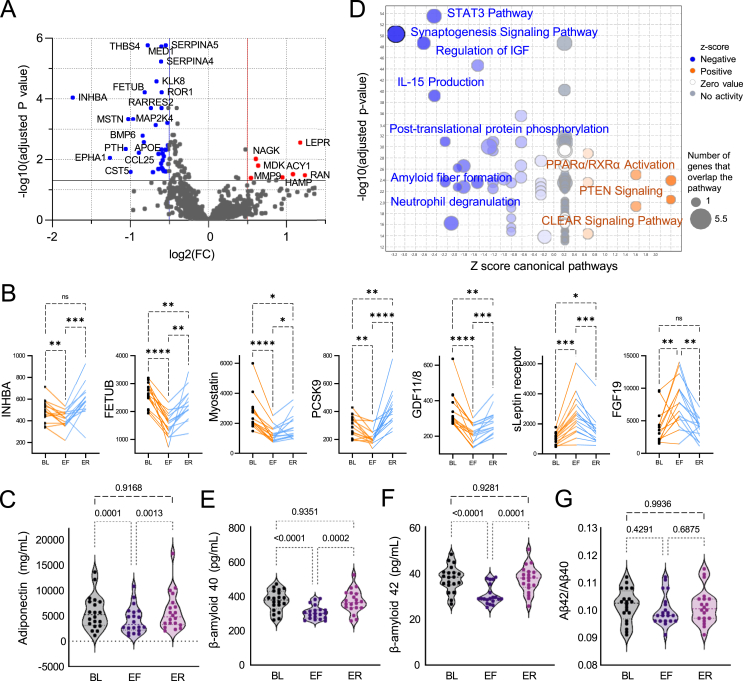
Figure 1
Figure 1
Proteomics adaptations to prolonged fasting in humans. (A) Volcano plot of differentially expressed SOMAScan plasma proteins during fasting from N = 15 participants. Significance cut-off adjusted p < 0.05. FC = End of Fasting/Baseline. (B) Individual changes in highlighted proteins from (A) normalized to baseline during fasting and refeeding. Each dot represents protein levels in each participant (N = 15). Adjusted p-value calculated with one-way ANOVA. (C) Absolute levels of plasma adiponectin measured by ELISA across three time points. Each dot represents levels in each participant (N = 20). (D) Volcano plot of differentially enriched canonical pathways in IPA with predicted activation (orange) or inhibition (blue). Input = 1,255 mapped SOMAScan proteins from (A). (E-F-G) Absolute levels of plasma Aβ42, Aβ40, and their ratio measured by IP-LC-MS/MS across three timepoints. N = 20 participants. Statistical analysis is described in the Methods for each analysis. Significance levels are indicated as adjusted p-values, ∗p < 0.05, ∗∗p < 0.01, and ∗∗∗p < 0.001. For all graphs, BL = Baseline, EF = End of Fasting, ER = End of Refeeding.
Figure 2
Figure 2
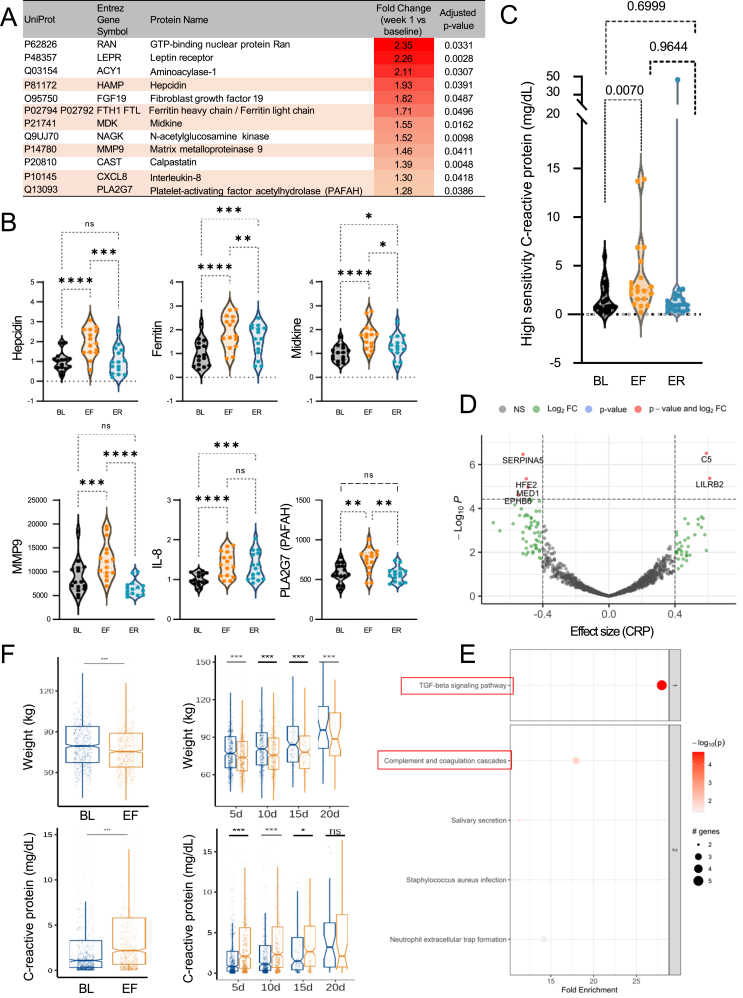
Prolonged fasting increases inflammation. (A) All significantly upregulated SOMAScan proteins (n = 12) during fasting normalized to baseline (targets from volcano plot in Figure 2A). Pro-inflammatory proteins are shown with light red background. N = 15 participants. FC = End of Fasting/Baseline (B) Individual changes in 6 inflammatory proteins from panel A during fasting and refeeding. Each dot represents protein levels in each participant. (C) Absolute hsCRP levels in the blood of each participant (N = 20) measured by ELISA across three time points. (D) Significantly correlated proteomic targets to CRP changes during fasting and refeeding (positive effect size = same changes; negative effect size = inverse changes). (E) Significantly enriched KEGG pathways relative to CRP changes. (F) Validation of CRP changes in an independent fasting cohort of 1,422 participants. Measurements of weight and CRP at baseline (BL, blue) and end of fasting (EF, orange) timepoints. The same variables are plotted by fasting length category. 5d = 5 day fast, 10d = 10 day fast, 15d = 15 day fast, 20d = 20 day fast. Median, interquartile range, and outliers are shown, with notches representing the 95% confidence intervals. Statistical analysis is described in the Methods for each analysis. Significance levels are indicated as adjusted p-values, ∗p < 0.05, ∗∗p < 0.01, and ∗∗∗p < 0.001. For all graphs, BL = Baseline, EF = End of Fasting, ER = End of Refeeding.
Figure 3
Figure 3
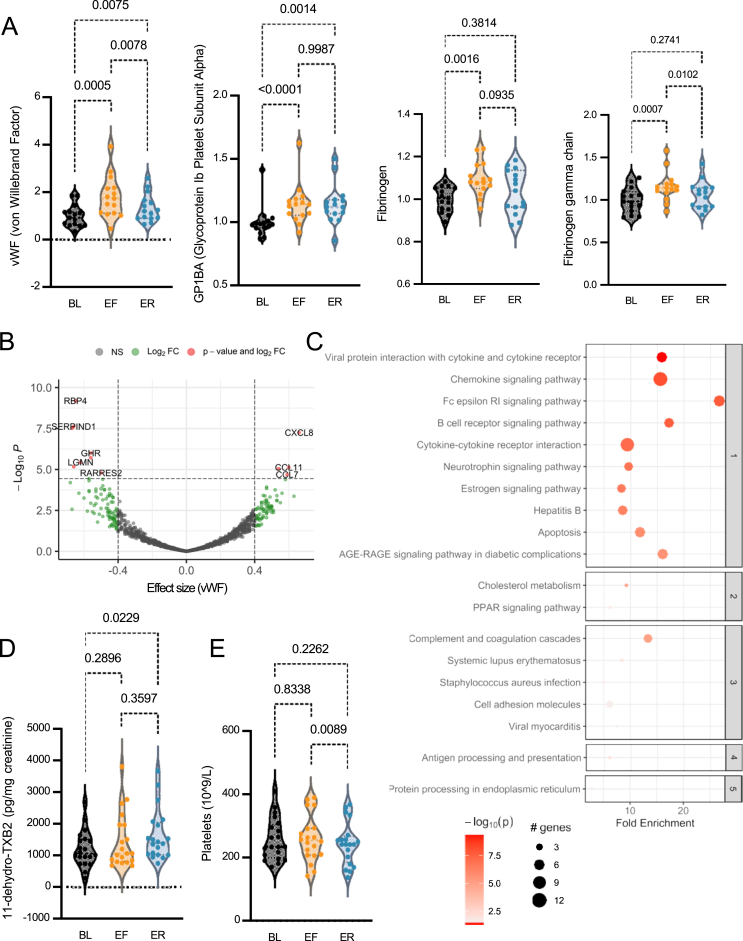
Fasting and refeeding elevate biomarkers of platelet activation and degranulation. (A) Individual changes in 4 platelet-associated proteins from SOMAScan normalized to baseline during fasting and refeeding. Each dot represents protein levels in each participant (N = 15). Adjusted p-value calculated with one-way ANOVA. (B) Volcano plot of vWF (effect size) on all 1,317 SOMAScan proteins during combined fasting and refeeding. Significance cut-off adjusted p < 0.01. N = 15 participants. (C) KEGG pathway enrichment analysis for proteins associated with vWF. Fold enrichments in KEGG pathway analysis are shown relative to fold changes for vWF. (D) Absolute TXB2 levels in the urine of each participant (N = 20) across three time points. (E) Absolute platelet counts in the blood of each participant (N = 20) across three time points. Statistical analysis is described in the Methods for each analysis. Significance levels are indicated as adjusted p-values, ∗p < 0.05, ∗∗p < 0.01, and ∗∗∗p < 0.001. For all graphs, BL = Baseline, EF = End of Fasting, ER = End of Refeeding.

References

    1. DA K., C B., E H., C K., H C., AR K., et al. International consensus on fasting terminology - PubMed. Cell Metab. 2024;36(8) - PMC - PubMed
    1. Longo V.D., Di Tano M., Mattson M.P., Guidi N. Intermittent and periodic fasting, longevity and disease. Nat Aging. 2021;1(1):47–59. - PMC - PubMed
    1. Crupi A.N., Haase J., Brandhorst S., Longo V.D. Periodic and intermittent fasting in diabetes and cardiovascular disease. Curr Diabetes Rep. 2020;20(12):83. - PubMed
    1. Finnell J.S., Saul B.C., Goldhamer A.C., Myers T.R. Is fasting safe? A chart review of adverse events during medically supervised, water-only fasting. BMC Compl Alternative Med. 2018;18(1):67. - PMC - PubMed
    1. Wilhelmi de Toledo F., Grundler F., Bergouignan A., Drinda S., Michalsen A. Safety, health improvement and well-being during a 4 to 21-day fasting period in an observational study including 1422 subjects. PLoS One. 2019;14(1) - PMC - PubMed

Substances