


Navigating prognostic strategies for GH- and PRL-secreting pituitary neuroendocrine tumors: key insights from a clinicopathological study
- PMID: 40276548
- PMCID: PMC12018879
- DOI: 10.3389/fendo.2025.1541514
Navigating prognostic strategies for GH- and PRL-secreting pituitary neuroendocrine tumors: key insights from a clinicopathological study
Abstract
Background: The classification of pituitary neuroendocrine tumors (PitNETs), also known as pituitary adenomas, has progressed significantly since 2004. The PitNET lineage now serves as the foundation of the classification. We investigated the prognostic value of clinicopathological markers in a cohort of patients diagnosed with acromegaly and prolactinomas who underwent transsphenoidal tumor resection.
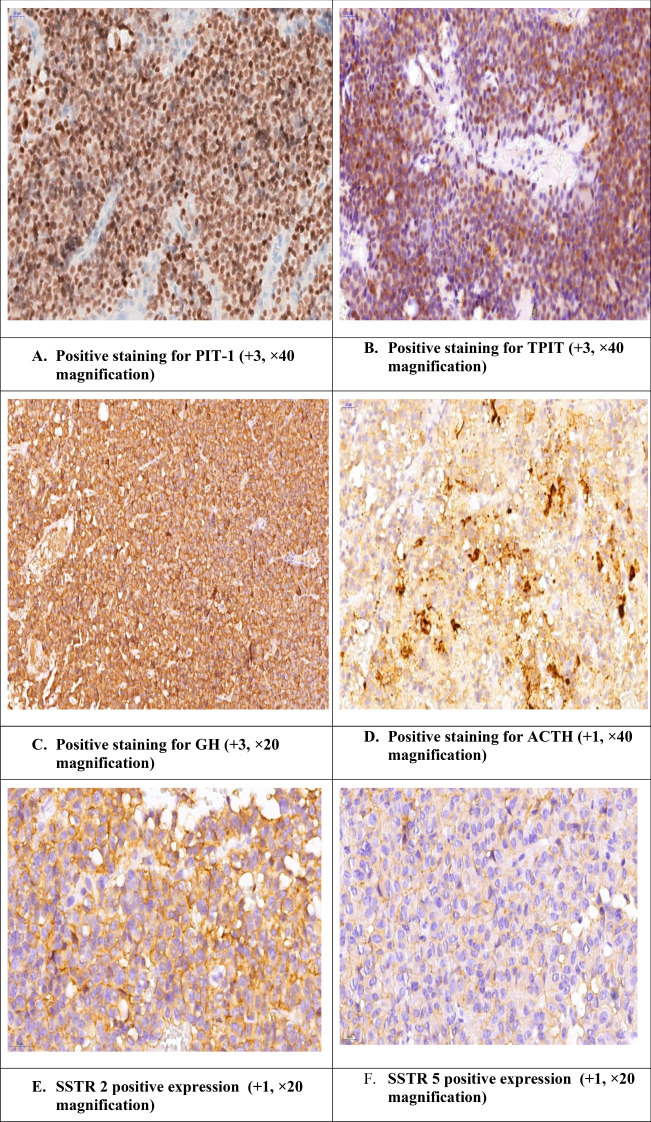
Methods: A total of 50 patients (45 patients with confirmed acromegaly and 5 with prolactinomas) in evidence at 'C. I. Parhon National Institute of Endocrinology (Pituitary and Neuroendocrine Pathology Department, Bucharest, Romania), who underwent tumor resection between 2010 and 2023, was recruited, with a median follow-up time of 7.02 years (IQR: 3-10). Surgical samples were stained for anterior pituitary hormones, ki-67 labeling index, CAM 5.2 expression, and the following transcription factors (TFs): steroidogenic factor (SF-1), T-box family member TBX19 (TPIT) and POU class 1 homeobox 1 (PIT-1). Additionally, somatostatin receptor 5 (SSTR 5) and 2 (SSTR 2) expression was evaluated in all patients.
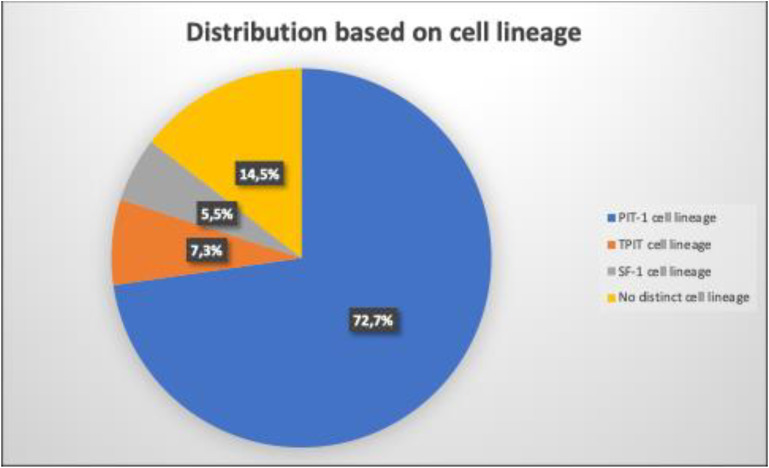
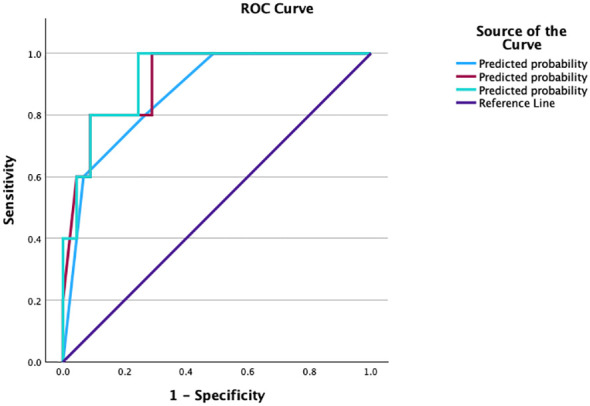
Results: Based on the 2022 WHO classification, the majority of cases were PIT-1 lineage tumors (n=40, 72.7%), followed by TPIT-lineage (n=4, 7.3%), and SF-1 lineage (n=3, 5.5%) and 14.5% (n=4) were classified as tumors with no distinct cell lineage (NDCL). In the multivariate Cox regression analysis, the postoperative GH value was independently associated with the outcome (HR 1.042, 95% CI 1.004-1.081, p=0.030), as well as the postoperative PRL value (HR 1.95% CI 1,1.001, p=0.019), the ki-67 labelling index (HR 2.43, 95% CI 1.109-5.330, p=0.026). Other factors associated as well with the success of the treatment were the postoperative tumor diameter (HR 1.038 95% CI 0.997-1.080, p=0.068) and the expression of SSTRs 2 and 5. Combining the four parameters, ki-67, SSTR 2, SSTR 5, GH, IGF-1 and the maximal tumor diameter (postoperative values), we established a prediction model with an AUC of 0.924 and relatively high sensitivity and specificity.
Conclusion: A clear classification system that can guide clinical and neurosurgical management of patients with GH- and PRL-secreting PitNETs is not currently available, but certain clinicopathological factors can be used to predict patient prognosis. In our study, somatostatin receptor expression, ki-67, and postoperative values of GH and IGF-1, as well as the maximal postoperative tumor diameter, were the strongest predictors of outcome.
Keywords: 2022 WHO classification; acromegaly; pituitary tumor; prognostic factors; prolactinoma.
Copyright © 2025 Dumitriu-Stan, Burcea, Dobre, Nastase, Ceausu, Molnar, Raica and Poiana.
Conflict of interest statement
The authors declare that the research was conducted in the absence of any commercial or financial relationships that could be construed as a potential conflict of interest.
Figures
References
-
- Silva-Ortega S, García-Martinez A, Niveiro de Jaime M, Torregrosa ME, Abarca J, Monjas I, et al. Proposal of a clinically relevant working classification of pituitary neuroendocrine tumors based on pituitary transcription factors. Hum Pathol. (2021) 110:20–30. doi: 10.1016/j.humpath.2020.12.001 - DOI - PubMed
-
- McDonald WC, Banerji N, McDonald KN, Ho B, Macias V, Kajdacsy-Balla A. Steroidogenic factor 1, pit-1, and adrenocorticotropic hormone: a rational starting place for the immunohistochemical characterization of pituitary adenoma. Arch Pathol Lab Med. (2016) 141:104–12. doi: 10.5858/arpa.2016-0082-OA - DOI - PubMed
MeSH terms
Substances
LinkOut - more resources
Full Text Sources
Medical
Research Materials
Miscellaneous
