


Odor localization in structural interhemispheric deficits
- PMID: 40277384
- PMCID: PMC12084763
- DOI: 10.1093/chemse/bjaf010
Odor localization in structural interhemispheric deficits
Abstract
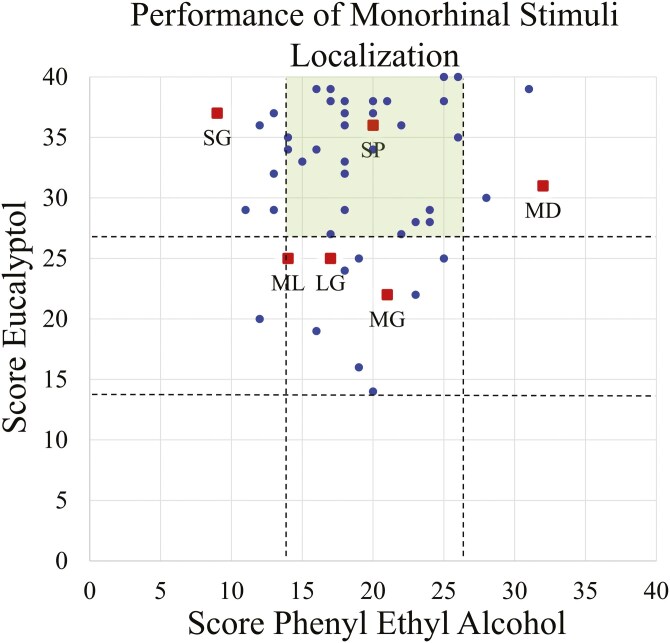
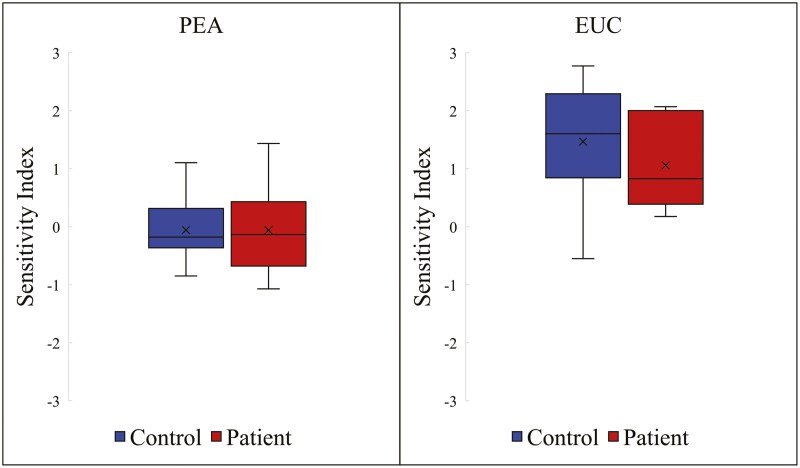
Contrary to all other sensory systems, olfactory information is processed predominantly ipsilaterally. Furthermore, odor localization, based on inter-nostril differences, is usually not possible under controlled conditions. These two observations suggest information exchange between both cerebral hemispheres in the olfactory system, although the exact anatomical substrate remains unknown. This study aimed to identify the anatomical structures necessary for odor localization, with a particular focus on the role of interhemispheric communication. We assessed the ability to localize pure olfactory and mixed olfactory/trigeminal stimuli in 6 participants with structural interhemispheric deficits (including surgical transection or agenesis of the corpus callosum (CC) and agenesis of the CC and anterior commissure (AC, one case)) and compared their performance to 46 healthy controls. Of the six participants with structural interhemispheric deficits, three were unable to localize either stimulus. Two participants performed significantly better than chance for both pure and mixed stimuli, while one participant exhibited the typical localization pattern observed in most controls-accurate localization of the mixed olfactory/trigeminal stimulus but inability to localize the pure olfactory stimulus. Our results suggest that localization of chemosensory stimuli relies, at least in part, on CC, highlighting its role in interhemispheric communication for olfactory processing. The varying odor localization performance observed in participants with agenesis of CC indicates that compensatory mechanisms may be promoted in some cases, potentially preserving normal localization functions despite the absence of major commissural pathways.
Keywords: commissural deficits; lateralization; olfaction; structural connectivity; trigeminal system.
© The Author(s) 2025. Published by Oxford University Press.
Figures
References
-
- Albrecht J, Kopietz R, Frasnelli J, Wiesmann M, Hummel T, Lundstrom JN.. The neuronal correlates of intranasal trigeminal function-an ALE metaanalysis of human functional brain imaging data. Brain Res Rev. 2010:62(2):183–196. doi: https://doi.org/ 10.1016/j.brainresrev.2009.11.001 - DOI - PMC - PubMed
-
- Antonini A, Berlucchi G, Marzi CA, Sprague JM.. Importance of corpus callosum for visual receptive fields of single neurons in cat superior colliculus. J Neurophysiol. 1979:42(1 Pt 1):137–152. doi: https://doi.org/ 10.1152/jn.1979.42.1.137 - DOI - PubMed
-
- Ballardini E, Marino P, Maietti E, Astolfi G, Neville AJ.. Prevalence and associated factors for agenesis of corpus callosum in Emilia Romagna (1981–2015). Eur J Med Genet. 2018:61(9):524–530. doi: https://doi.org/ 10.1016/j.ejmg.2018.06.004 - DOI - PubMed
-
- Barr MS, Corballis MC.. The role of the anterior commissure in callosal agenesis. Neuropsychology. 2002:16(4):459–471. doi: https://doi.org/ 10.1037/0894-4105.16.4.459 - DOI - PubMed
-
- Berlucchi G, Rizzolatti G.. Binocularly driven neurons in visual cortex of split-chiasm cats. Science. 1968:159(3812):308–310. doi: https://doi.org/ 10.1126/science.159.3812.308 - DOI - PubMed
MeSH terms
Grants and funding
LinkOut - more resources
Full Text Sources
