


Usability and User Experience Testing of a Co-Designed Electronic Patient-Reported Outcomes App ("MyPal for Adults") for Palliative Cancer Care: Mixed Methods Study
- PMID: 40278640
- PMCID: PMC12045520
- DOI: 10.2196/57342
Usability and User Experience Testing of a Co-Designed Electronic Patient-Reported Outcomes App ("MyPal for Adults") for Palliative Cancer Care: Mixed Methods Study
Abstract
Background: Mobile health technologies have the potential to enhance the management, communication, and overall quality of life of patients with cancer. The MyPal project, using a participatory design approach, aims to provide palliative care support for patients with cancer through an electronic patient-reported outcomes eHealth platform.
Objective: This study aims to evaluate the usability and user experience of "MyPal for adults," a co-designed palliative care mobile app designed to support adults with cancer.
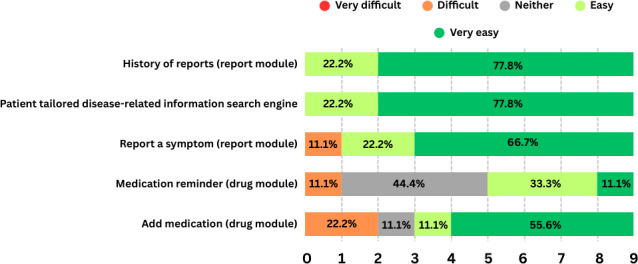
Methods: Representative users participated in a 4-step usability study using a "think-aloud" protocol, complemented with feature satisfaction, difficulty perceived, and design impression surveys along with a short, structured interview. Participants were also asked to provide quantitative feedback via the postuse System Usability Scale, User Experience Questionnaire, and Post-Study System Usability Questionnaire. The data were analyzed along the lines of the International Organization for Standardization (ISO) 9241-210 framework.
Results: All participants found the intervention content useful, and they reported satisfactory usability, with a mean Post-Study System Usability Questionnaire score of 2.458 (SD 1.08) and a System Usability Scale score of 68.9. All aspects of the User Experience Questionnaire (attractiveness, perspicuity, efficiency, dependability, stimulation, and novelty) surpassed usability quality benchmarks. The qualitative analysis identified 43 usability issues, primarily related to effectiveness and efficiency as defined in ISO 9241-210.
Conclusions: In this study, we conducted a usability evaluation of the "MyPal for adults" app, a digital tool designed to enhance the palliative care experience. This approach identifies real-world usability issues, enabling iterative improvements in the eHealth platform's design. Our findings reveal a user-friendly interface and positive patient experiences. This study emphasizes the need to enhance mobile health platform usability, offering insights to improve digital palliative care.
Keywords: app; cancer care; digital intervention; mHealth; mobile health; mobile phone; palliative care; patient-reported outcomes; think-aloud test; usability evaluation.
© Panos Bonotis, Pantelis Angelidis, Pantelis Natsiavas. Originally published in JMIR Human Factors (https://humanfactors.jmir.org).
Conflict of interest statement
Figures
Similar articles
-
Evaluating User Experience and Satisfaction in a Concussion Rehabilitation App: Usability Study.JMIR Form Res. 2025 Apr 11;9:e67275. doi: 10.2196/67275. JMIR Form Res. 2025. PMID: 40215401 Free PMC article.
-
User-Centered Design and Usability of Voxe as a Pediatric Electronic Patient-Reported Outcome Measure Platform: Mixed Methods Evaluation Study.JMIR Hum Factors. 2024 Sep 19;11:e57984. doi: 10.2196/57984. JMIR Hum Factors. 2024. PMID: 39298749 Free PMC article.
-
A Digital Health Intervention Platform (Active and Independent Management System) to Enhance the Rehabilitation Experience for Orthopedic Joint Replacement Patients: Usability Evaluation Study.JMIR Hum Factors. 2024 May 14;11:e50430. doi: 10.2196/50430. JMIR Hum Factors. 2024. PMID: 38743479 Free PMC article.
-
Methods of usability testing in the development of eHealth applications: A scoping review.Int J Med Inform. 2019 Jun;126:95-104. doi: 10.1016/j.ijmedinf.2019.03.018. Epub 2019 Mar 31. Int J Med Inform. 2019. PMID: 31029270
-
Aging barriers influencing mobile health usability for older adults: A literature based framework (MOLD-US).Int J Med Inform. 2018 Jun;114:66-75. doi: 10.1016/j.ijmedinf.2018.03.012. Epub 2018 Mar 27. Int J Med Inform. 2018. PMID: 29673606 Review.
References
-
- Scarfò L, Karamanidou C, Doubek M, et al. MyPal ADULT study protocol: a randomised clinical trial of the MyPal ePRO-based early palliative care system in ADULT patients with haematological malignancies. BMJ Open. 2021 Nov 2;11(11):e050256. doi: 10.1136/bmjopen-2021-050256. doi. Medline. - DOI - PMC - PubMed
-
- What is palliative care? Get Palliative Care. [17-08-2022]. https://getpalliativecare.org/whatis/ URL. Accessed.
-
- Kiderlen TR, Schnack A, de Wit M. Essential barriers and considerations for the implementation of electronic patient-reported outcome (ePRO) measures in oncological practice: contextualizing the results of a feasibility study with existing literature. J Public Health (Berl) 2023 Dec;31(12):2071–2088. doi: 10.1007/s10389-022-01767-3. doi. - DOI - PMC - PubMed
MeSH terms
LinkOut - more resources
Full Text Sources
Medical
