


Effect of heel height on patellofemoral joint stress during stair descent
- PMID: 40281014
- PMCID: PMC12032224
- DOI: 10.1038/s41598-025-96444-2
Effect of heel height on patellofemoral joint stress during stair descent
Abstract
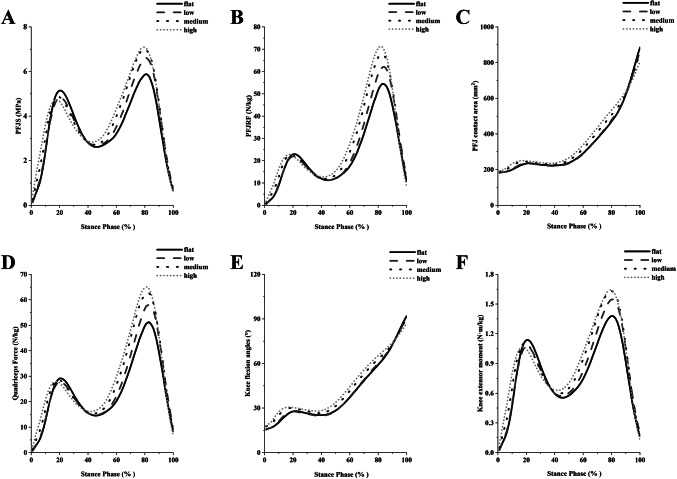
This study aimed to investigate the effect of heel height on patellofemoral joint stress (PFJS) in young women during stair descent. A total of 25 healthy females were recruited. They were instructed to descend a six-step staircase while wearing heeled shoes of different heel heights: flat heel (1 cm), low heel (3 cm), medium heel (5 cm), and high heel (7 cm). Then, PFJS was calculated using kinematic and kinetic data obtained from a biomechanical model of the patellofemoral joint. Compared with the flat heel condition, the high, medium, and low heel conditions resulted in significant increases in peak PFJS (Phigh = 0.001, Pmedium < 0.001, Plow = 0.018), peak patellofemoral joint reaction force (PFJRF) (Phigh < 0.001, Pmedium < 0.001, Plow = 0.039), peak quadriceps force (Phigh < 0.001, Pmedium < 0.001, Plow = 0.026), and peak knee extensor moment (Phigh = 0.004, Pmedium < 0.001, Plow = 0.017); in addition, the knee flexion angle (Phigh < 0.001, Pmedium = 0.025) and patellofemoral joint contact area (Phigh < 0.001, Pmedium = 0.037) at the time of peak PFJS between the high and medium heel conditions showed a significant increase. The increase in PFJS was mainly driven by an increase in PFJRF, owing to increased knee extensor moments and knee flexion angle. Our findings support the premise that wearing high-heeled shoes with a height of 3 cm or more may be a contributing factor with respect to the development of patellofemoral pain.
Keywords: Heel height; Patellofemoral joint stress; Patellofemoral pain; Stair descent.
© 2025. The Author(s).
Conflict of interest statement
Declarations. Competing interests: The authors declare no competing interests. Ethics approval and consent to participate: This study protocol was approved by the Ethics Committee of Shandong Sport University (approval number: 2023011), and all participants signed the informed consent form before the experiment.
Figures



References
-
- Constantinou, A., Mamais, I., Papathanasiou, G., Lamnisos, D. & Stasinopoulos, D. Comparing hip and knee focused exercises versus hip and knee focused exercises with the use of blood flow restriction training in adults with patellofemoral pain. Eur. J. Phys. Rehabil. Med.58, 225–235. 10.23736/s1973-9087.22.06691-6 (2022). - DOI - PMC - PubMed
MeSH terms
Grants and funding
LinkOut - more resources
Full Text Sources
