


Effective for Whom? A Review of Psychological and Social Intervention Recommendations in European Dementia Care Guidelines Through the Lenses of Social Health and Intersectionality
- PMID: 40282079
- PMCID: PMC12023985
- DOI: 10.3390/bs15040457
Effective for Whom? A Review of Psychological and Social Intervention Recommendations in European Dementia Care Guidelines Through the Lenses of Social Health and Intersectionality
Abstract
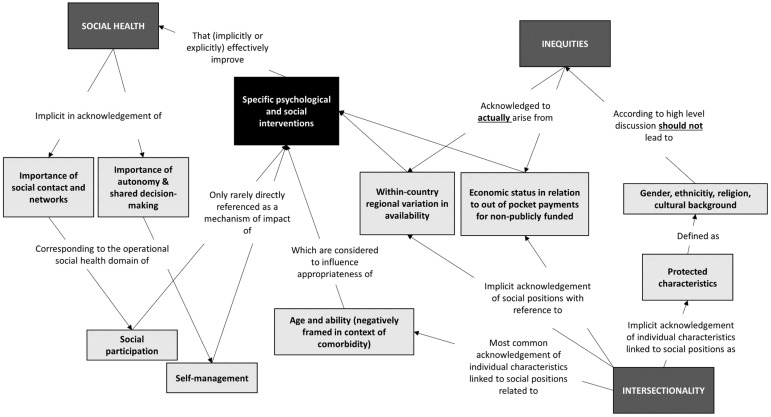
In dementia care, access to effective psychosocial interventions is often addressed by evidence-based guidelines for care providers. However, it is unclear if current guidelines consider personal characteristics that may impact intervention effectiveness. This study investigates if, and within what framing, dementia care guidelines in Europe address what is effective and for whom. A review of 47 guidelines from 12 European countries was conducted. Content analysis focused on (i) if guidelines recommended specific psychosocial interventions, and how guidelines referred to (ii) social health, (iii) the intersection of social positioning, and (iv) inequities in care or outcomes. Thirty-five guidelines (74%) recommended specific psychosocial interventions. Around half referenced aspects of social health and of intersectionality. Thirteen guidelines (28%) referenced inequities. Social health was not explicitly recognised as a mechanism of psychosocial interventions. Only age and comorbidity were consistently considered to impact interventions' effectiveness. Inequities were acknowledged to arise from within-country regional variations and individual economic status, but were not linked to (intersectional) individual societal positions such as sex and/or gender, sexuality, and/or religion. The results between European countries were heterogeneous. Current guidelines offer little insight into what works for whom. Policymakers and guideline developers should work with researchers, generating and translating evidence into policy.
Keywords: dementia; diversity; equity; guideline; intersectionality; intervention; social health.
Conflict of interest statement
M.G.P. was a coauthor of (Portuguese) Guidelines 33 and 34 and contributed to the development of Guideline 35. M.F.M. was a co-author of (Spanish) Guideline 40. J.R.T. was involved as an expert and representative of the German Alzheimer Association in developing (German) Guideline 13.
Figures
References
-
- Alzheimer Europe Overcoming ethical challenges affecting the involvement of people with dementia in research: Recognising diversity and promoting inclusive research. 2019. [(accessed on 27 March 2025)]. Available online: https://www.alzheimer-europe.org/sites/default/files/2022-01/05706%20Alz....
-
- Alzheimer Europe 2020. [(accessed on 27 March 2025)]. Available online: https://www.alzheimer-europe.org/sites/default/files/alzheimer_europe_de....
-
- Bentley A., Morgan T., Salifu Y., Walshe C. Exploring the experiences of living with Lewy body dementia: An integrative review. Journal of Advanced Nursing. 2021;77(12):4632–4645. - PubMed
Publication types
Grants and funding
LinkOut - more resources
Full Text Sources
Medical
