


Tertiary Lymphoid Structures Are Associated with Progression-Free Survival of Peripheral Neuroblastic Tumor Patients
- PMID: 40282480
- PMCID: PMC12025499
- DOI: 10.3390/cancers17081303
Tertiary Lymphoid Structures Are Associated with Progression-Free Survival of Peripheral Neuroblastic Tumor Patients
Abstract
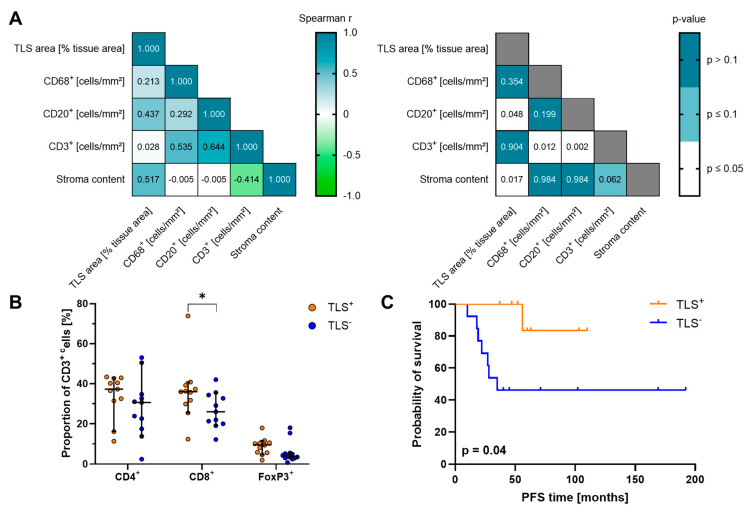
Background/Objectives: Peripheral neuroblastic tumors (pNT) are a biologically heterogeneous group of embryonal tumors that derive from the neural crest and affect the sympathetic nervous system. So far, little is known about the complex immune landscape in these rare childhood cancers. Methods: We focused on the immune cell infiltrate of treatment-naïve pNT from 24 patients, including high-risk neuroblastoma (HR-NBL), non-high-risk neuroblastoma (NHR-NBL), ganglioneuroblastoma (GNBL), and rare ganglioneuroma (GN). To gain novel insights into the immune architecture of these pNT subtypes, we used multiplex immunohistochemistry, multispectral imaging, and algorithm-based data evaluation to detect and characterize T cells, B cells, neutrophils, macrophages, and tertiary lymphoid structures (TLS). Results: The majority of the investigated tumor-infiltrating immune cells were macrophages and T cells. Their detailed phenotypic characterization revealed high proportions of M2-like macrophages as well as activated GrzB+ CD8+ and PD-1+ T lymphocytes. Proportions of these T cell phenotypes were significantly increased in GN compared to HR-NBL, NHR-NBL, or GNBL. In addition, TLS occurred in 11 of 24 patients, independent of immune cell frequencies in the whole tissues. Interestingly, all GN, most GNBL, but only a few NBL contained TLS. We distinguished between three TLS maturation stages that were present irrespective of the pNT subtype. The majority belonged to mature TLS of the primary follicle state. Mature LAMP3+ dendritic cells were also found, predominantly in T cell zones of TLS. Furthermore, TLS presence identified pNT patients with significantly prolonged progression-free survival in contrast to all other analyzed immunological features. Conclusions: We propose TLS to be a potential prognostic marker for pNT to predict patient outcomes.
Keywords: T cells; macrophages; multiplex immunohistochemistry; peripheral neuroblastic tumors; tertiary lymphoid structures; tumor immune microenvironment.
Conflict of interest statement
The authors declare no conflicts of interest. The funders had no role in the design of the study, in the collection, analyses, or interpretation of data, in the writing of the manuscript, or in the decision to publish the results.
Figures


References
-
- Shimada H., Sano H., Hazard F.K. Pathology of Peripheral Neuroblastic Tumors. Clin. Pediatr. Hematol. Oncol. 2020;27:73–86. doi: 10.15264/cpho.2020.27.2.73. - DOI
Grants and funding
LinkOut - more resources
Full Text Sources
Research Materials
