


A Real-World Analysis of the Population with Hepatitis C Virus Infection Affected by Type 2 Diabetes in Italy: Patients' Characteristics, Comorbidity Profiles and Treatment Patterns
- PMID: 40282905
- PMCID: PMC12028345
- DOI: 10.3390/medicina61040614
A Real-World Analysis of the Population with Hepatitis C Virus Infection Affected by Type 2 Diabetes in Italy: Patients' Characteristics, Comorbidity Profiles and Treatment Patterns
Abstract
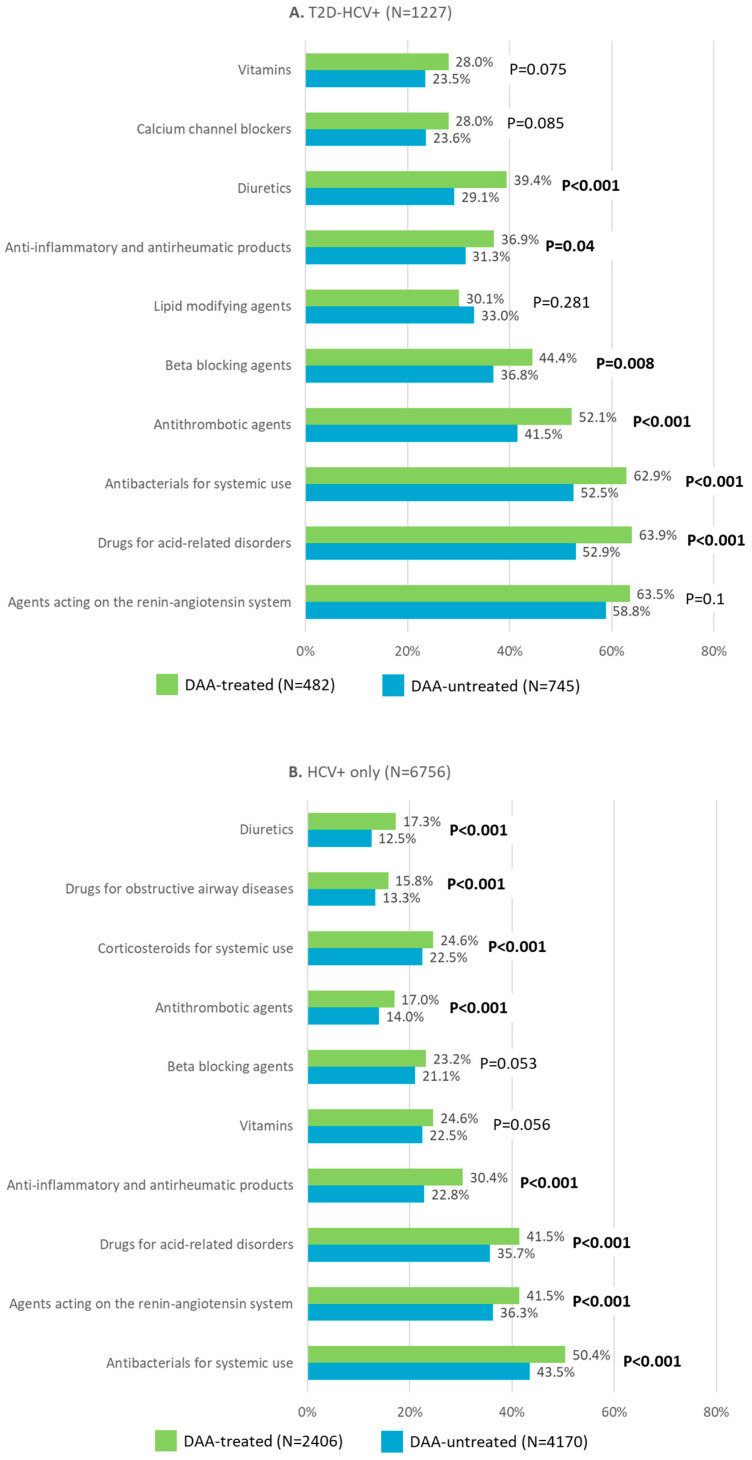
Background and Objectives: HCV infection represents a main risk factor for type 2 diabetes (T2D). This real-world analysis investigated the HCV-positive (HCV+) population with a T2D co-diagnosis in Italy. Methods: From 2017 to 2021, HCV+ patients were identified from administrative databases and stratified into T2D-HCV+ and HCV+-only cohorts in the presence/absence of a T2D diagnosis. Both cohorts were further divided by treatment with direct-acting antivirals (DAAs). The subgroups were compared for demographic variables, comorbidity profiles, most frequent hospitalizations, and drug prescriptions before inclusion. A sensitivity analysis was performed on patients included after 2019, the year of widespread use of pangenotypic DAAs. Results: Considering HCV+ patients aged ≥55 years, T2D-HCV+ patients (N = 1277) were significantly (p < 0.001) older than HCV+-only (N = 6576) ones and burdened by a worse comorbidity profile (average Charlson index: 1.4 vs. 0.3, p < 0.05). Moreover, regardless of T2D presence, DAA-treated patients were older (p < 0.001) and had a worse Charlson index than the untreated ones. T2D-HCV+ patients showed tendentially higher hospitalization rates and co-medication prescriptions compared to the HCV+-only patients. After 2019, a trend towards reduced co-medication use in DAA-treated patients was noticed, especially antibiotics and cardiovascular drugs. Conclusions: The co-presence of T2D in HCV+ patients resulted in a worse clinical status, as confirmed by the more frequent requirement of hospitalizations and complex polypharmacy regimens.
Keywords: antiviral therapies; direct-acting antivirals; hepatitis C virus; pangenotypic direct-acting antivirals; real-world evidence; type 2 diabetes.
Conflict of interest statement
None of the authors has conflicts of interest related to the study design or its results. Other disclosures unrelated to the present manuscript are listed as follows: Alessandra Mangia reports speaking/consulting/research for Angelini, Gilead, Intercept, MSD, and Spring Bank. Pierluigi Toniutto reports speaking/consulting/research for AbbVie, Bayer, and Gilead. Angelo Avogaro has received research grants and lecture or advisory board fees from Merck Sharp & Dome, AstraZeneca, Novartis, Boeringher-Ingelheim, Sanofi, Mediolanum, Janssen, Novo Nordisk, Lilly, Servier, Neopharmed Gentili, and Takeda. Stefano Fagiuoli reports speaking/consulting/research for AbbVie, Astellas, Bayer, Gilead, Intercept, Roche, Eisai, Kedrion, MSD, and Novartis. Claudio Borghi has received consulting fees from Sanofi, Novo Nordisk, Alfasigma, Gilead, Recordati, Novartis, and Amarin; payment or honoraria from Servier, Menarini Asia-Pacific, Berlin Chemie, Novo Nordisk, and Gilead; and has participated on a data safety monitoring board or advisory board for Alfasigma, Amarin, Boehringer Ingelheim, AstraZeneca, and Novartis. Francesca Frigerio is an employee of Gilead Sciences. Chiara Veronesi, Marta Nugnes, Maria Cappuccilli, and Luca Degli Esposti received funding for medical writing for their institution (CliCon) from Gilead Sciences.
Figures
References
-
- Andriulli A., Stroffolini T., Mariano A., Valvano M.R., Grattagliano I., Ippolito A.M., Grossi A., Brancaccio G., Coco C., Russello M., et al. Declining prevalence and increasing awareness of HCV infection in Italy: A population-based survey in five metropolitan areas. Eur. J. Intern. Med. 2018;53:79–84. doi: 10.1016/j.ejim.2018.02.015. - DOI - PubMed
-
- Milner K.L., van der Poorten D., Trenell M., Jenkins A.B., Xu A., Smythe G., Dore G.J., Zekry A., Weltman M., Fragomeli V., et al. Chronic hepatitis C is associated with peripheral rather than hepatic insulin resistance. Gastroenterology. 2010;138:932–941.e1–3. doi: 10.1053/j.gastro.2009.11.050. - DOI - PubMed
MeSH terms
Substances
Grants and funding
LinkOut - more resources
Full Text Sources
Medical
