


Spontaneous Coronary Artery Dissection: A Narrative Review of Epidemiology and Public Health Implications
- PMID: 40282941
- PMCID: PMC12028618
- DOI: 10.3390/medicina61040650
Spontaneous Coronary Artery Dissection: A Narrative Review of Epidemiology and Public Health Implications
Abstract
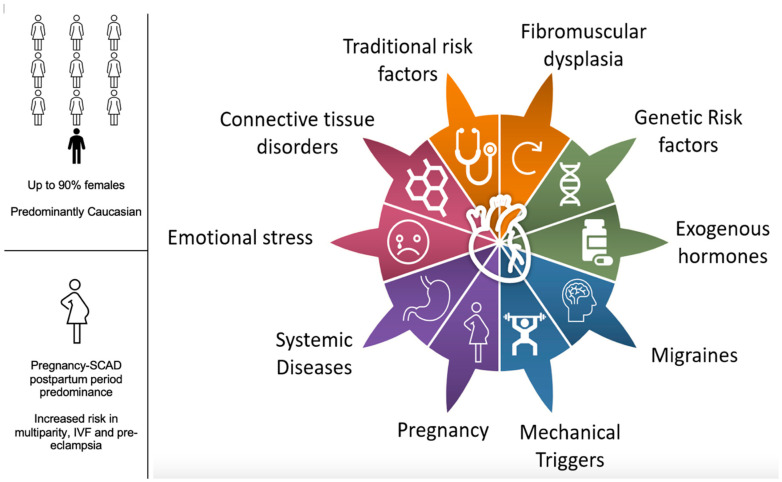
Spontaneous coronary artery dissection (SCAD) is an uncommon but significant cause of acute coronary syndrome (ACS), predominantly affecting younger women without traditional cardiovascular risk factors. SCAD is defined as a non-atherosclerotic, non-traumatic dissection of the coronary artery, leading to the formation of an intramural haematoma or intimal tear causing obstruction to blood flow and myocardial ischaemia. Unlike traditional atherosclerotic coronary artery disease, SCAD has unique pathophysiological mechanisms. SCAD is thought to arise secondary to a bleed and/or dissection within the arterial wall, linked to hormonal influences with potential triggers of physical or emotional stress and predisposition such as an underlying connective tissue disorder. Despite being increasingly recognised, SCAD remains underdiagnosed, and knowledge regarding SCAD epidemiology is limited. In addition, the impact of SCAD extends beyond the immediate cardiac event, encompassing psychological distress, the need for rehabilitation, and long-term surveillance. This has implications not just for the patient but also their family and the healthcare system. This narrative review summarises the current knowledge of SCAD epidemiology, including the affected population, its associated risk factors, and healthcare impact. By identifying current gaps in knowledge, this review aims to encourage targeted research, public awareness, and policy initiatives to improve outcomes for individuals affected by SCAD.
Keywords: acute coronary syndrome; epidemiology; public health; sex; spontaneous coronary artery dissection; women.
Conflict of interest statement
The authors declare no conflicts of interest related to this manuscript.
Figures
References
-
- Hayes S.N., Kim E.S., Saw J., Adlam D., Arslanian-Engoren C., Economy K.E., Ganesh S.K., Gulati R., Lindsay M.E., Mieres J.H., et al. Spontaneous Coronary Artery Dissection: Current State of the Science: A Scientific Statement From the American Heart Association. Circulation. 2018;137:e523–e557. doi: 10.1161/cir.0000000000000564. (In English) - DOI - PMC - PubMed
-
- Tweet M.S., Hayes S.N., Pitta S.R., Simari R.D., Lerman A., Lennon R.J., Gersh B.J., Khambatta S., Best P.J., Rihal C.S., et al. Clinical features, management, and prognosis of spontaneous coronary artery dissection. Circulation. 2012;126:579–588. doi: 10.1161/circulationaha.112.105718. (In English) - DOI - PubMed
-
- Adlam D., Alfonso F., Maas A., Vrints C., Writing Committee. Al-Hussaini A., Bueno H., Capranzano P., Gevaert S., Hoole S.P., et al. European Society of Cardiology, acute cardiovascular care association, SCAD study group: A position paper on spontaneous coronary artery dissection. Eur. Heart J. 2018;39:3353–3368. doi: 10.1093/eurheartj/ehy080. - DOI - PMC - PubMed
Publication types
MeSH terms
Supplementary concepts
LinkOut - more resources
Full Text Sources
Medical
