


Effects of Telehealth-Supervised Respiratory Exercise Training on Respiratory Function, Fatigue, Quality of Life, and Functional Capacity of Patients with Multiple Sclerosis
- PMID: 40282942
- PMCID: PMC12028881
- DOI: 10.3390/medicina61040651
Effects of Telehealth-Supervised Respiratory Exercise Training on Respiratory Function, Fatigue, Quality of Life, and Functional Capacity of Patients with Multiple Sclerosis
Abstract
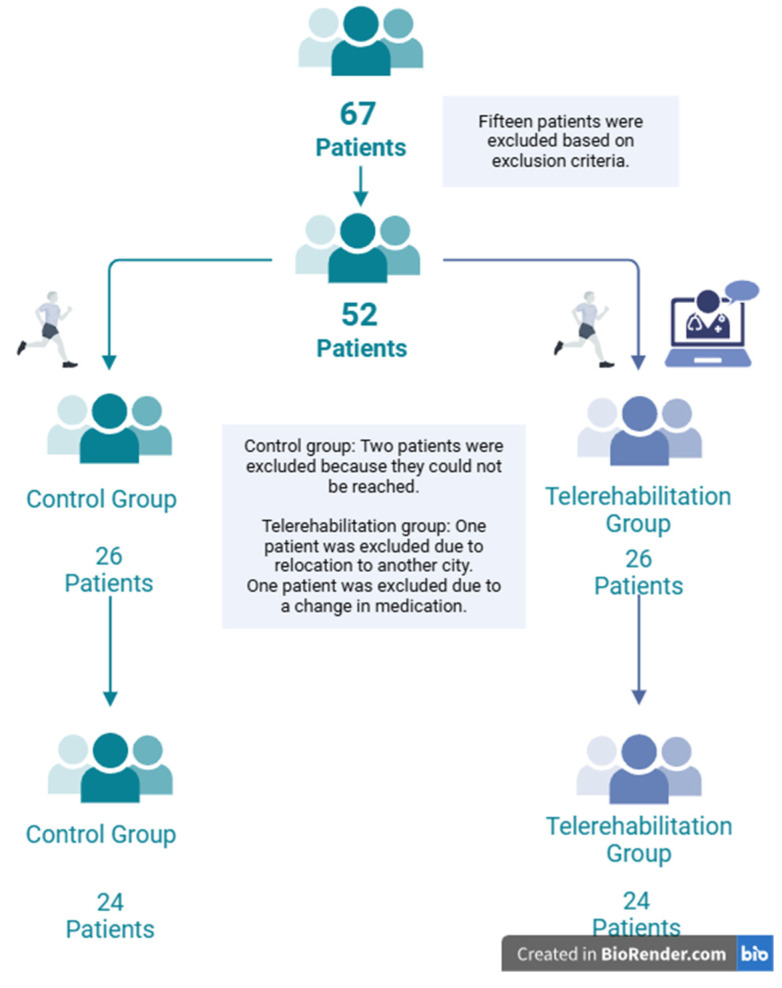
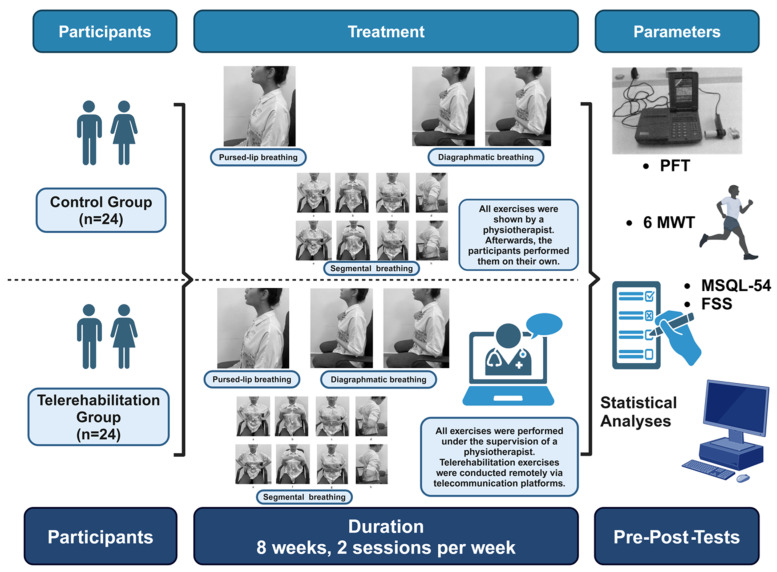
Background and Objectives: Telerehabilitation (TR) offers an innovative approach to overcome accessibility challenges in managing multiple sclerosis (MS). This exploratory study evaluated the efficacy of integrating respiratory exercises into TR programs for improving respiratory function, fatigue, and quality of life. Materials and Methods: A randomized controlled trial involving 48 MS patients randomized into TR and control groups was conducted. Both groups performed respiratory exercises over eight weeks. Pulmonary function, fatigue severity (FSS), quality of life (MSQOL-54), and functional capacity (6MWT) were assessed before and after the intervention. Results: Both groups demonstrated significant within-group improvements in FEV1 (L), PEF (L), FEF%25-75 (L), FSS, MSQOL-54 physical and mental subscales, and the 6MWT distance (p < 0.05). The TR group exhibited unique improvements in FEV1 (%) and slightly greater reductions in fatigue, although the intergroup differences were not statistically significant. Conclusions: Telerehabilitation incorporating respiratory exercises effectively enhances the respiratory function, fatigue, and quality of life of MS patients, suggesting a viable alternative to conventional rehabilitation. Future studies should focus on advanced-stage MS, long-term sustainability, and technological integration to optimize the potential of TR.
Keywords: fatigue; multiple sclerosis; quality of life; respiratory function tests; telerehabilitation.
Conflict of interest statement
The authors declare no conflicts of interest.
Figures
References
-
- White L. Prevalence and Severity of MS Across the World: Can New Research Explain the Patterns? MS International Federation [Internet]. [Updated 23 September 2022] 2022. [(accessed on 21 April 2024)]. Available online: https://www.msif.org/news/2022/09/01/prevalence-and-severity-of-ms-acros...
Publication types
MeSH terms
LinkOut - more resources
Full Text Sources
Medical
