


The Effects of Virtual Reality-Based Task-Oriented Movement on Upper Extremity Function in Healthy Individuals: A Crossover Study
- PMID: 40282958
- PMCID: PMC12028600
- DOI: 10.3390/medicina61040668
The Effects of Virtual Reality-Based Task-Oriented Movement on Upper Extremity Function in Healthy Individuals: A Crossover Study
Abstract
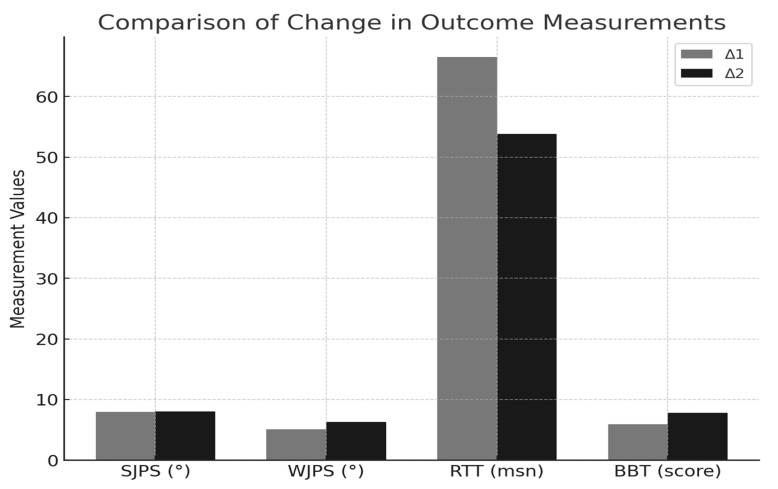
Background and Objectives: Although virtual reality (VR) has been shown to be effective in rehabilitation through motor learning principles, its impact on upper extremity function, particularly in the context of console use, remains unclear. Materials and Methods: This study aimed to investigate the effects of VR-based task-oriented movement on the upper extremity of healthy individuals. A total of 26 healthy individuals performed task-oriented movements in both real and virtual environments in a randomized order. All participants completed a single session of task-oriented movements using a VR Goggle system in a virtual setting. Physiotherapists designed immersive VR-based experiences and 3D screen-based exergames for this study. Upper extremity function was assessed using several measures: joint position sense (JPS) of the wrist and shoulder was evaluated using a universal goniometer, reaction time was measured via a mobile application, and gross manual dexterity was assessed using the box-and-block test (BBT). Evaluations were conducted before and after the interventions. Results: The results showed that JPS remained similar between conditions, while BBT performance improved in both groups. However, the reaction time increased significantly only after VR intervention (p < 0.05). No significant period or carryover effects were observed across the parameters. These findings suggest that VR-based task-oriented training positively influences reaction time and supports hand function. Moreover, VR systems that simulate joint position sense similar to real-world conditions may be beneficial for individuals with musculoskeletal motor deficits. Conclusions: These results highlight the potential for integrating VR technology into rehabilitation programs for patients with neurological or orthopedic impairments, providing a novel tool for enhancing upper extremity function and injury prevention strategies.
Keywords: joint position sense; reaction time; task-oriented; upper extremity; virtual reality.
Conflict of interest statement
The authors declare no conflicts of interest.
Figures

References
-
- Greco G., Centrone C., Poli L., Silva A.F., Russo L., Cataldi S., Giustino V., Fischetti F. Impact of coastal walking outdoors and virtual reality indoor walking on heart rate, enjoyment levels, and mindfulness experiences in healthy adults. J. Funct. Morphol. Kinesiol. 2024;9:11. doi: 10.3390/jfmk9010011. - DOI - PMC - PubMed
Publication types
MeSH terms
LinkOut - more resources
Full Text Sources
