


Artificial Intelligence-Powered Quality Assurance: Transforming Diagnostics, Surgery, and Patient Care-Innovations, Limitations, and Future Directions
- PMID: 40283208
- PMCID: PMC12028931
- DOI: 10.3390/life15040654
Artificial Intelligence-Powered Quality Assurance: Transforming Diagnostics, Surgery, and Patient Care-Innovations, Limitations, and Future Directions
Abstract
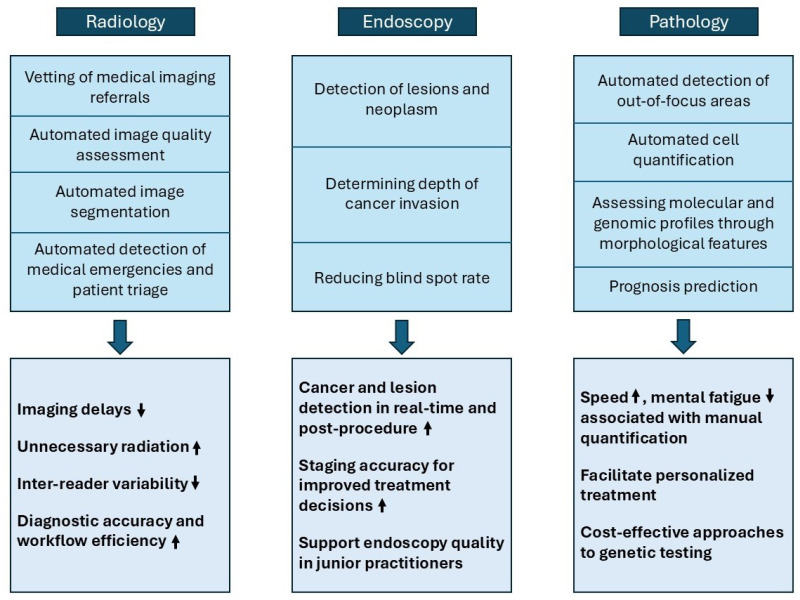
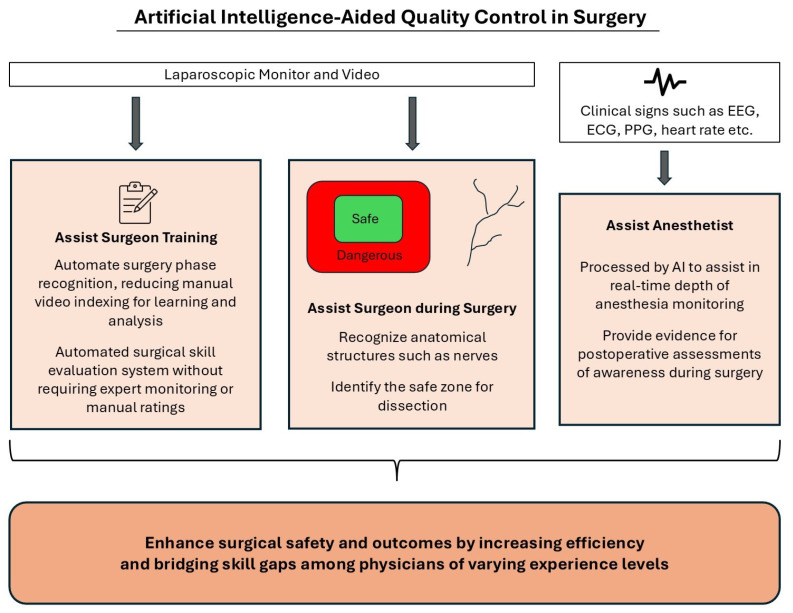
Artificial intelligence is rapidly transforming quality assurance in healthcare, driving advancements in diagnostics, surgery, and patient care. This review presents a comprehensive analysis of artificial intelligence integration-particularly convolutional and recurrent neural networks-across key clinical domains, significantly enhancing diagnostic accuracy, surgical performance, and pathology evaluation. Artificial intelligence-based approaches have demonstrated clear superiority over conventional methods: convolutional neural networks achieved 91.56% accuracy in scanner fault detection, surpassing manual inspections; endoscopic lesion detection sensitivity rose from 2.3% to 6.1% with artificial intelligence assistance; and gastric cancer invasion depth classification reached 89.16% accuracy, outperforming human endoscopists by 17.25%. In pathology, artificial intelligence achieved 93.2% accuracy in identifying out-of-focus regions and an F1 score of 0.94 in lymphocyte quantification, promoting faster and more reliable diagnostics. Similarly, artificial intelligence improved surgical workflow recognition with over 81% accuracy and exceeded 95% accuracy in skill assessment classification. Beyond traditional diagnostics and surgical support, AI-powered wearable sensors, drug delivery systems, and biointegrated devices are advancing personalized treatment by optimizing physiological monitoring, automating care protocols, and enhancing therapeutic precision. Despite these achievements, challenges remain in areas such as data standardization, ethical governance, and model generalizability. Overall, the findings underscore artificial intelligence's potential to outperform traditional techniques across multiple parameters, emphasizing the need for continued development, rigorous clinical validation, and interdisciplinary collaboration to fully realize its role in precision medicine and patient safety.
Keywords: artificial intelligence; image analysis; neural network; prognosis prediction; quality control; tissue classification.
Conflict of interest statement
The authors declare no conflicts of interest.
Figures
References
-
- Lee K.Y., Kim J. Artificial intelligence technology trends and IBM Watson references in the medical field. Korean Med. Educ. Rev. 2016;18:51–57. doi: 10.17496/KMER.2016.18.2.51. - DOI
Publication types
Grants and funding
LinkOut - more resources
Full Text Sources
