


Epidemiological Assessment of Depression, Activities of Daily Living and Associated Factors in Elderly Individuals Aged 65 Years and Older: Evidence from a Population-Based Study
- PMID: 40283685
- PMCID: PMC12028177
- DOI: 10.3390/jcm14082853
Epidemiological Assessment of Depression, Activities of Daily Living and Associated Factors in Elderly Individuals Aged 65 Years and Older: Evidence from a Population-Based Study
Abstract
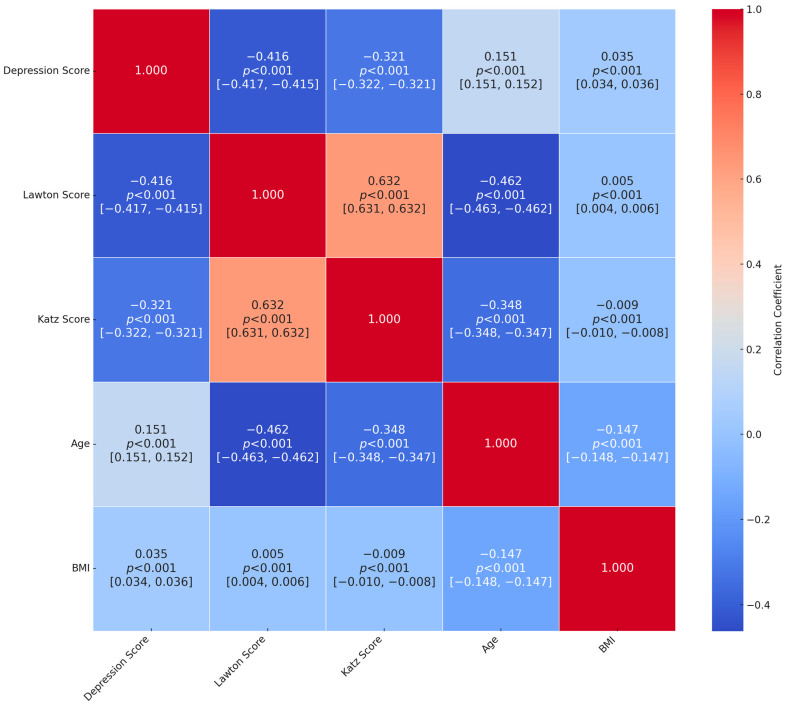
Background: It is a well-established fact that late-life depression represents a significant public health issue, particularly in low- and middle-income countries experiencing rapid demographic aging. Although its clinical and societal impacts are well-recognized, data on the interplay between depressive symptoms and functional status in older populations remain limited for Türkiye. This study aimed to estimate the prevalence of depression among individuals aged 65 years or older, examine its associations with instrumental and basic activities of daily living, and identify key sociodemographic and behavioral correlates. Methods: In this study, data obtained from a population-based survey in 2264 clusters by the Turkish Statistical Institute (TUIK) were used, and weighted data were yielded from 6,036,396 adults aged 65 and over. Depression was measured using the Geriatric Depression Scale (GDS), categorizing participants as "not depressed", "mildly depressed", or "severely depressed". Functional status was evaluated using the Lawton-Brody Instrumental Activities of Daily Living (IADL) Scale and the Katz Activities of Daily Living (ADL) Scale. Logistic regression models, adjusted for age and body mass index (BMI), were used to determine the associations of depression with functional impairment and various covariates, including gender, education, marital status, chronic disease, physical activity, smoking, and alcohol use. Results: Overall, the prevalence of depression in this cohort was 49.9% [95% CI = 48.7-51%], with 36.0% [95% CI = 34.8-37.0%] classified as mild and 13.9% [95% CI = 13.1-14.7%] as severe depression. IADL and ADL scores were negatively correlated with GDS scores (r = -0.416 and r = -0.321, respectively; p < 0.001). In logistic models, lower IADL scores were linked to higher odds of mild (OR = 0.797, 95% CI = [0.796-0.798], p < 0.001) and severe depression (OR = 0.689, 95% CI = [0.688-0.690], p < 0.001). Being semi-dependent or dependent in ADL further escalated depression risk. Female gender, lower education, single/divorced status, chronic disease, and inactivity also emerged as strong predictors. Conclusions: The findings of this study suggest that depression is highly prevalent among older adults in Türkiye, with functional impairment, unfavorable health behaviors, and sociodemographic vulnerabilities heightening risk. Integrating depression screening into geriatric care-alongside interventions to maintain functional independence-may help mitigate the burden of late-life depression in similar contexts.
Keywords: activities of daily living; late-life depression; older adults; population-based; public health.
Conflict of interest statement
The authors declare no conflicts of interest.
Figures

References
-
- Stein D.J., Szatmari P., Gaebel W., Berk M., Vieta E., Maj M., de Vries Y.A., Roest A.M., de Jonge P., Maercker A., et al. Mental, behavioral and neurodevelopmental disorders in the ICD-11: An international perspective on key changes and controversies. BMC Med. 2020;18:21. doi: 10.1186/s12916-020-1495-2. - DOI - PMC - PubMed
-
- Depressive Disorder (Depression) [(accessed on 25 March 2025)]. Available online: https://www.who.int/news-room/fact-sheets/detail/depression.
-
- Chauhan P., Kokiwar P.R., Shridevi K., Katkuri S. A study on prevalence and correlates of depression among elderly population of rural South India. Int. J. Community Med. Public Health. 2016;3:236–239. doi: 10.18203/2394-6040.ijcmph20151569. - DOI
LinkOut - more resources
Full Text Sources
