Review
. 2025 Apr 20;14(8):1250.
doi: 10.3390/plants14081250.

Trans-Kingdom RNA Dialogues: miRNA and milRNA Networks as Biotechnological Tools for Sustainable Crop Defense and Pathogen Control

Affiliations
Review

Trans-Kingdom RNA Dialogues: miRNA and milRNA Networks as Biotechnological Tools for Sustainable Crop Defense and Pathogen Control

Hui Jia et al. Plants (Basel). .

Abstract

MicroRNAs (miRNAs) are a class of non-coding RNAs approximately 20-24 nucleotides in length, which play a crucial role during gene regulation in plant-pathogen interaction. They negatively regulate the expression of target genes, primarily at the transcriptional or post-transcriptional level, through complementary base pairing with target gene sequences. Recent studies reveal that during pathogen infection, miRNAs produced by plants and miRNA-like RNAs (milRNAs) produced by fungi can regulate the expression of endogenous genes in their respective organisms and undergo trans-kingdom transfer. They can thereby negatively regulate the expression of target genes in recipient cells. These findings provide novel perspectives for deepening our understanding of the regulatory mechanisms underlying plant-pathogen interactions. Here, we summarize and discuss the roles of miRNAs and milRNAs in mediating plant-pathogen interactions via multiple pathways, providing new insights into the functions of these RNAs and their modes of action. Collectively, these insights lay a theoretical foundation for the targeted management of crop diseases.

Keywords: endogenous regulation; fungal milRNA; plant miRNA; plant–pathogen interaction; trans-kingdom regulation.


Conflict of interest statement

The authors declare no competing financial interests.

Figures
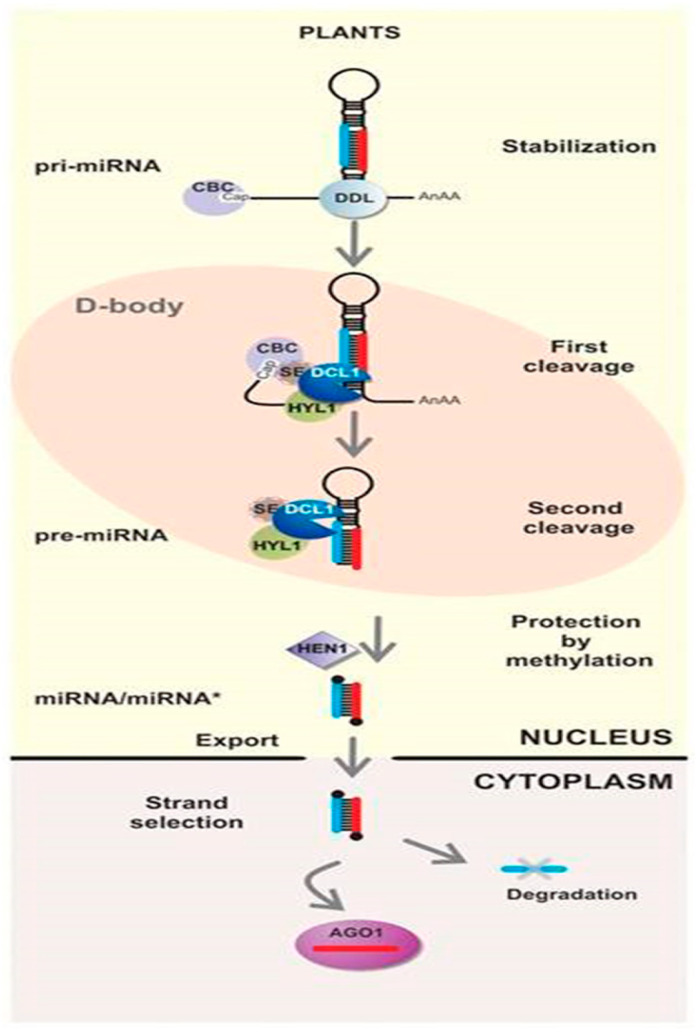
Figure 1
Figure 1
Schematic diagram of miRNA biogenesis and function in plants [27]. The biogenesis pathway of miRNA in plants. The biogenesis of miRNAs in plants typically occurs within the Dicing body (D-body), which consists of a cleavage complex made up of the Cap Binding Complex (CBC), the zinc finger protein SERRATE (SE), the double-stranded RNA binding protein HYPONASTIC LEAVES 1 (HYL1), and Dicer-like 1 (DCL1). Among them, DCL1 performs two cleavage events on the pri-miRNA to generate an miRNA/miRNA* duplex. Subsequently, HUAENHANCER1 (HEN1) recognizes the miRNA/miRNA* duplex and methylates the last nucleotide at the 3′ end of each strand of the duplex to maintain its structural stability. Finally, HASTY (HST) transports the duplex out of the nucleus. In the cytoplasm, the miRNA/miRNA* duplex is recognized by Argonaute (AGO) proteins to form the miRNA-induced silencing complex (miRISC). The RNA helicase within miRISC separates the miRNA/miRNA* duplex. Thereafter, the miRNA regulates the expression of target genes while the miRNA* is rapidly degraded.
Figure 2
Figure 2
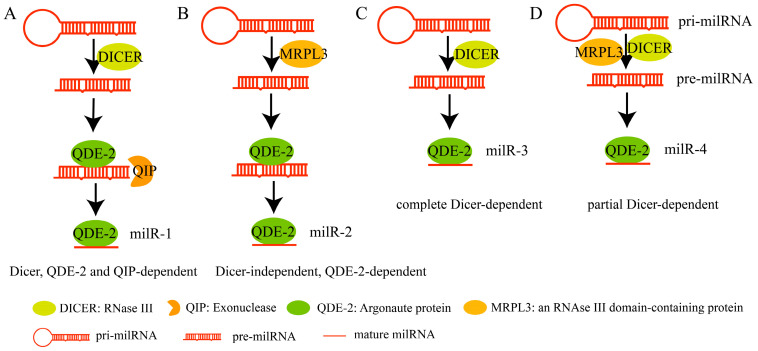
Biogenesis of fungal milRNAs: (A) Biogenesis of milR-1 is dependent on Dicer, QDE-2, and QIP. (B) The biogenesis mechanism of milR-2 is independent of Dicer and dependent on MRPL3 and QDE-2. (C) The synthesis of milR3 relies entirely on DCL proteins, similar to miRNA synthesis in plants. (D) The biogenesis of milR-4 is partially dependent on Dicer.
Figure 3
Figure 3
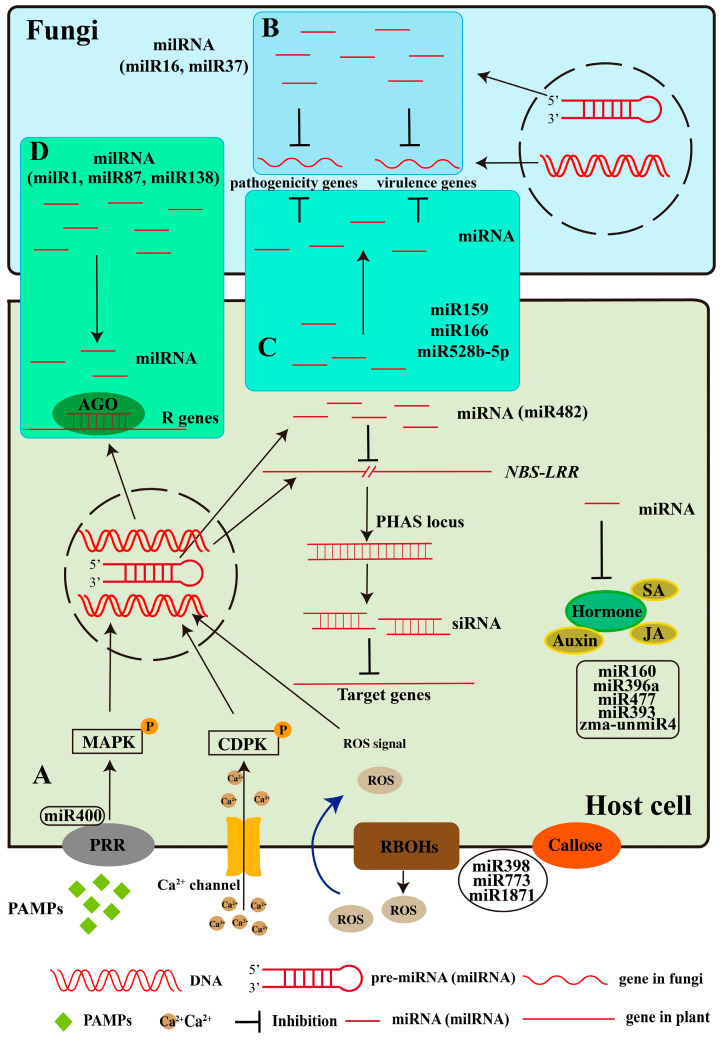
miRNAs (milRNA) are involved in plant–pathogen interaction: (A) Plant-derived miRNAs regulate endogenous gene expression by binding to target mRNAs through base-complementary pairing. These miRNAs are involved in regulating various biological processes in response to PTI and ETI, including ROS accumulation, callose deposition in the cell wall, rapid Ca2+ influx through ion channels, fine regulation of phytohormone signaling pathways, and expression of defense-related genes. Callose deposition in the cell wall, rapid Ca2+ endocytosis through ion channels, fine regulation of phytohormone signaling pathways, and the expression of defense-related genes ultimately play a crucial role in plant disease resistance. (B) milRNAs are involved in pathogenicity by specifically targeting and regulating the expression levels of endogenous genes related to pathogenicity and virulence. (C) Trans-kingdom regulation occurs in plant–pathogen interactions. On the one hand, plant miRNAs can be transferred to fungi to reduce pathogen pathogenicity by targeting and inhibiting the expression of pathogenicity- or virulence-related genes in fungi, thus decreasing pathogen virulence. (D) On the other hand, fungal miRNAs can be transferred to plants and reduce plant disease resistance by interfering with the expression of disease resistance genes.
Figure 4
Figure 4
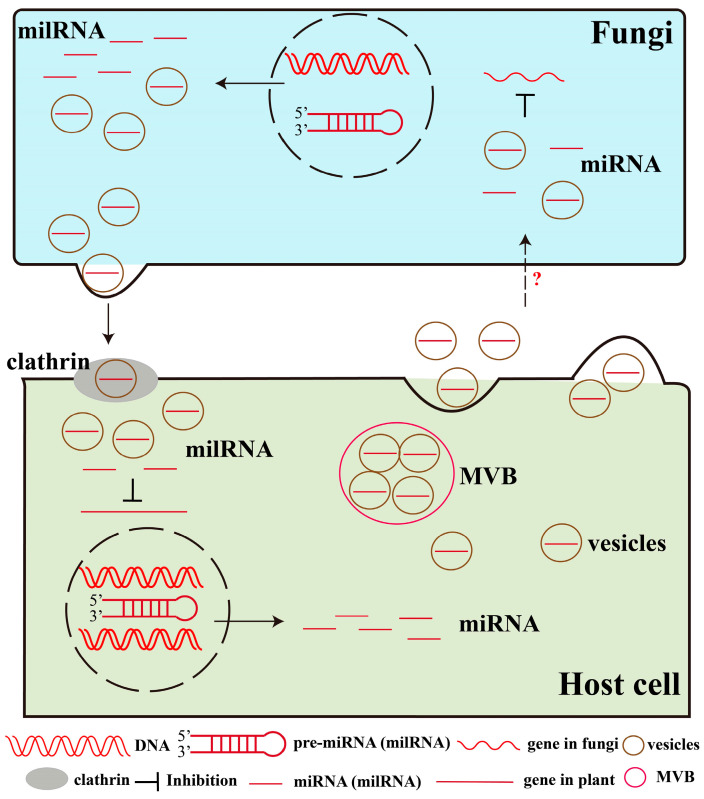
The secretion pathway of miRNAs (milRNAs) during the interaction between host plants and pathogens. Plant miRNAs can be translocated to fungi via extracellular vesicles (EVs) during pathogen infection. They are released after the fusion of multivesicular bodies (MVBs) with the cell membrane. However, it is not yet clear how the miRNAs in the EVs get into the fungal cells. Fungi milRNAs are transported outside of plant cells by EVs. Clathrin-mediated endocytosis (CME) in plants is able to take up EVs containing milRNAs in order to enter the plant cell and regulate the expression of their target genes.

Similar articles

References

    1. Kubicek C.P., Starr T.L., Glass N.L. Plant cell wall-degrading enzymes and their secretion in plant-pathogenic fungi. Annu. Rev. Phytopathol. 2014;52:427–451. doi: 10.1146/annurev-phyto-102313-045831. - DOI - PubMed
    1. Presti L.L., Lanver D., Schweizer G., Tanaka S., Liang L., Tollot M., Zuccaro A., Reissmann S., Kahmann R. Fungal effectors and plant susceptibility. Annu. Rev. Plant Biol. 2015;66:513–545. doi: 10.1146/annurev-arplant-043014-114623. - DOI - PubMed
    1. Boller T., He S.Y. Innate immunity in plants: An arms race between pattern recognition receptors in plants and effectors in microbial pathogens. Science. 2009;324:742–744. doi: 10.1126/science.1171647. - DOI - PMC - PubMed
    1. Jones J.D.G., Dangl J.L. The plant immune system. Nature. 2006;444:323–329. doi: 10.1038/nature05286. - DOI - PubMed
    1. Yu X.Q., Niu H.Q., Liu C., Wang H.L., Yin W.L., Xia X.L. PTI-ETI synergistic signal mechanisms in plant immunity. Plant Biotechnol. J. 2024;22:2113–2128. doi: 10.1111/pbi.14332. - DOI - PMC - PubMed

LinkOut - more resources