


Frailty and Energy Intake Deficiency Reduce the Efficiency of Activities of Daily Living in Patients with Musculoskeletal Disorders: A Retrospective Cohort Study
- PMID: 40284199
- PMCID: PMC12030590
- DOI: 10.3390/nu17081334
Frailty and Energy Intake Deficiency Reduce the Efficiency of Activities of Daily Living in Patients with Musculoskeletal Disorders: A Retrospective Cohort Study
Abstract
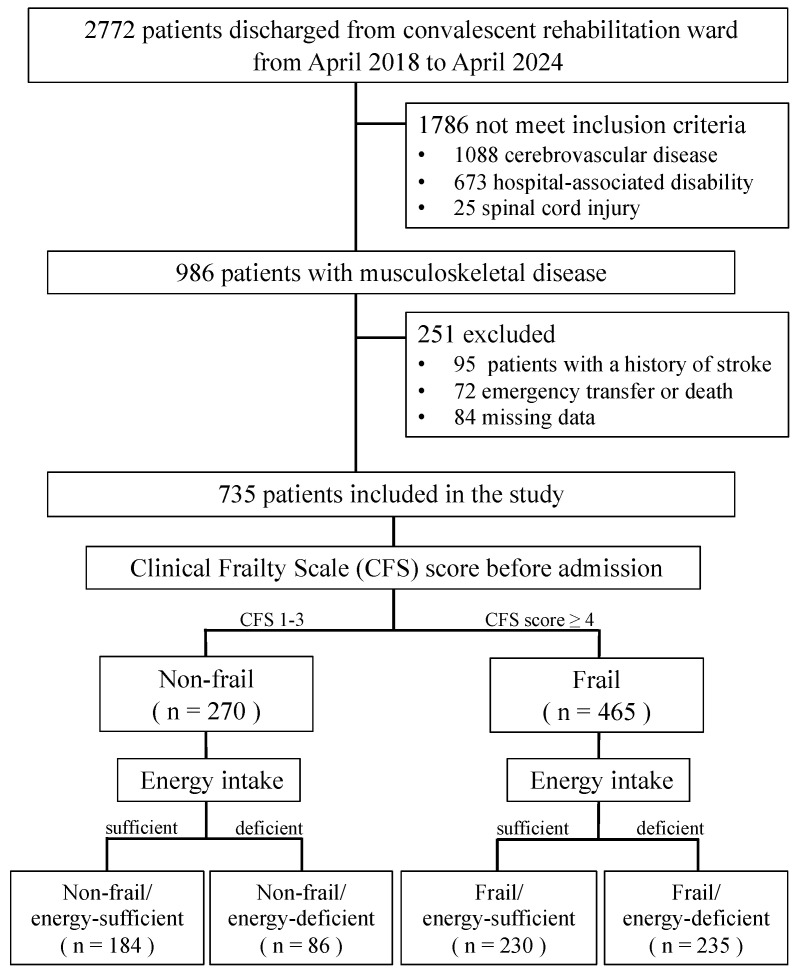
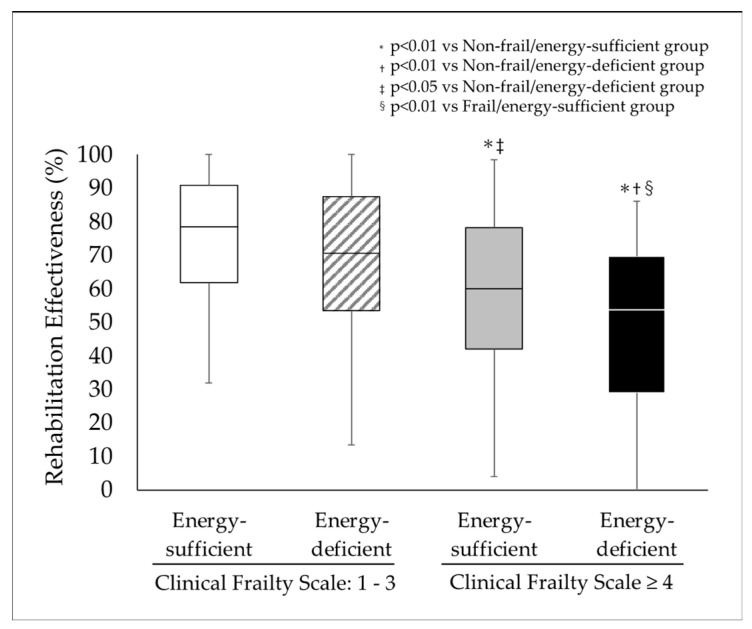
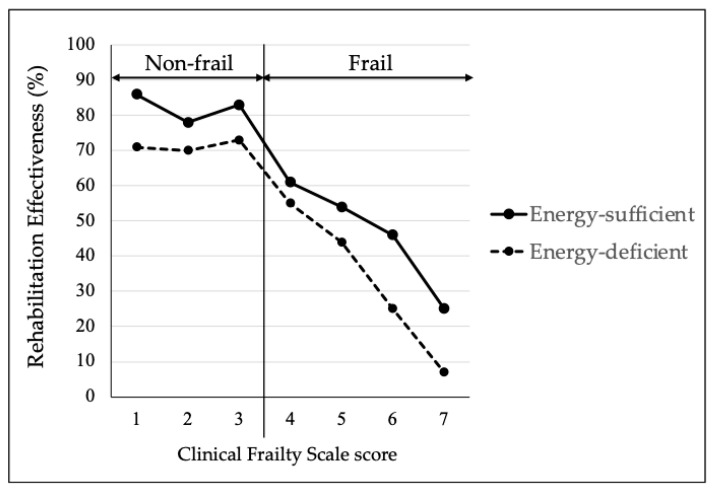
Background/Objective: This study aimed to investigate the relationship between rehabilitation effectiveness (RE) and pre-admission Clinical Frailty Scale (CFS) scores and energy intake. Methods: This retrospective observational study included 735 patients (81 ± 10 years; male: 27.5%) with musculoskeletal disorders discharged from convalescent rehabilitation wards between April 2018 and April 2024. The patients were classified into four groups based on their CFS scores (non-frail, CFS 1-3; frail, CFS ≥ 4) and rate of energy intake (energy-sufficient vs. energy-deficient). Group comparisons of RE were conducted, and the relationships between the CFS score, energy intake, and RE were analyzed. Results: The RE was significantly lower in the frail/energy-deficient group (53.6 [41.9-78.1]) than in the non-frail/energy-sufficient (78.5 [61.8-90.7]), non-frail/energy-deficient (70.6 [53.4-87.4]), and frail/energy-sufficient (59.9 [41.9-78.1]) groups. Additionally, the frail/energy-sufficient group had significantly lower RE scores than the non-frail/energy-sufficient and non-frail/energy-deficient groups. A multiple linear regression analysis revealed that age, male sex, CFS score, energy intake, handgrip strength, Functional Oral Intake Scale score, Mini Nutritional Assessment-Short Form score, B-type natriuretic peptide, and creatinine were significantly associated with the RE. Conclusions: Both frailty and inadequate energy intake reduce the rate of improvement in activities of daily living in patients with musculoskeletal diseases.
Keywords: activities of daily living; clinical frailty scale; convalescent rehabilitation wards; energy intake; musculoskeletal disorders; rehabilitation.
Conflict of interest statement
The authors declare no conflicts of interest.
Figures
References
-
- Yoshimura N., Muraki S., Oka H., Mabuchi A., En-Yo Y., Yoshida M., Saika A., Yoshida H., Suzuki T., Yamamoto S., et al. Prevalence of knee osteoarthritis, lumbar spondylosis, and osteoporosis in Japanese men and women: The research on osteoarthritis/osteoporosis against disability study. J. Bone Min. Metab. 2009;27:620–628. doi: 10.1007/s00774-009-0080-8. - DOI - PubMed
-
- Fried L.P., Tangen C.M., Walston J., Newman A.B., Hirsch C., Gottdiener J., Seeman T., Tracy R., Kop W.J., Burke G., et al. Cardiovascular Health Study Collaborative Research Group. Frailty in older adults: Evidence for a phenotype. J. Gerontol. A Biol. Sci. Med. Sci. 2001;56:M146–M156. doi: 10.1093/gerona/56.3.M146. - DOI - PubMed
Publication types
MeSH terms
LinkOut - more resources
Full Text Sources
Miscellaneous
