


The Impact of Macronutrient Intake on Sleep Quality in Female Endurance Athletes: A Pilot Observational Cross-Sectional Study
- PMID: 40284231
- PMCID: PMC12030440
- DOI: 10.3390/nu17081368
The Impact of Macronutrient Intake on Sleep Quality in Female Endurance Athletes: A Pilot Observational Cross-Sectional Study
Abstract
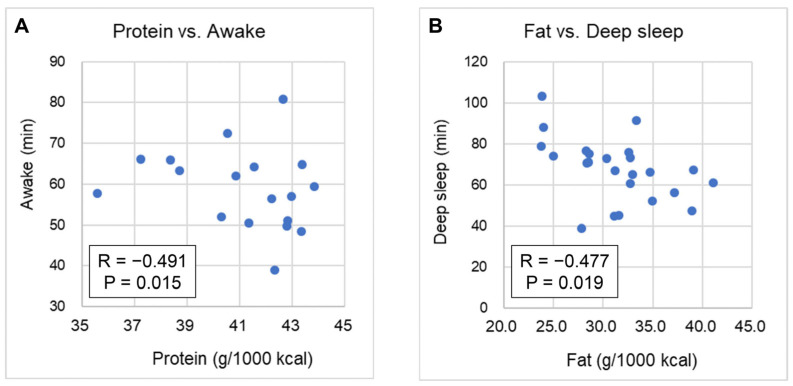
Background/Objectives: Sleep is essential for athletes. However, the impact of dietary habits on sleep quality in female endurance athletes at risk for low energy availability (LEA) is underexplored. This was a pilot study to examine the correlation between dietary patterns and sleep quality in healthy female endurance athletes. Methods: Twenty-four female endurance athletes recorded their dietary intake and sleeping habits for 6 days. Dietary intake data were collected via meal logs and photos. Sleep parameters were tracked using the Fitbit Charge 3 device. Correlation analyses were performed to explore the associations between macronutrient intake and sleep. Results: The athletes' mean consumption was 2049.3 ± 396.9 kcal/day (52.9% carbohydrates, 28.2% fat, and 17.2% protein). One-third of the athletes had poor sleep quality, and thirty-eight percent experienced high daytime sleepiness. A higher protein intake was correlated with a lower awake time (R = -0.491; p = 0.015), and fat intake was related to a lower duration of deep sleep (R = -0.477; p = 0.019). Deep sleep was negatively correlated with fat intake during dinner (R = -0.417; p = 0.042) and was positively correlated with carbohydrate intake (R = 0.417; p = 0.042). Conclusions: In healthy female endurance athletes without LEA, dietary fat intake, especially at dinner, negatively affects deep sleep. Meanwhile, carbohydrates promote deep sleep. Therefore, optimizing macronutrient balance during evening meals may enhance sleep quality and, consequently, athletic performance.
Keywords: Epworth sleepiness scale; Fitbit; Pittsburgh sleep quality index; female endurance athletes; low energy availability; macronutrient; sleep quality.
Conflict of interest statement
Author Yume Minamino was employed by the company Tamanoi Vinegar Co., Ltd. T.K. is affiliated with a department endowed by Philips Respironics, ResMed, and Fukuda Denshi, and a department endowed by Paramount Bed. The remaining authors declare that the research was conducted in the absence of any commercial or financial relationships that could be construed as a potential conflict of interest.
Figures

References
-
- Mountjoy M., Ackerman K.E., Bailey D.M., Burke L.M., Constantini N., Hackney A.C., Heikura I.A., Melin A., Pensgaard A.M., Stellingwerff T., et al. 2023 International Olympic Committee’s (IOC) Consensus Statement on Relative Energy Deficiency in Sport (REDs) Br. J. Sports Med. 2023;57:1073–1097. doi: 10.1136/bjsports-2023-106994. - DOI - PubMed
Publication types
MeSH terms
Substances
Grants and funding
LinkOut - more resources
Full Text Sources
