


Development and Evaluation of Bilayer Sustained-Release Tablets of Ruxolitinib Using Discriminative Pharmacokinetic Analysis and IVIVC
- PMID: 40284427
- PMCID: PMC12030279
- DOI: 10.3390/pharmaceutics17040432
Development and Evaluation of Bilayer Sustained-Release Tablets of Ruxolitinib Using Discriminative Pharmacokinetic Analysis and IVIVC
Abstract
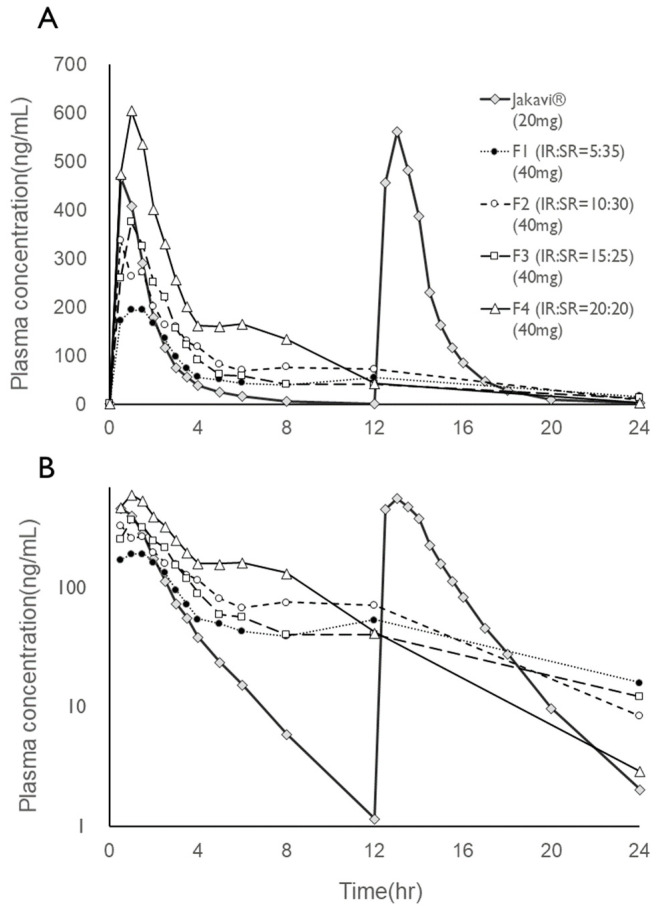
Objectives: This study explores the development and evaluation of a bilayer sustained-release (SR) tablet formulation of ruxolitinib. As a BCS Class 1 drug, ruxolitinib requires twice-daily dosing due to its short half-life. We designed a bilayer tablet that integrates immediate-release (IR) and SR components in varying ratios to achieve sustained plasma concentrations, which we evaluated using discriminative analysis. Methods: Bilayer tablets combining IR and SR components were prepared in different ratios. In vitro dissolution tests and pharmacokinetic studies were conducted using Beagle dogs, followed by the evaluation of in vivo-in vitro correlation (IVIVC), along with a discriminative pharmacokinetic analysis focused on the SR layer. Results: A discriminative pharmacokinetic and IVIVC analysis was applied to all bilayer tablets, offering clearer insights into the plasma concentration and dissolution profiles. Pharmacokinetic studies showed that test formulation F4, which has a 20:20 IR-to-SR ratio, is expected to provide a similar area under the curve (AUC) while prolonging exposure compared to the reference IR tablet. Conclusions: This study highlights the potential of a bilayer tablet approach, combined with discriminative pharmacokinetic and IVIVC analysis, for creating a sustained-release dosage form of ruxolitinib.
Keywords: IVIVC; bilayer tablet; dissolution; ruxolitinib; sustained release formulation.
Conflict of interest statement
N.K., K.K., S.J., J.K., S.P. and H.C. are current employees of Samyang holdings Corp. This affiliation did not influence the design, execution, or interpretation of the study. Y-J.L. declares that there are no conflicts of interest.
Figures




References
-
- Shilling A.D., Nedza F.M., Emm T., Diamond S., McKeever E., Punwani N., Williams W., Arvanitis A., Galya L.G., Li M., et al. Metabolism, excretion, and pharmacokinetics of [14C]INCB018424, a selective Janus tyrosine kinase 1/2 inhibitor, in humans. Drug Metab. Dispos. 2010;38:2023–2031. doi: 10.1124/dmd.110.033787. - DOI - PubMed
LinkOut - more resources
Full Text Sources
Research Materials
