


Sulfurimonas microaerophilic sp. nov. and Sulfurimonas diazotrophicus sp. nov.: Two Novel Nitrogen-Fixing and Hydrogen- and Sulfur-Oxidizing Chemolithoautotrophs Within the Campylobacteria Isolated from Mangrove Sediments
- PMID: 40284549
- PMCID: PMC12029903
- DOI: 10.3390/microorganisms13040713
Sulfurimonas microaerophilic sp. nov. and Sulfurimonas diazotrophicus sp. nov.: Two Novel Nitrogen-Fixing and Hydrogen- and Sulfur-Oxidizing Chemolithoautotrophs Within the Campylobacteria Isolated from Mangrove Sediments
Abstract
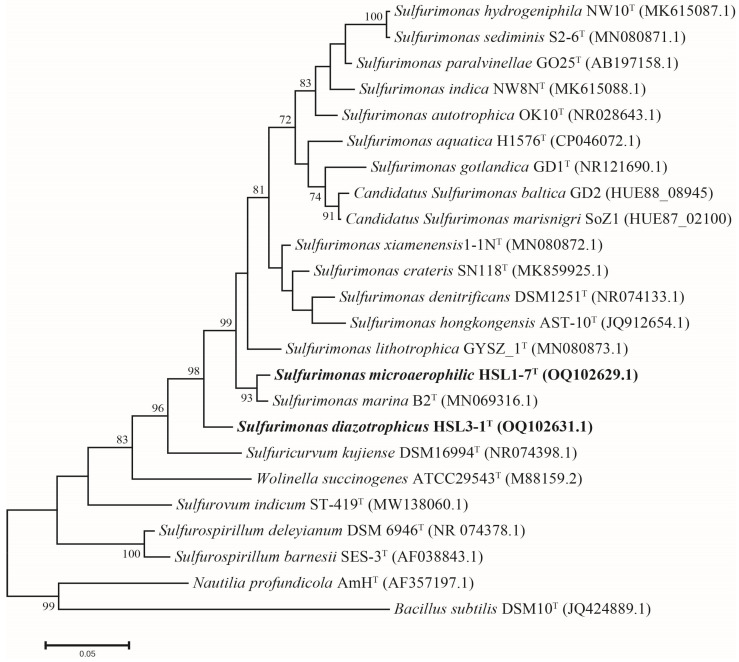
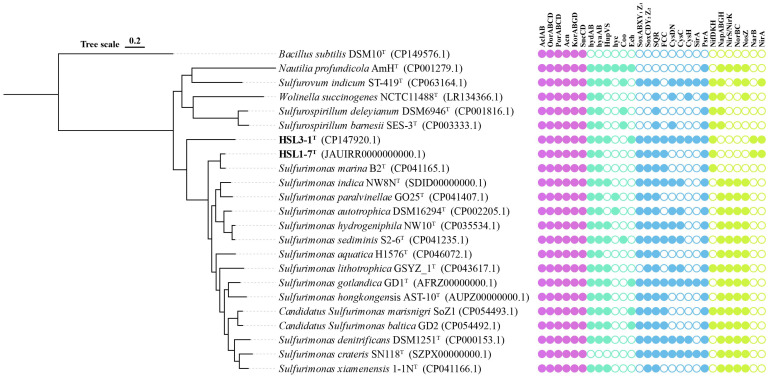
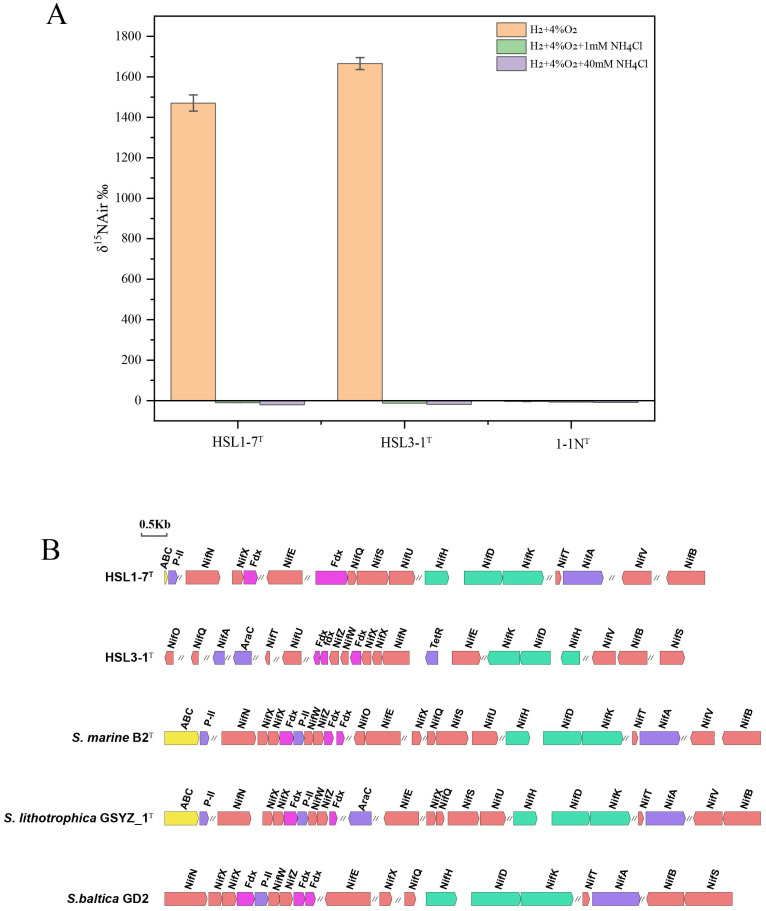
Two novel marine hydrogen- and sulfur-oxidizing bacteria, designated HSL1-7T and HSL3-1T, were isolated from mangrove sediments from Fujian Province, China. Strain HSL1-7T exhibited Gram-negative, rod-shaped to slightly curved morphology with polar flagellum-driven motility, whereas strain HSL3-1T was Gram-negative, rod-shaped and non-motile. Strain HSL1-7T and HSL3-1T were obligate chemolithoautotrophs, capable of using molecular hydrogen and thiosulfate as an energy source, and molecular oxygen and elemental sulfur as the electron acceptors for growth. Cellular fatty acid profiles revealed similar predominant components (C16:1ω7c, C16:0, C18:1ω7c, and C14:0) in both strains. Strains HSL1-7T and HSL3-1T were strongly diazotrophic, as demonstrated by 15N2 fixation when a fixed nitrogen source was absent from the growth medium. The DNA G+C contents of strains HSL1-7T and HSL3-1T were determined to be 36.1% and 57.3%, respectively. Based on the 16S rRNA gene sequences, strains HSL1-7T and HSL3-1T exhibited the highest sequence similarities with Sulfurimonas marina B2T (98.5% and 94.45%, respectively). Notably, the 16S rRNA gene sequence similarity between strains HSL1-7T and HSL3-1T was 93.19%, indicating that they represent distinct species within the genus Sulfurimonas. Comparative genomic analyses revealed the presence of diverse metabolic profiles in strains HSL1-7T and HSL3-1T, including carbon fixation, hydrogen oxidation, sulfur oxidation, and nitrogen fixation. The combined phenotypic, chemotaxonomic, and phylogenetic evidence, including average nucleotide identity and in silico DNA-DNA hybridization values, shows that strains HSL1-7T and HSL3-1T represent two novel species of the genus Sulfurimonas for which the names Sulfurimonas microaerophilic sp. nov. and Sulfurimonas diazotrophicus sp. nov. are proposed, with the type strains HSL1-7T (=MCCC 1A18899T = KCTC 25640T) and HSL3-1T (=MCCC 1A18844T), respectively.
Keywords: Sulfurimonas diazotrophicus HSL3-1T; Sulfurimonas microaerophilic HSL1-7T; chemolithoautotroph; hydrogen oxidation; nitrogen fixation; sulfur oxidation.
Conflict of interest statement
The authors declare that there are no conflicts of interest.
Figures
References
-
- Holguin G., Vazquez P., Bashan Y. The role of sediment microorganisms in the productivity, conservation, and rehabilitation of mangrove ecosystems: An overview. Biol. Fertil. Soils. 2001;33:265–278. doi: 10.1007/s003740000319. - DOI
-
- Biderre-Petit C., Courtine D., Hennequin C., Galand P.E., Bertilsson S., Debroas D., Monjot A., Lepère C., Divne A.-M., Hochart C. A pan-genomic approach reveals novel Sulfurimonas clade in the ferruginous meromictic Lake Pavin. Mol. Ecol. Resour. 2024;24:e13923. doi: 10.1111/1755-0998.13923. - DOI - PubMed
Grants and funding
LinkOut - more resources
Full Text Sources
