


European Pine Marten (Martes martes) as Natural Definitive Host of Sarcocystis Species in Latvia: Microscopic and Molecular Analysis
- PMID: 40284881
- PMCID: PMC12031116
- DOI: 10.3390/vetsci12040379
European Pine Marten (Martes martes) as Natural Definitive Host of Sarcocystis Species in Latvia: Microscopic and Molecular Analysis
Abstract
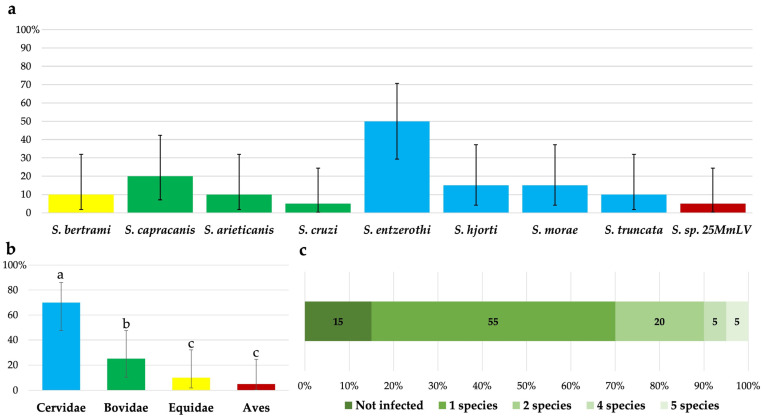
Apicomplexan parasites of the genus Sarcocystis utilize a wide range of vertebrate hosts, including reptiles, birds, and mammals, and follow a complex two-host prey-predator life cycle. Sarcocysts develop within the muscle tissue of intermediate hosts, while oocyst sporulation occurs in the intestines of definitive hosts. Despite their broad host range, the role of Mustelidae predators in the transmission and maintenance of Sarcocystis species remains poorly understood, highlighting the need for targeted studies in this area. In 2023, 20 intestinal samples were collected from European pine martens (Martes martes) in Latvia. Light microscopy revealed sporocysts of Sarcocystis spp. in 70.0% of the samples. Sarcocystis species were identified by using the analysis of obtained cox1 and ITS1 sequences. Using molecular methods, Sarcocystis spp. were confirmed in 85.0% of the samples examined, and co-infections with two or more different parasite species were established in 30.0% samples. We detected eight Sarcocystis species (S. arieticanis, S. bertrami, S. capracanis, S. cruzi, S. entzerothi, S. hjorti, S. morae, and S. truncata) associated with intermediate hosts such as cervids, cattle, sheep, goats, and horses. Additionally, a genetically novel species, Sarcocystis sp. 25MmLV, was detected in a single European pine marten. These findings suggest that European pine martens serve as definitive hosts for multiple Sarcocystis species, particularly those infecting cervids.
Keywords: ITS1; Martes martes; Mustelidae; Sarcocystis; cox1; definitive host; genetic identification; natural transmission.
Conflict of interest statement
The authors declare no conflicts of interest.
Figures
References
-
- Kollias G.V., Fernandez-Moran J. Fowler’s Zoo and Wild Animal Medicine. Volume 8. Elsevier; Amsterdam, The Netherlands: 2015. Mustelidae; pp. 476–491.
-
- Sato J.J., Hosoda T., Wolsan M., Tsuchiya K., Yamamoto M., Suzuki H. Phylogenetic Relationships and Divergence Times among Mustelids (Mammalia: Carnivora) Based on Nucleotide Sequences of the Nuclear Interphotoreceptor Retinoid Binding Protein and Mitochondrial Cytochrome b Genes. Zool. Sci. 2003;20:243–264. doi: 10.2108/zsj.20.243. - DOI - PubMed
-
- Wright P.G.R., Croose E., Macpherson J.L. A Global Review of the Conservation Threats and Status of Mustelids. Mamm. Rev. 2022;52:410–424. doi: 10.1111/mam.12288. - DOI
-
- Ozoliņš J., Pilāts V. Distribution and Status of Small and Medium-Sized Carnivores in Latvia. Ann. Zool. Fenn. 1995;32:21–29.
LinkOut - more resources
Full Text Sources
Miscellaneous
