


Transmissible Gastroenteritis Virus (TGEV) and Porcine Respiratory Coronavirus (PRCV): Epidemiology and Molecular Characteristics-An Updated Overview
- PMID: 40284936
- PMCID: PMC12031570
- DOI: 10.3390/v17040493
Transmissible Gastroenteritis Virus (TGEV) and Porcine Respiratory Coronavirus (PRCV): Epidemiology and Molecular Characteristics-An Updated Overview
Abstract
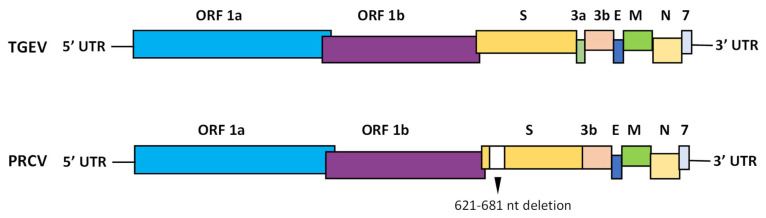
Transmissible gastroenteritis virus (TGEV) and porcine respiratory coronavirus (PRCV) are enveloped, single-stranded RNA viruses belonging to the genus Alphacoronavirus in the family Coronaviridae. PRCV, a TGEV mutant with a spike(S) gene deletion, exhibits altered tissue tropism. TGEV replicates mainly in the intestines and causes severe diarrhea and high mortality in piglets, whereas PRCV replicates mainly in the respiratory tract. PRCV causes mild or subclinical respiratory infections but may contribute to respiratory disease syndrome in pigs infected with other respiratory pathogens. As PRCV and TGEV continuously evolve, monitoring these viruses is important for disease prevention and control. In this review, we provide updated information on the prevalence and genetic characteristics of TGEV/PRCV and their phylogenetic relationships. We also discuss the impact of mutations, deletions and recombination on the virulence and tissue tropism of TGEV/PRCV and highlight the possible zoonotic potential of these viruses.
Keywords: PRCV; TGEV; coronavirus; epidemiology; mutation; pig; virulence.
Conflict of interest statement
The authors declare that they have no conflicts of interest.
Figures
References
-
- Bedsted A.E., Goecke N.B., Hjulsager C.K., Ryt-Hansen P., Larsen K.C., Rasmussen T.B., Bøtner A., Larsen L.E., Belsham G.J. High-throughput screening for respiratory pathogens within pigs in Denmark; analysis of circulating porcine respiratory coronaviruses and their association with other pathogens. Virus Res. 2024;350:199501. doi: 10.1016/j.virusres.2024.199501. - DOI - PMC - PubMed
-
- Jung K., Renukaradhya G.J., Alekseev K.P., Fang Y., Tang Y., Saif L.J. Porcine reproductive and respiratory syndrome virus modifies innate immunity and alters disease outcome in pigs subsequently infected with porcine respiratory coronavirus: Implications for respiratory viral co-infections. Pt 11J. Gen. Virol. 2009;90:2713–2723. doi: 10.1099/vir.0.014001-0. - DOI - PMC - PubMed
Publication types
MeSH terms
LinkOut - more resources
Full Text Sources
Research Materials
