. 2025 Apr 5;17(4):530.
doi: 10.3390/v17040530.

Sulfatide Binds to Influenza B Virus and Enhances Viral Replication

Affiliations

Sulfatide Binds to Influenza B Virus and Enhances Viral Replication

Yuuki Kurebayashi et al. Viruses. .

Abstract

Seasonal influenza epidemics caused by influenza A viruses (IAV) and influenza B viruses (IBV) pose a substantial public health burden. Despite the significant impact of IBV, its restricted host range and the absence of documented pandemics have resulted in limited research attention relative to IAV. Understanding the viral infection mechanisms of both IAV and IBV is crucial for controlling seasonal epidemics. Previously, we demonstrated that 3'-O-sulfated galactosylceramide sulfatide binds to IAV and enhances viral replication, a finding with potential therapeutic implications. However, the role sulfatide plays in other influenza virus infections, including those caused by IBV, remains unknown. Accordingly, in this paper, we investigate the function of sulfatide during IBV infection. We demonstrate that sulfatide binds to IBV hemagglutinin (HA), and that sulfatide overexpression significantly enhances IBV replication, whereas treatment with sulfatase or an anti-sulfatide antibody markedly suppressed IBV replication. Moreover, further tests involving the inhibition of sulfatide biosynthesis resulted in the suppression of viral replication with impaired nuclear export of viral ribonucleoproteins (vRNPs). These findings establish that sulfatide is a critical regulator of IBV replication, which parallels its role in IAV infection, and suggest that targeting sulfatide-virus interactions can lead to broad-spectrum therapeutic strategies against influenza virus.

Keywords: antivirus therapeutics; hemagglutinin; influenza B virus; sulfatide; viral replication.


Conflict of interest statement

We have read the journal’s policy, and all authors of this manuscript declare that they have no conflicts of interest to disclose.

Figures
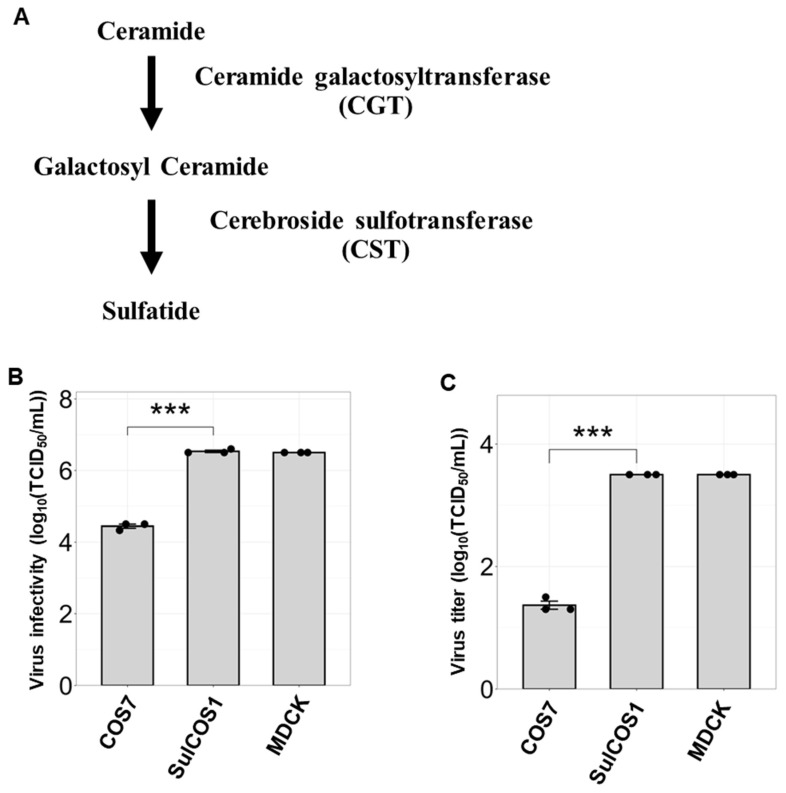
Figure 1
Figure 1
Sulfatide enrichment enhances influenza B virus infection and its replication. (A) Sulfatide biosynthetic pathway. (B) Virus infectivity was quantified using the TCID50 assay. IBV B/Lee/1940 strain was used to infect COS7 cells, sulfatide-expressing COS7 cells (SulCOS1), and MDCK cells at equal viral loads. SulCOS1 cells were generated by the stable expression of ceramide sulfotransferase (CST) and ceramide galactosyltransferase (CGT) genes in sulfatide-deficient COS7 cells. MDCK cells were used as the positive control. (C) Viral replication was assessed using TCID50 assays. Cells were infected with IBV at an MOI of 0.01, and the viral titer in the culture supernatants was determined 24 h post-infection. Data were obtained from three independent experiments. Values are presented as the mean ± SD. *** p < 0.001.
Figure 2
Figure 2
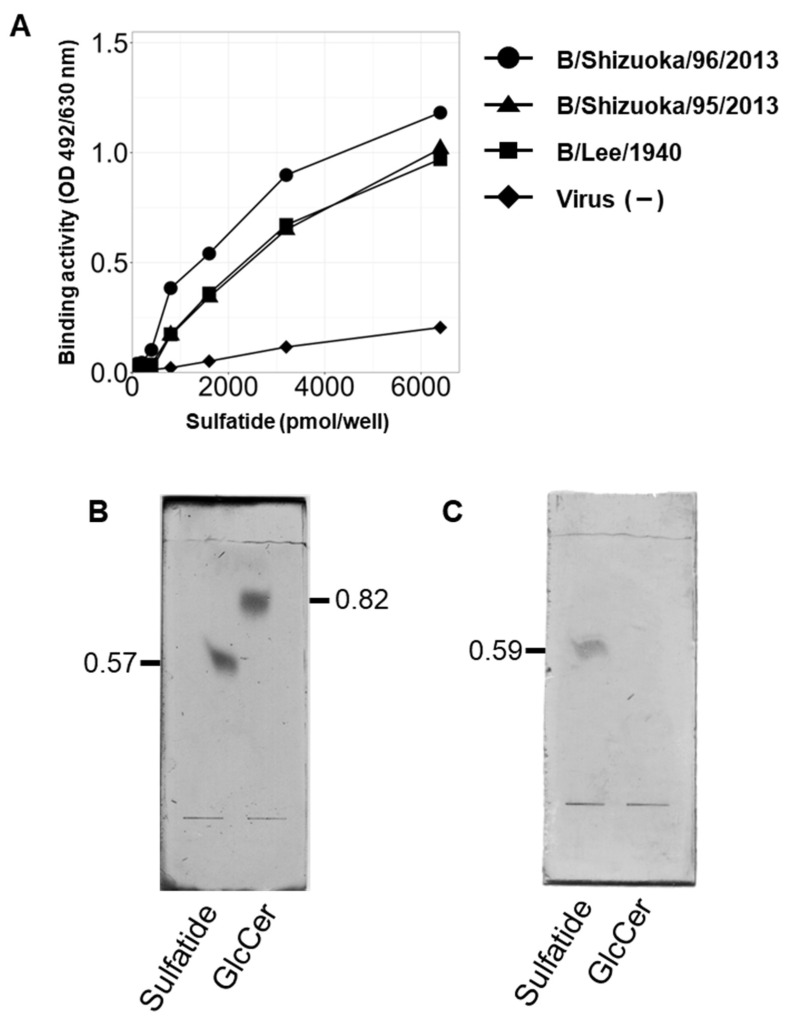
IBV exhibits binding affinity to sulfatide. (A) Analysis of IBV binding to sulfatide using enzyme-linked immunosorbent assay (ELISA). Three IBV strains (B/Lee/1940, B/Shizuoka/96/2013, and B/Shizuoka/95/2013) were added at 26 HAU/well to sulfatide-coated plates, and the binding activity was determined using HRP-conjugated antibodies. Data were obtained from three independent experiments. The values indicate the mean ± S.D. (B,C) Thin-layer chromatography (TLC) overlay assay of IBV glycolipid binding. (B) Glycolipids were visualized using orcinol sulfate reagent. (C) IBV (B/Lee/1940) binding to glycolipids was detected using anti-influenza A and B rabbit polyclonal antibodies and HRP-conjugated anti-rabbit IgG. The values indicated in (B,C) are the retention factor (Rf) values.
Figure 3
Figure 3
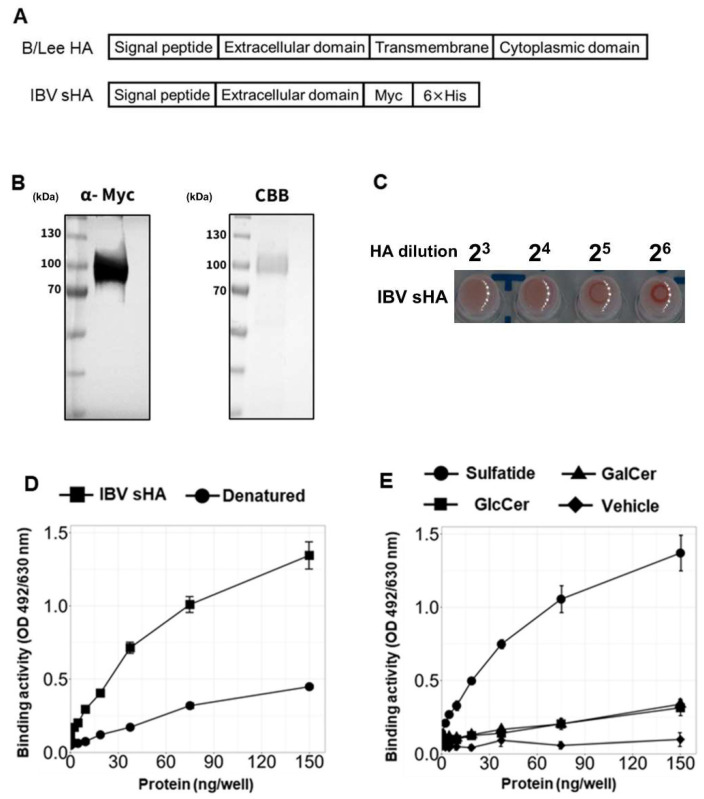
Soluble IBV HA binds to sulfatide. (A) Schematic representation of the secreted IBV HA (IBV sHA) constructs. This construct was generated by removing the transmembrane and cytoplasmic domains of B/Lee/1940 HA and then inserting the resulting sequence into the pCAGGS vector with C-terminal 6×His and Myc tags for detection and purification. (B) Detection of IBV sHA in culture supernatants via Western blotting using an anti-Myc antibody (left) and Coomassie Brilliant Blue (CBB) staining (right). (C) Hemagglutination activity of purified IBV sHA (85 ng/µL) assessed by serial twofold dilution with 0.5% guinea pig erythrocytes in PBS. (D,E) Analysis of IBV sHA binding to sulfatide as assessed using ELISA. For this test, sulfatides or other glycolipids were immobilized at a concentration of 6.4 nmol/well. (D) Effect of heat denaturation (95 °C, 10 min) on IBV sHA binding to sulfatide. (E) Binding specificity of IBV sHA, as determined by a comparative analysis of various glycolipids. The data are from three independent experiments for (D,E). The values are presented as the mean ± SD.
Figure 4
Figure 4
Sulfatide inhibition suppresses IBV replication. (A) Analysis of B/Lee/1940 infectivity in MDCK cells following sulfatide inhibition. Cells were pretreated with the anti-sulfatide monoclonal antibody GS-5 prior to infection. TCID50 was determined 24 h post-infection. (B) Quantification of IBV replication under sulfatide inhibition, as determined using a focus-forming assay. MDCK cells were treated with GS-5 during infection with B/Lee/1940 (MOI = 1), and anti-Gb3Cer monoclonal antibody TU-1 was used as a negative control. The virus titer of the culture supernatants was determined 24 h post-infection. (C) Effects of sulfatase-mediated sulfatide degradation on virus infectivity. Cells were pretreated with sulfatase prior to infection. (D) Impact of sulfatase treatment on IBV replication. Here, sulfatase was added simultaneously with virus infection. Data were obtained from three independent experiments. Values are presented as the mean ± SD. * p < 0.05, ** p < 0.01.
Figure 5
Figure 5
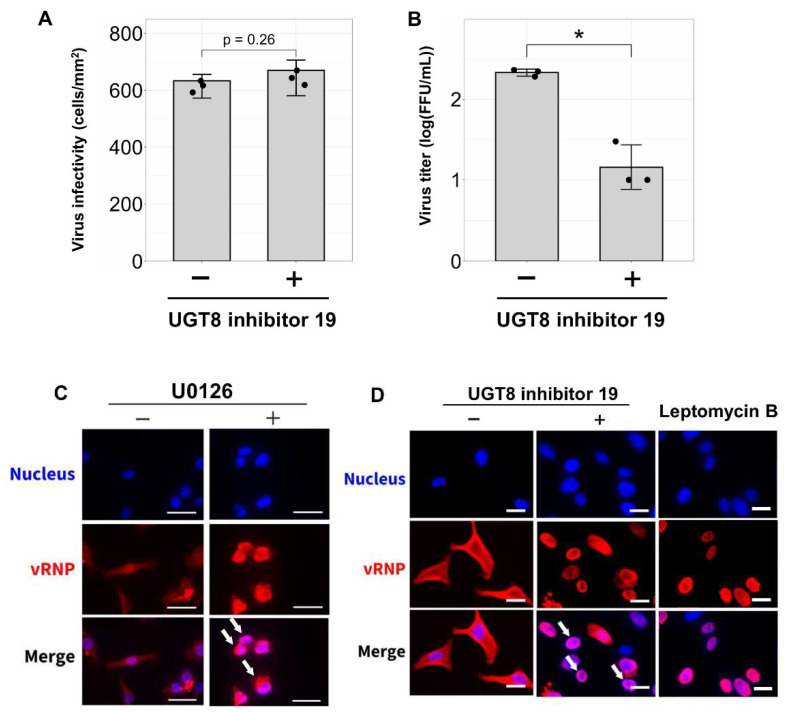
Inhibition of sulfatide biosynthesis impairs IBV replication and viral ribonucleoprotein transport. UGT8 inhibitor 19, an inhibitor of galactosylceramide synthase, was used to inhibit sulfatide biosynthesis. Cells were pretreated with 200 nM UGT8 inhibitor 19 for 72 h prior to infection. (A) Quantification of B/Lee/1940 infectivity in A549 cells following inhibition of sulfatide synthesis. Infected cells were counted 24 h post-infection and expressed as infected cells/mm2. (B) Analysis of IBV replication in A549 cells with inhibited sulfatide synthesis, as measured using focus-forming assays. (C,D) Immunofluorescence analysis of nuclear export of viral ribonucleoprotein (vRNP). A549 cells infected with B/Lee/1940 were immunostained for nuclei (DAPI, blue) and vRNP (anti-IBV NP followed by Alexa Fluor 555-conjugated anti-mouse IgG; red). White arrows indicate cells with impaired vRNP nuclear export. (C) Effects of the ERK signaling inhibitor U0126 on vRNP nuclear export. U0126 was used to confirm the role of ERK signaling in vRNP nuclear export. (D) Impact of UGT8 inhibitor and leptomycin B on vRNP nuclear export. Leptomycin B, a nuclear export inhibitor, was used as the positive control. The scale bar represents 40 µm. Data were obtained from three independent experiments for (A,B). Values are presented as the mean ± SD. * p < 0.05.
Figure 6
Figure 6
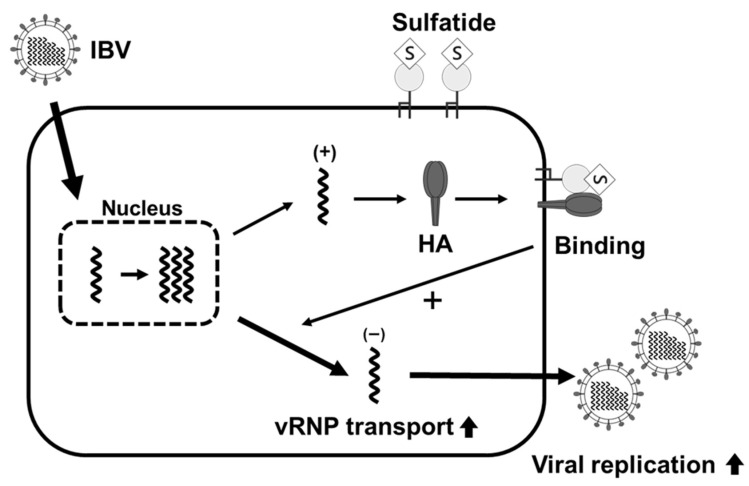
Predicted mechanism by which sulfatide promotes IBV replication.

Similar articles

References

    1. Collin E.A., Sheng Z., Lang Y., Ma W., Hause B.M., Li F. Cocirculation of two distinct genetic and antigenic lineages of proposed influenza D virus in cattle. J. Virol. 2015;89:1036–1042. doi: 10.1128/JVI.02718-14. - DOI - PMC - PubMed
    1. Taubenberger J.K., Kash J.C. Influenza virus evolution, host adaptation, and pandemic formation. Cell Host Microbe. 2010;7:440–451. doi: 10.1016/j.chom.2010.05.009. - DOI - PMC - PubMed
    1. Chang C.P., New A.E., Taylor J.F., Chiang H.S. Influenza virus isolations from dogs during a human epidemic in Taiwan. Int. J. Zoonoses. 1976;3:61–64. - PubMed
    1. Osterhaus A.D., Rimmelzwaan G.F., Martina B.E., Bestebroer T.M., Fouchier R.A. Influenza B virus in seals. Science. 2000;288:1051–1053. doi: 10.1126/science.288.5468.1051. - DOI - PubMed
    1. Ren H., Zhou P. Epitope-focused vaccine design against influenza A and B viruses. Curr. Opin. Immunol. 2016;42:83–90. doi: 10.1016/j.coi.2016.06.002. - DOI - PubMed

Publication types

MeSH terms

Substances

LinkOut - more resources