


Identification of key hub genes and potential therapeutic drugs for nasopharyngeal carcinoma: Insights into molecular mechanisms and treatment strategies
- PMID: 40286596
- PMCID: PMC12056400
- DOI: 10.1016/j.bjorl.2025.101618
Identification of key hub genes and potential therapeutic drugs for nasopharyngeal carcinoma: Insights into molecular mechanisms and treatment strategies
Abstract
Objective: Nasopharyngeal Carcinoma (NPC) is a highly malignant cancer with a high incidence in East and Southeast Asia, including southern China. Despite advances in treatment, the prognosis for advanced NPC remains poor due to high recurrence and metastasis rates. The molecular mechanisms driving NPC progression are not fully understood, and identifying key genes and potential therapeutic agents is critical. This study aims to uncover critical genes and screen therapeutic drugs, providing insights into NPC pathogenesis and novel treatment strategies.
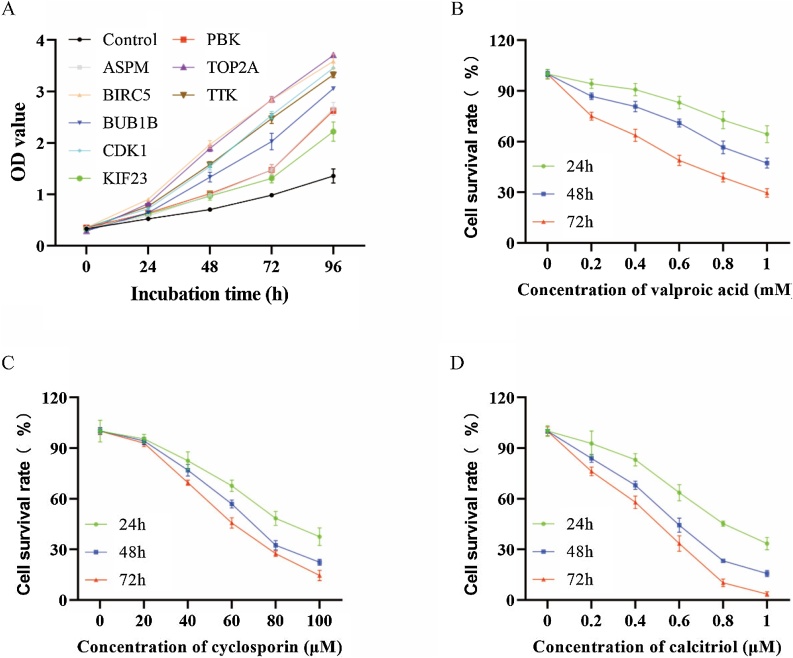
Methods: Three GEO datasets (GSE12452, GSE53819, and GSE61218) were analyzed to identify overlapping Differentially Expressed Genes (DEGs) in NPC. Gene Ontology (GO), Kyoto Encyclopedia of Genes and Genomes (KEGG), and Gene Set Enrichment Analysis (GSEA) were used to explore the biological roles of DEGs. Protein-Protein Interaction (PPI) and mRNA-miRNA-lncRNA interaction networks were constructed to identify key hub genes. Potential therapeutic drugs were predicted via a Drug-Gene Interaction network. The overexpression of hub genes was validated in NPC cells using CCK-8 assays, and the anti-proliferative effects of three drugs ‒ valproic acid, cyclosporine, and calcitriol ‒ were tested.
Results: Eight hub genes (ASPM, BIRC5, BUB1B, CDK1, KIF23, PBK, TOP2A, and TTK) were identified, with ASPM reported for the first time in the context of NPC. Overexpression of these genes significantly promoted NPC cell proliferation. Among the tested drugs, calcitriol exhibited the most potent anti-proliferative effect, with IC50 values of 0.90 μM, 0.47 μM, and 0.31 μM at 24-, 48-, and 72-hs, respectively.
Conclusion: This study identified eight key genes as potential biomarkers for NPC and validated calcitriol as a promising therapeutic agent, providing a foundation for further research into NPC treatment.
Level of evidence: Level 2 (Individual cross-sectional studies or systematic review of surveys that allow matching to local circumstances).
Keywords: Calcitriol; Drug screening; Key genes; Nasopharyngeal carcinoma.
Copyright © 2025 Associação Brasileira de Otorrinolaringologia e Cirurgia Cérvico-Facial. Published by Elsevier España S.L.U. All rights reserved.
Conflict of interest statement
Declaration of competing interest The authors declare that they have no known competing financial interests or personal relationships that could have appeared to influence the work reported in this paper.
Figures


References
-
- Chen Y.P., Chan A.T.C., Le Q.T., Blanchard P., Sun Y., Ma J. Nasopharyngeal carcinoma. Lancet. 2019;394:64–80. - PubMed
-
- Sung H., Ferlay J., Siegel R.L., Laversanne M., Soerjomataram L., Jemal A., et al. Global cancer statistics 2020: GLOBOCAN estimates of incidence and mortality worldwide for 36 cancers in 185 countries. CA Cancer J Clin. 2021;71:209–249. - PubMed
MeSH terms
Substances
LinkOut - more resources
Full Text Sources
Research Materials
Miscellaneous
