. 2025 Apr 26;11(1):203.
doi: 10.1038/s41420-025-02489-7.

Heightened IDO1 levels predict Bacillus Calmette-Guèrin failure in high-risk non-muscle-invasive bladder cancer patients

Affiliations

Heightened IDO1 levels predict Bacillus Calmette-Guèrin failure in high-risk non-muscle-invasive bladder cancer patients

Alice Turdo et al. Cell Death Discov. .

Abstract

Recent studies have indicated a potential link between immune-related gene expression and Bacillus Calmette-Guèrin (BCG) treatment response in non-muscle-invasive bladder cancer (NMIBC) patients, however, prognostic gene signatures have not significantly improved risk stratification beyond clinical characteristics. To identify predictive biomarkers in T1 high-risk (HR) bladder cancer (BC) patients responding to BCG treatment, a gene signature was derived from a discovery cohort of 73 BCG-naïve patients, both responders and non-responders, using the publicly available dataset GSE1542618. Among the identified genes, Indoleamine 2,3-dioxygenase (IDO1), an immunosuppressive enzyme, emerged as a crucial determinant of treatment outcomes. The association between IDO1 expression and worse prognosis was subsequently validated in a cohort of 75 BC patients using formalin-fixed paraffin-embedded (FFPE) BC specimens collected prior BCG treatment. This research revealed significant insights into the mechanisms underlying unsatisfactory responses to BCG treatment in HR patients, posing IDO1 as a promising prognostic biomarker and therapeutic target for NMIBC.


Conflict of interest statement

Competing interests: The authors declare no competing interests.

Figures
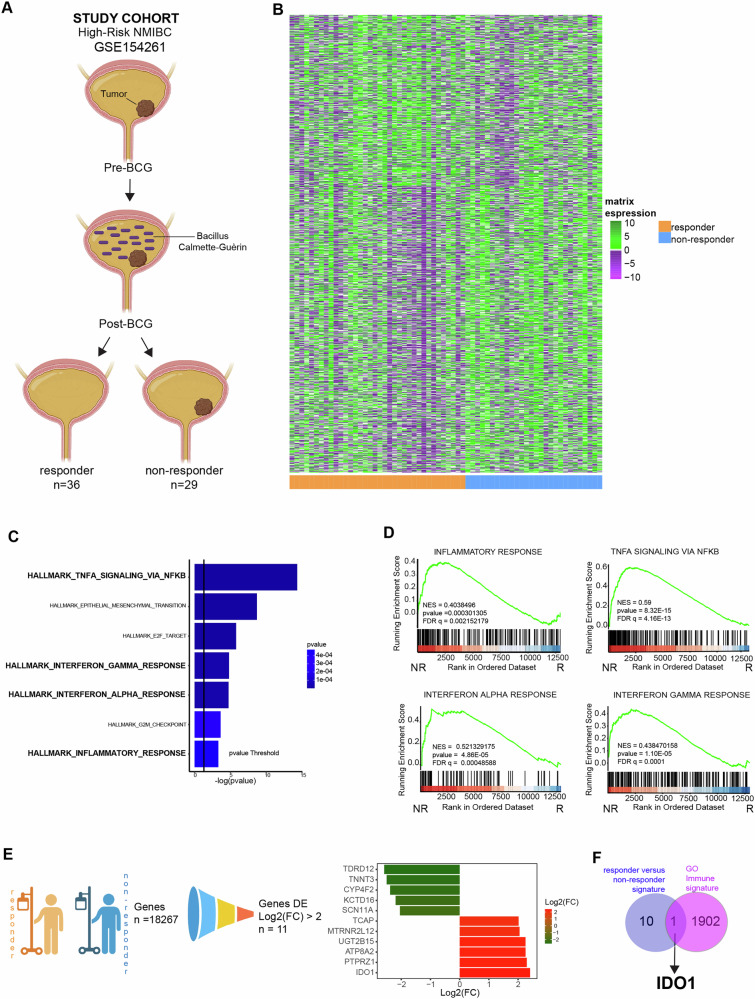
Fig. 1
Fig. 1. Gene expression analysis of a validation cohort of BC patients highlighted a gene expression signature associated with BCG therapy response.
A Workflow chart indicating the process to select naïve BC patients according to the response to BCG treatment, retrieved from GSE154261 database (discovery cohort). B Heatmap of differential expressed genes (DEGs) performed with the R edgeR library in responder versus non-responder BC patients (p-value < 0.05). C Enrichment analysis using the EnrichR library in Ontology terms Biological Process, Molecular Function and Cellular Component of DEGs from responder versus non-responder BC patient cohort. D GSEA plot performed, between Non-Responder (NR) vs Responder (R), with the MSigDB library in the C2 class for inflammatory response, TNFA signaling via NFKB, Interferon alpha response and Interferon Gamma Response. E Funnel graph to filter 18,267 DE Genes, starting from 59,000 genes, 1246 genes have a p value < 0.05, and 11 are coding genes with an abs(fc) ≥ 2 (left). Barplot showing 11 top DEGs (right). F Venn diagram showing the intersection between 11 top DEGs and genes belonging to the GO immune signature (n = 1903).
Fig. 2
Fig. 2. IDO1 expression is negatively associated with BC prognosis.
A IDO1 log2 expression in tumor (black box plot frame) versus normal (green box plot frame) samples retrieved from TCGA. Bladder cancer (BC) is shown in bold. B IDO1 log2 expression in BC (red box plot) (n = 404) and normal tissue (grey box plot) (n = 28) retrieved from GEPIA. C Percentage of IDO1 mutations for each tumor type sample as in (A). (D-F) RNA-seq expression data of IDO1 in normal bladder tissue and in different BC molecular subtypes (D), stages (E) and weight status (F) retrieved from the TCGA database and analyzed by UALCAN. (G) Kaplan Meier disease free survival curves of BC patients (GSE32548, GSE48075, GSE31684) stratified by high (n = 180) or low (n = 117) IDO1 expression levels. Statistical analysis has been performed with log-rank test.
Fig. 3
Fig. 3. BCG response is correlated with anti-tumor immune response.
A Functional protein association network of IDO1 based on canSAR.ai database. B Scatter plot showing correlation analysis computed on log2 expression data of IDO1 and PDCD1, CD274, CTLA4 or IFNG. C Correlation between the abundance of immune cells and IDO1 expression in the GSE154261 patients cohort, performed by ImmuneCellAI. p-value is indicated by different bar colors. D Cell state abundance patterns in responder (n = 38) and non-responder (n = 26) BC patient cohort (GSE154261), with cell states organized into different cell types and carcinoma ecotypes (CE) according to the EcoTyper machine learning framework [17] and CIBERSORTx analysis [18].
Fig. 4
Fig. 4. IDO1 is a predictive biomarker of BCG treatment response.
A Workflow chart indicating the validation of IDO1 in our cohort of FFPE BC samples. B Representative droplet digital PCR (ddPCR) scatter plots showing positive droplets for IDO1 (blue) and GAPDH (green) used as housekeeping gene of FFPE samples of responder and non-responder BC patient. C Absolute mRNA levels (copies/µl) of IDO1 in responder and non-responder BC patients (n = 23). Data are represented as mean ± SD of three independent experiments. D Representative IHC analysis for IDO1 of patients as in (C). Scale bar is 100 µm. E Representative immunohistochemical analysis for CD8 and granzyme B in BC responder and non-responder BC patients. F Percentage of T cells positive for granzyme B and CD8 in responder and non-responder BC patients, as in (E), normalized to the tumor area analyzed.

References

    1. Claps, F, Pavan, N, Ongaro, L, Tierno, D, Grassi, G, Trombetta, C, et al. BCG-unresponsive non-muscle-invasive bladder cancer: current treatment landscape and novel emerging molecular targets. Int J Mol Sci. 2023;24. 10.3390/ijms241612596. - PMC - PubMed
    1. See WA, Zhang G, Chen F, Cao Y, Langenstroer P, Sandlow J. Bacille-Calmette Guerin induces caspase-independent cell death in urothelial carcinoma cells together with release of the necrosis-associated chemokine high molecular group box protein 1. BJU Int. 2009;103:1714–20. - PubMed
    1. Bohle A, Jocham D, Bock PR. Intravesical bacillus Calmette-Guerin versus mitomycin C for superficial bladder cancer: a formal meta-analysis of comparative studies on recurrence and toxicity. J Urol. 2003;169:90–5. - PubMed
    1. Sylvester RJ, van der MA, Lamm DL. Intravesical bacillus Calmette-Guerin reduces the risk of progression in patients with superficial bladder cancer: a meta-analysis of the published results of randomized clinical trials. J Urol. 2002;168:1964–70. - PubMed
    1. van der Meijden AP, Sylvester RJ, Oosterlinck W, Hoeltl W, Bono AV, Group EG-UTC. Maintenance Bacillus Calmette-Guerin for Ta T1 bladder tumors is not associated with increased toxicity: results from a European Organisation for Research and Treatment of Cancer Genito-Urinary Group Phase III Trial. Eur Urol. 2003;44:429–34. - PubMed

LinkOut - more resources
