


Patterns of CPBMI-OC and associated factors among platform workers in new forms of employment in China: a cross-sectional study
- PMID: 40287689
- PMCID: PMC12032796
- DOI: 10.1186/s12889-025-22678-4
Patterns of CPBMI-OC and associated factors among platform workers in new forms of employment in China: a cross-sectional study
Abstract
Introduction: Despite the basic medical insurance system achieving 95% coverage in China, platform workers in new forms of employment (PWNFEs) face significant challenges in maintaining continuous participation in basic medical insurance (CPBMI). This study aims to identify distinct patterns of CPBMI by occupational characteristics (CPBMI-OC) and their associated factors.
Methods: We conducted a cross-sectional survey with 641 PWNFEs in China using a structured questionnaire and employed latent class analysis (LCA) to identify patterns of CPBMI-OC. We utilized multinomial logistic regression to examine the associations between patterns of CPBMI-OC and variables, including demographics, socioeconomic status, medical service utilization, and health and insurance statuses.
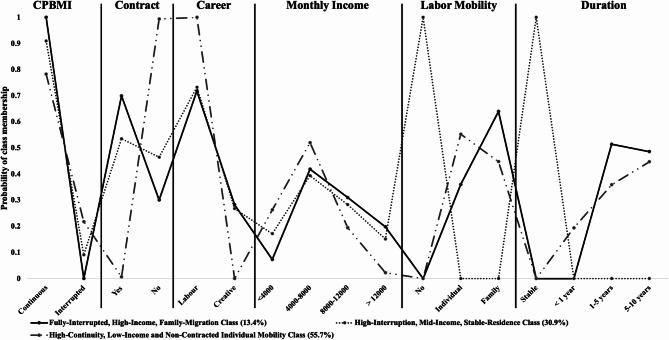
Results: Among the 641 PWNFEs surveyed (74.4% aged 20-39 years, 79.4% male), the basic medical insurance (BMI) coverage rate was 38.7%, with 85.6% of participants reporting interruptions. LCA identified three distinct patterns: (1) fully interrupted, high-income, family migration class (13.4%); (2) high interruption, mid-income, stable residence class (30.9%); and (3) high continuity, low-income, non-contracted individual mobility class (50.7%). Urban and Rural Resident Basic Medical Insurance and urban hukou were positively associated with higher CPBMI probability. In contrast, higher education, better self-rated health, female gender, supplementary insurance coverage, and platform-insurance enrollment linkage were associated with a higher interrupt probability of CPBMI.
Conclusion: This study highlights the low CPBMI rate. The diverse patterns of CPBMI-OC among PWNFEs underscore the systemic challenges associated with flexible BMI enrollment options, which hinder continuous insurance participation. Our findings emphasize the need for targeted policy interventions to address structural inequities, improve the inclusiveness of BMI schemes, and better accommodate the diverse needs of PWNFEs.
Keywords: Basic medical insurance; CPBMI; Health policy; Occupational characteristics; Platform workers.
© 2025. The Author(s).
Conflict of interest statement
Declarations. Ethics approval and consent to participate: This study was approved by the Ethical Review Committee of Capital Medical University. Before receiving the questionnaire, each participant was informed of the study’s objectives and provided written informed consent. All methodologies adhered strictly to the ethical guidelines of Capital Medical University. The data collection procedure was anonymous. Consent for publication: Not applicable. Competing interests: The authors declare no competing interests.
Figures
References
-
- Mandl I, Curtarelli M, Riso S, Vargas O, Gerogiannis E. New forms of employment: Publications Office of the European Union Luxembourg; 2015.
-
- Zhang G, Zhu X, Zhang P, Meng S. Influencing factors of occupational injury risk of workers in diverse forms of employment and the prevention and control countermeasures in China. Chin J Disease Control Prev. 2024;28(4):468–72.
-
- Seccombe K. Employer sponsored medical benefits: the influence of occupational characteristics and gender. Sociol Q. 1993;34(4):557–80. - DOI
MeSH terms
Grants and funding
LinkOut - more resources
Full Text Sources
Medical
Research Materials
