


Thermally Conductive Ti3C2Tx Fibers with Superior Electrical Conductivity
- PMID: 40287905
- PMCID: PMC12034612
- DOI: 10.1007/s40820-025-01752-x
Thermally Conductive Ti3C2Tx Fibers with Superior Electrical Conductivity
Abstract
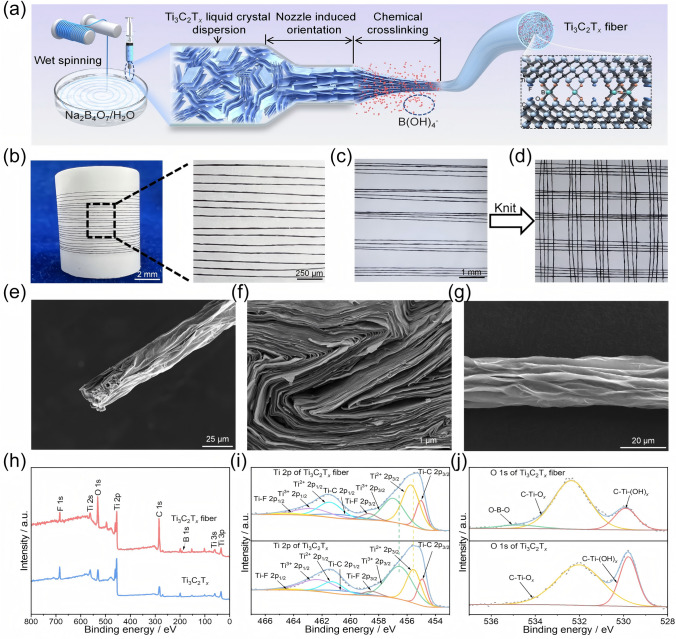
High-performance Ti3C2Tx fibers have garnered significant potential for smart fibers enabled fabrics. Nonetheless, a major challenge hindering their widespread use is the lack of strong interlayer interactions between Ti3C2Tx nanosheets within fibers, which restricts their properties. Herein, a versatile strategy is proposed to construct wet-spun Ti3C2Tx fibers, in which trace amounts of borate form strong interlayer crosslinking between Ti3C2Tx nanosheets to significantly enhance interactions as supported by density functional theory calculations, thereby reducing interlayer spacing, diminishing microscopic voids and promoting orientation of the nanosheets. The resultant Ti3C2Tx fibers exhibit exceptional electrical conductivity of 7781 S cm-1 and mechanical properties, including tensile strength of 188.72 MPa and Young's modulus of 52.42 GPa. Notably, employing equilibrium molecular dynamics simulations, finite element analysis, and cross-wire geometry method, it is revealed that such crosslinking also effectively lowers interfacial thermal resistance and ultimately elevates thermal conductivity of Ti3C2Tx fibers to 13 W m-1 K-1, marking the first systematic study on thermal conductivity of Ti3C2Tx fibers. The simple and efficient interlayer crosslinking enhancement strategy not only enables the construction of thermal conductivity Ti3C2Tx fibers with high electrical conductivity for smart textiles, but also offers a scalable approach for assembling other nanomaterials into multifunctional fibers.
Keywords: Density functional theory simulation; Equilibrium molecular dynamics simulation; High electrical conductivity; Interlayer crosslinking; Thermally conductive Ti3C2Tx fibers.
© 2025. The Author(s).
Conflict of interest statement
Declarations. Conflict of Interest: The authors declare no interest conflict. They have no known competing financial interests or personal relationships that could have appeared to influence the work reported in this paper. Junwei Gu is an editorial board member for Nano-Micro Letters and was not involved in the editorial review or the decision to publish this article. All authors declare that there are no competing interests.
Figures



References
-
- N. Lu, X. Sun, H. Wang, J. Zhang, C. Ma et al., Synergistic effect of woven copper wires with graphene foams for high thermal conductivity of carbon fiber/epoxy composites. Adv. Compos. Hybrid Mater. 7(1), 29 (2024). 10.1007/s42114-024-00840-7 - DOI
-
- M. Liu, Y. Yang, R. Liu, K. Wang, S. Cheng et al., Carbon nanotubes/graphene-skinned glass fiber fabric with 3D hierarchical electrically and thermally conductive network. Adv. Funct. Mater. 34(49), 2409379 (2024). 10.1002/adfm.202409379 - DOI
LinkOut - more resources
Full Text Sources