Dietary Ficus carica Inhibits Cognitive Impairment in Hypoxia-induced Non-alcoholic Fatty Liver Disease
- PMID: 40288909
- PMCID: PMC12455911
- DOI: 10.24546/0100495569
Dietary Ficus carica Inhibits Cognitive Impairment in Hypoxia-induced Non-alcoholic Fatty Liver Disease
Abstract
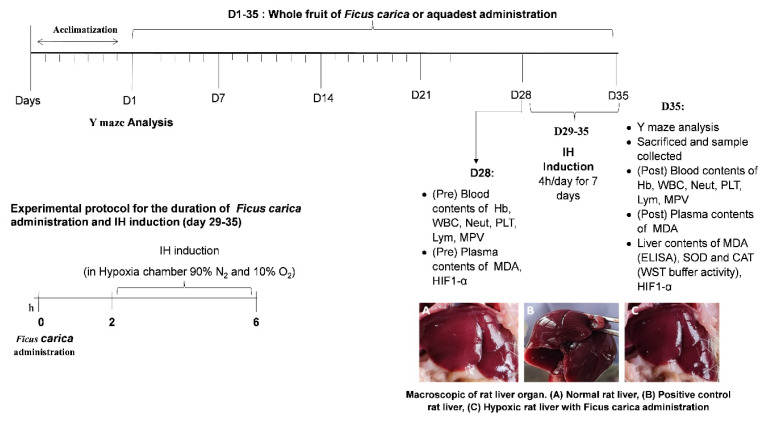
Intermittent hypoxia (IH) can aggravate non-alcoholic fatty liver disease (NAFLD) by activating hypoxia-inducible Factor-α and increasing oxidative stress. Lipid peroxidation, which occurs as a consequence of reactive oxygen species (ROS) generation, is characterized by malondialdehyde (MDA) formation and decreased catalase (CAT) and superoxide dismutase (SOD) levels. Hence, inadequate management of NAFLD might induce cognitive impairment. However, although studies have shown that Ficus carica could prevent cognitive impairment due to NAFLD complications, the mechanism by which this is achieved remains unclear. The current study therefore aimed to clarify the effects of Ficus carica in suppressing cognitive impairments caused by hypoxia-induced NAFLD. Sprague-Dawley male rats were divided into five groups: negative control positive control (PC), and IH with Ficus carica treatment (6.25, 12.5, and 25 mL/kg/day) for 4 weeks before and 1 week during IH. Rats were exposed to IH exposure by placing them in a hypoxic chamber (90% N₂ and 10% O₂) for 7 days. Regardless of dosage, Ficus carica treatment reduced MDA levels when compared to PC, and low-dose increased liver SOD levels more than the other groups. In contrast, the medium Ficus carica dose was associated with increased CAT activity and decreased inflammatory marker levels compared to the other treatments. Meanwhile, the neutrophil-to-lymphocyte ratio, platelet-to-lymphocyte ratio, and systemic immune-inflammation index were all greatest in the medium-dose group. The PC group showed a significant decrease in the percentage of alteration. Our data implies that medium doses of Ficus carica can reduce cognitive impairment caused by hypoxia-induced NAFLD.
Keywords:
Antioxidant; Cognitive impairment;
Figures


 or decrease
 impact of oxidative stress condition Increase
 or decrease
 action of Ficus carica administration
References
-
- Musso G, Cassader M, Olivetti C, Rosina F, Carbone G, Gambino R. Association of obstructive sleep apnoea with the presence and severity of non-alcoholic fatty liver disease. A systematic review and meta-analysis. Obes Rev. 2013;14(5):417–431. - PubMed
-
- Fan JG, Kim SU, Wong VW. New trends on obesity and NAFLD in Asia. J Hepatol. 2017;67(4):862–873. - PubMed
-
- Wang X, Cui L, Ji X. Cognitive impairment caused by hypoxia: from clinical evidences to molecular mechanisms. Metab Brain Dis. 2022;37(1):51–66. - PubMed
MeSH terms
Substances
LinkOut - more resources
Full Text Sources
Medical
Miscellaneous