


Clinical Prediction Models for Pneumonia in Children Presenting to an Emergency Department in a Resource-Limited Setting Using Lung Ultrasound Diagnosis as the Gold Standard
- PMID: 40291322
- PMCID: PMC12034295
- DOI: 10.7759/cureus.81360
Clinical Prediction Models for Pneumonia in Children Presenting to an Emergency Department in a Resource-Limited Setting Using Lung Ultrasound Diagnosis as the Gold Standard
Abstract
Introduction: Clinical prediction rules for pediatric pneumonia often rely on radiographic pneumonia for diagnosis; however, lung ultrasound has higher diagnostic accuracy. Our objective was to derive a clinical prediction model for pneumonia in children under five using lung ultrasound as the criterion standard.
Methods: This was a prospective study of children under five presenting to an emergency department (ED) with respiratory complaints in a resource-limited setting. Clinical findings, chest X-ray, and lung ultrasound results were recorded for each patient. Classification tree models were used to predict pneumonia using lung ultrasound as the criterion standard. Separate models were used without and with inclusion of chest X-ray results.
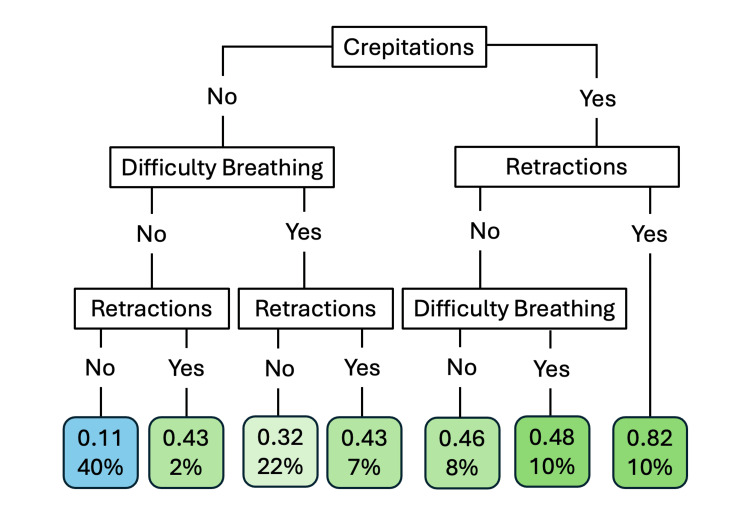
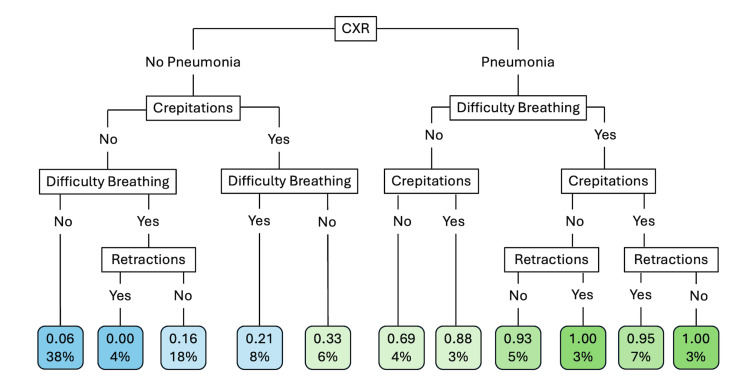
Results: Of 386 patients enrolled, 125 patients (32.4%) had pneumonia on lung ultrasound. The mean age was 20.8 (SD 15.5) months. Using recursive feature selection, three variables provided the best prediction for pneumonia, namely, crepitations, retractions, and difficulty breathing, demonstrating a sensitivity of 74.2% and specificity of 38.5%. The algorithm including chest X-ray provided a sensitivity of 51.6% and specificity of 87.7%.
Conclusions: Using lung ultrasound as the gold standard, no single clinical finding or combination of clinical findings provided enough accuracy to reliably diagnose pneumonia in children under five years.
Keywords: developing countries; diagnosis; lung ultrasound; pediatrics; pneumonia.
Copyright © 2025, House et al.
Conflict of interest statement
Human subjects: Consent for treatment and open access publication was obtained or waived by all participants in this study. Patan Institutional Review Committee issued approval drs1805271178. The study was performed as part of our registered study with clinicaltrials.gov, registration number NCT03630380. Animal subjects: All authors have confirmed that this study did not involve animal subjects or tissue. Conflicts of interest: In compliance with the ICMJE uniform disclosure form, all authors declare the following: Payment/services info: All authors have declared that no financial support was received from any organization for the submitted work. Financial relationships: Darlene R. House declare(s) personal fees from Caption Health. She provided consultations for lung ultrasound AI development. Other relationships: All authors have declared that there are no other relationships or activities that could appear to have influenced the submitted work.
Figures
References
-
- World Health Organization. Children: improving survival and well-being. 2020. http://www.who.int/mediacentre/factsheets/fs178/en/ http://www.who.int/mediacentre/factsheets/fs178/en/
-
- Antibiotic therapy and 48-hour mortality for patients with pneumonia. Mortensen EM, Restrepo MI, Anzueto A, Pugh JA. Am J Med. 2006;119:859–864. - PubMed
-
- Factors associated with diagnosis of bacterial pneumonia in children of Northern Thailand. Muangchana C. https://wwww.ncbi.nlm.nih.gov/pubmed/19842444. Southeast Asian J Trop Med Public Health. 2009;40:563–569. - PubMed
-
- Lack of predictive value of tachypnea in the diagnosis of pneumonia in children. Shah S, Bachur R, Kim D, Neuman MI. Pediatr Infect Dis J. 2010;29:406–409. - PubMed
LinkOut - more resources
Full Text Sources