Effect of Probiotic Supplementation on Body Fat, Skeletal Muscle Mass, and Body Mass Index in Individuals ≥45 Years Old: A Systematic Review
- PMID: 40294995
- PMCID: PMC12041995
- DOI: 10.21873/invivo.13927
Effect of Probiotic Supplementation on Body Fat, Skeletal Muscle Mass, and Body Mass Index in Individuals ≥45 Years Old: A Systematic Review
Abstract
Background/aim: Probiotics are living microorganisms that confer health benefits when administered in adequate amounts. Several studies have shown the positive effects on body fat, muscle mass, and body mass index (BMI) in young adults and athletes; however, the results in adults aged ≥45 years are not conclusive.
Materials and methods: A systematic review was conducted in accordance with the PRISMA guidelines, analyzing studies up to December 10, 2024, from nine databases (PubMed, Scopus, Web of Science, LILACS, SciELO, Springer, Redalyc, Cochrane Library and TESIUNAM). Mean differences (MD) were estimated using RevMan V 5.4.1. software.
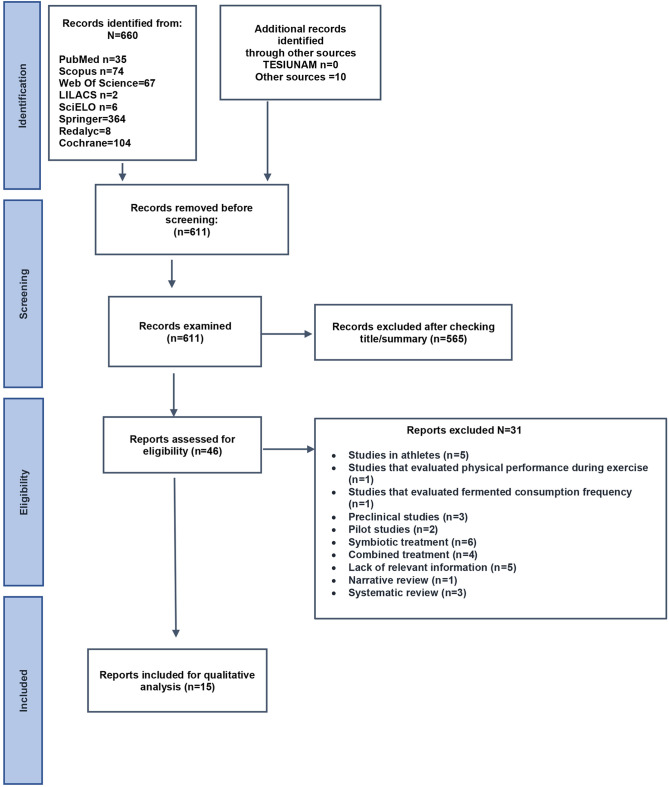
Results: Six hundred and sixty-six studies were identified, of which 15 met the eligibility criteria. A statistically significant decrease in fat mass (%) was found in two studies and in fat mass (kg) in another two studies. Likewise, one study reported a statistically significant increase in skeletal muscle mass.
Conclusion: Probiotic supplementation may have a beneficial effect on reducing body fat mass and increasing or preventing skeletal muscle mass loss in adults ≥45 years old; however, further clinical trials are needed to determine the optimal types, doses, and duration of probiotic treatment for best results.
Keywords: Probiotics; aging; body fat; body mass index; muscle mass; review.
Copyright © 2025, International Institute of Anticancer Research (Dr. George J. Delinasios), All rights reserved.
Conflict of interest statement
The Authors declare that there are no conflicts of interest regarding this study. The funders had no role in study design, data collection and analysis, publication decision, or manuscript preparation.
Figures
References
-
- Beas-Jiménez JD, López-Lluch G, Sánchez-Martínez I, Muro-Jiménez A, Rodríguez-Bies E, Navas P. Sarcopenia: implications of physical exercise in its pathophysiology, prevention and treatment. Rev Andal Med Deporte. 2011;4:158–166.
-
- Cruz-Jentoft AJ, Bahat G, Bauer J, Boirie Y, Bruyère O, Cederholm T, Cooper C, Landi F, Rolland Y, Sayer AA, Schneider SM, Sieber CC, Topinkova E, Vandewoude M, Visser M, Zamboni M, Writing Group for the European Working Group on Sarcopenia in Older People 2 (EWGSOP2), and the Extended Group for EWGSOP2 Sarcopenia: revised European consensus on definition and diagnosis. Age Ageing. 2019;48(1):16–31. doi: 10.1093/ageing/afy169. - DOI - PMC - PubMed
Publication types
MeSH terms
LinkOut - more resources
Full Text Sources
Medical
Miscellaneous