In Vivo Antitumor Activity of Allicin in a Pediatric Neuroblastoma Patient-derived Xenograft (PDX) Mouse Model
- PMID: 40295032
- PMCID: PMC12041990
- DOI: 10.21873/invivo.13932
In Vivo Antitumor Activity of Allicin in a Pediatric Neuroblastoma Patient-derived Xenograft (PDX) Mouse Model
Abstract
Background/aim: Allicin is a small-molecule natural product found in garlic (Allium sativum). We previously showed that allicin inhibits ornithine decarboxylase (ODC) in vitro and induces apoptotic cell death in pediatric neuroblastoma (NB) cancer cell cultures. However, its potency as an anticancer agent in vivo has not been sufficiently explored.
Materials and methods: In this study, we used cell proliferation assays, immunoblotting techniques, and light microscopy to study NB tumor cell cultures and human primary neonatal skin fibroblast control cells as well as a MYCN-amplified NB patient-derived xenograft (PDX) mouse tumor model to study the efficacy of allicin in vivo.
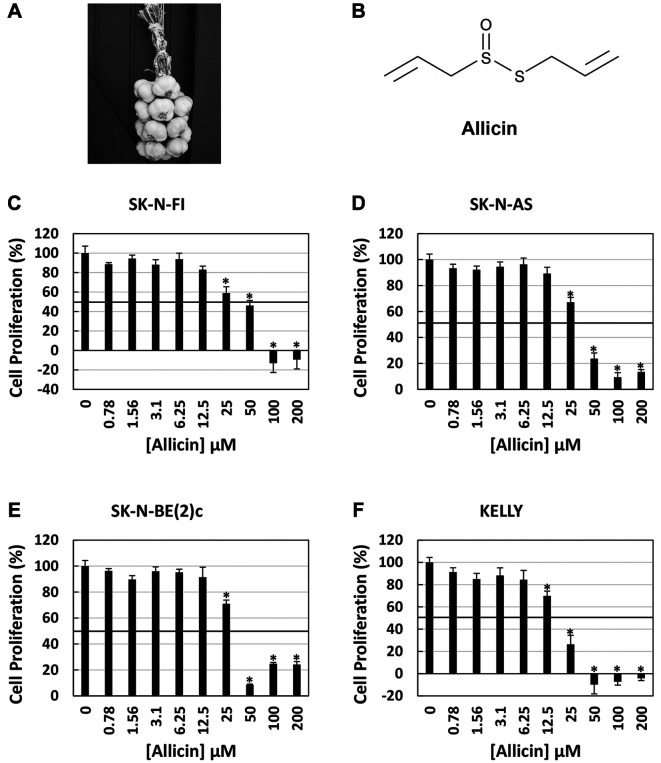
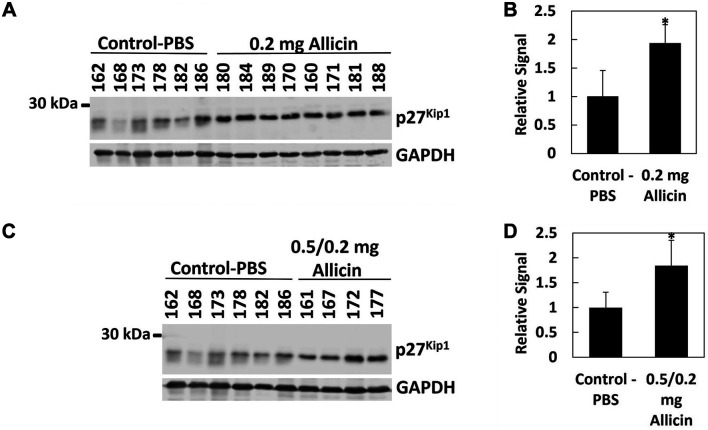
Results: Allicin strongly inhibits NB tumor cell proliferation in a dose-dependent manner while non-cancerous human primary neonatal skin fibroblast control cells were largely unaffected. Importantly, two intra-tumoral injections of allicin over a two-week trial period significantly reduced the NB tumor burden in mice compared to controls (N=4-9 mice/group). Excised tumor tissues revealed that allicin treatment increased the cyclin-dependent kinase inhibitor p27Kip1 protein levels, suggesting that in vivo, allicin increases p27Kip1-mediated G1/S cell cycle arrest.
Conclusion: Our findings warrant further preclinical development of allicin as a potential anticancer agent, especially for those types of cancers that are treatable by intra-tumoral injections, including neuroblastoma, glioblastoma, and medulloblastoma.
Keywords: Allicin; childhood cancer; in vivo antitumor activity; intra-tumoral injection; natural products; neuroblastoma; patient-derived xenograft (PDX).
Copyright © 2025, International Institute of Anticancer Research (Dr. George J. Delinasios), All rights reserved.
Conflict of interest statement
The Authors report no conflicts of interest in relation to this study.
Figures


References
-
- Mengers HG, Schier C, Zimmermann M, Gruhlke MCH, Block E, Blank LM, Slusarenko AJ. Seeing the smell of garlic: Detection of gas phase volatiles from crushed garlic (Allium sativum), onion (Allium cepa), ramsons (Allium ursinum) and human garlic breath using SESI-Orbitrap MS. Food Chem. 2022;397:133804. doi: 10.1016/j.foodchem.2022.133804. - DOI - PubMed
MeSH terms
Substances
LinkOut - more resources
Full Text Sources
Medical
Research Materials
Miscellaneous