


Patients with periprosthetic femoral fractures are older adults who are commonly diagnosed with osteoporosis
- PMID: 40295337
- PMCID: PMC12122641
- DOI: 10.1007/s00198-025-07486-1
Patients with periprosthetic femoral fractures are older adults who are commonly diagnosed with osteoporosis
Abstract
This study focused on individuals aged ≥ 50 years with periprosthetic femoral fractures (PFF). When compared to those with native hip fractures, patients with PFF were older, had a higher BMI, and demonstrated a greater number of comorbidities. Given the high frequency of osteoporosis risk factors and the BMD results, PFF should be classified as osteoporotic fractures.
Introduction: To compare patients presenting with periprosthetic femoral fractures (PFF) to patients with native hip fractures with a special focus on bone mineral density (BMD) measurements, in order to reinforce the hypothesis that PFF are osteoporotic fractures.
Methods: A retrospective, single-centre, observational study of all patients aged ≥ 50 years with low-energy PFF identified at the Lille University Hospital from January 1, 2016, to December 31, 2022, was conducted. The PFF group was compared to a group of patients with native hip fractures hospitalized during the same period. To compare the T-score data, we used a linear mixed model that considered a predefined adjustment for age, sex, and BMI. Adjusted means ± standard error of the mean (SEM) are derived from the mixed model.
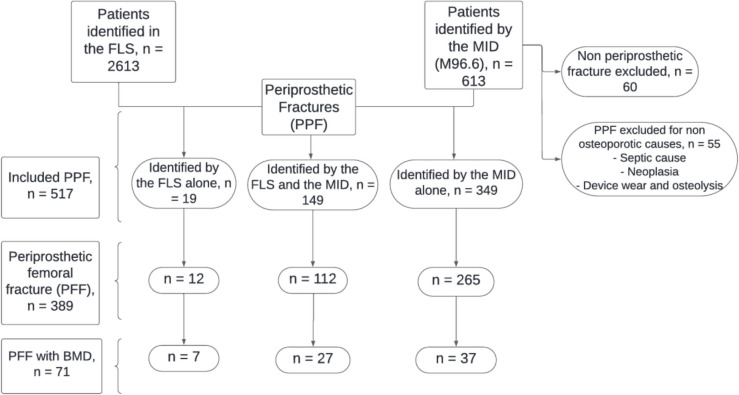
Results: Among 71 patients with PFF (78.9% female, median (IQR) age 81 (72-88) years), osteoarthritis (57.8%) was the primary indication for hip surgery. Compared with the native hip fracture group (n = 117), patients in the PFF group were significantly older (p = 0.002), had a significantly greater BMI (p = 0.043), and had a higher history of multiple falls (54.3% vs. 26.1%, p < 0.001). A greater frequency of previous low-energy fractures (69.0% vs. 44.0%, p < 0.001) and an increased prescription of anti-osteoporosis medications (26.8% vs. 11.1%, p = 0.006) in patients with PFF were found. Adjusted T-scores differed between the two groups at the lumbar spine (mean adjusted ± SEM, - 0.5 ± 0.2 (PFF group) vs. - 1.2 ± 0.2 (comparator group), p = 0.008) but not at the femoral neck or at the total hip.
Conclusion: Low-energy PFF should be considered as an osteoporotic fracture and treated accordingly.
Keywords: Bone mineral density; Fracture liaison service; Osteoporosis; Periprosthetic femoral fractures; Periprosthetic fractures.
© 2025. The Author(s).
Conflict of interest statement
Declarations. Conflicts of interest: Julien Paccou has received honoraria from Amgen, MSD, Eli Lilly, Kyowa-Kirin, Theramex, and Pfizer. Cécile Philippoteaux received honoraria from Amgen, Galapagos, Kyowa-Kirin, AbbVie, and Eli Lilly. None of the remaining authors declares any conflict of interest.
Figures
References
-
- Binkley N, Nickel B, Anderson PA (2023) Periprosthetic fractures: an unrecognized osteoporosis crisis. Osteoporos Int 34(6):1055–64 - PubMed
-
- Whiting PS, Hare K, Krueger D, Borchardt G, Parvanta-Johnson K, Bernatz J, et al. Periprosthetic fractures are osteoporotic fractures: missed opportunities for osteoporosis diagnosis. Osteoporos Int J Establ Result Coop Eur Found Osteoporos Natl Osteoporos Found USA. 1 avr 2024; - PubMed
-
- Toogood PA, Vail TP (2015) Periprosthetic fractures: a common problem with a disproportionately high impact on healthcare resources. J Arthroplasty 30(10):1688–1691 - PubMed
Publication types
MeSH terms
LinkOut - more resources
Full Text Sources
Medical
