. 2025 Apr 28;11(1):68.
doi: 10.1038/s41522-025-00707-9.

Multi-omics approach identifies gut microbiota variations associated with depression

Affiliations

Multi-omics approach identifies gut microbiota variations associated with depression

Adrián Hernández-Cacho et al. NPJ Biofilms Microbiomes. .

Abstract

The gut microbiota plays a potential role in the pathophysiology of depression through the gut-brain axis. This cross-sectional study in 400 participants from the PREDIMED-Plus study investigates the interplay between gut microbiota and depression using a multi-omics approach. Depression was defined as antidepressant use or high Beck Depression Inventory-II scores. Gut microbiota was characterized by 16S rRNA sequencing, and faecal metabolites were analysed via liquid chromatography-tandem mass spectrometry. Participants with depression exhibited significant differences in gut microbial composition and metabolic profiles. Differentially abundant taxa included Acidaminococcus, Christensenellaceae R-7 group, and Megasphaera, among others. Metabolomic analysis revealed 15 significantly altered metabolites, primarily lipids, organic acids, and benzenoids, some of which correlated with gut microbial features. This study highlights the interplay between the gut microbiota and depression, paving the way for future research to determine whether gut microbiota influences depression pathophysiology or reflects changes associated with depression.


Conflict of interest statement

Competing interests: J.S.-S. reports serving on the board of and receiving grant support through his institution from the International Nut and Dried Fruit Council, serving on the board of the Instituto Danone Spain and the International Danone institute. None of the other authors declare competing interests.

Figures

Fig. 1
Fig. 1. Boxplots representing the differences in alpha diversity indices Chao1 (abundance), Shannon (diversity) and Inverse-Simpson (evenness) between depression groups.
Wilcoxon Sum Rank was used to test the differences between groups and p ≤ 0.05 was considered as significant. DG depression group, RG reference group.
Fig. 2
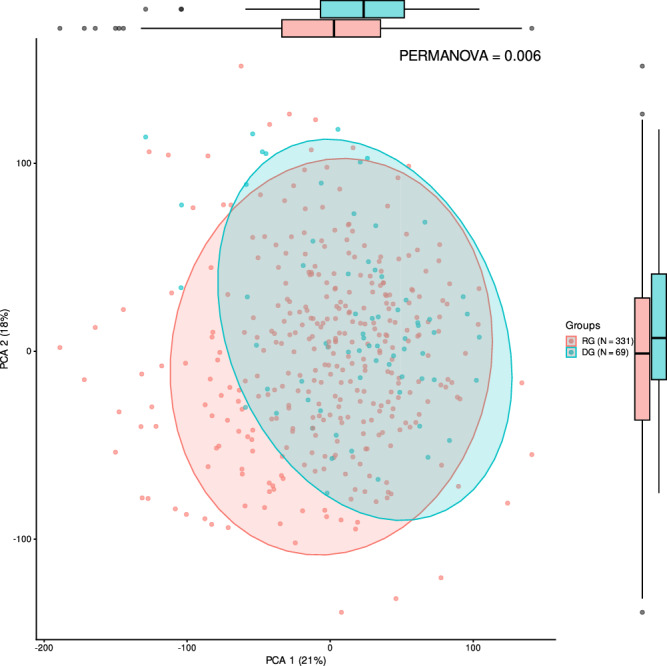
Fig. 2. Plot of principal components calculated over CLR-transformed taxonomic feature counts according to depression status.
DG depression group, PCA principal component analyses, RG reference group. The PERMANOVA model was adjusted by sex, age, BMI, smoking status, prevalence of diabetes and hypertension, education level, fibre consumption (g/day), alcohol consumption (g/day) and total physical activity (MET min/week).
Fig. 3
Fig. 3. The taxonomic tree showing the 8 genera associated with depression.
Letters with red background depict genera associated with reference group and letters with blue background depict genera associated with depression group. For significant taxa, the outermost layer depicts the phylum level followed by class, family and genus level.
Fig. 4
Fig. 4. Mean coefficients for the metabolites robustly associated with depression, according to the binomial elastic net regression for depression groups.
Values are means ± SDs for the sets of metabolites consistently selected 10 times after 10 iterations of the elastic net regression procedure with 10-fold cross-validation using the best set of alpha (0.6) and lambda (0.045) values that returned the best model accuracy across all cross-validated results employing the training data of the 400 participants. Metabolites with negative coefficients, associated with the reference group are plotted on the left, whereas those with positive coefficients, related to the depression group are plotted on the right. 20-Carboxy-LTB4 20-Carboxy-leukotriene B4, C16 Sphinganine 16-carbon Sphinganine, CE 20:4 20-carbon tetra-unsaturated cholesterol ester, TG 54:1 54-carbon monounsaturated triglyceride.
Fig. 5
Fig. 5. Volcano plot showing the associations between faecal metabolites and depression status groups.
A positive β-coefficient indicates association with the DG while a negative β-coefficient indicates that the metabolite is associated with the reference group. The model was adjusted by sex, age, BMI, smoking status, the prevalence of diabetes and hypertension, education level, fibre consumption (g/day), alcohol consumption (g/day) and total physical activity (MET min/week). An FDR ≤ 0.05 was deemed statistically significant (up dotted line). RG reference group, DG depression group, BMI body mass index, 20-Carboxy-LTB4 20-carboxy-leukotriene B4, C16 Sphinganine 16-carbon Sphinganine, CE 20:4 20-carbon tetra-unsaturated cholesterol ester.
Fig. 6
Fig. 6. Correlation matrix of the relative abundance of the significant taxa and the metabolite concentration of the significant metabolites.
Taxa abundance was stratified by depression groups. Left-side: Class and Family of each differentially abundant Genus. Right-side: CLR abundance of taxa per group represented with boxplots and significance between groups. Bottom-side: Group where the metabolite is more abundant. FDR false discovery rate, RG reference group, DG depression group, 20-Carboxy-LTB4 20-Carboxy-leukotriene B4, C16 Sphinganine 16-carbon Sphinganine, CE 20:4 20-carbon tetra-unsaturated cholesterol ester.

References

    1. Depressive Disorder (Depression)https://www.who.int/news-room/fact-sheets/detail/depression.
    1. Kunasegaran, T., Balasubramaniam, V. R. M. T., Arasoo, V. J. T., Palanisamy, U. D. & Ramadas, A. The modulation of gut microbiota composition in the pathophysiology of gestational diabetes mellitus: a systematic review. Biology (Basel)10, (2021). - PMC - PubMed
    1. Li, J. et al. Microbial and metabolic profiles unveil mutualistic microbe-microbe interaction in obesity-related colorectal cancer. Cell Rep. Med. 101429 10.1016/J.XCRM.2024.101429 (2024). - PMC - PubMed
    1. Garcia-Fernandez, H. et al. Sex-specific differences in intestinal microbiota associated with cardiovascular diseases. Biol. Sex Differ. 15, (2024). - PMC - PubMed
    1. Shimizu, K. et al. Dysbiosis of gut microbiota in patients with severe COVID-19. Acute Med. Surg. 11, (2024). - PMC - PubMed

Substances

LinkOut - more resources