


Lung function decline and incidence of chronic obstructive pulmonary disease in participants with spirometry-defined small airway dysfunction: a 15-year prospective cohort study in China
- PMID: 40296032
- PMCID: PMC12039187
- DOI: 10.1186/s12931-025-03244-3
Lung function decline and incidence of chronic obstructive pulmonary disease in participants with spirometry-defined small airway dysfunction: a 15-year prospective cohort study in China
Abstract
Background: Small airway dysfunction (SAD) is common but little is known about the longitudinal prognosis of spirometry-defined SAD. Therefore, we aimed to evaluate the risk of lung function decline and incident chronic obstructive pulmonary disease (COPD) of spirometry-defined SAD.
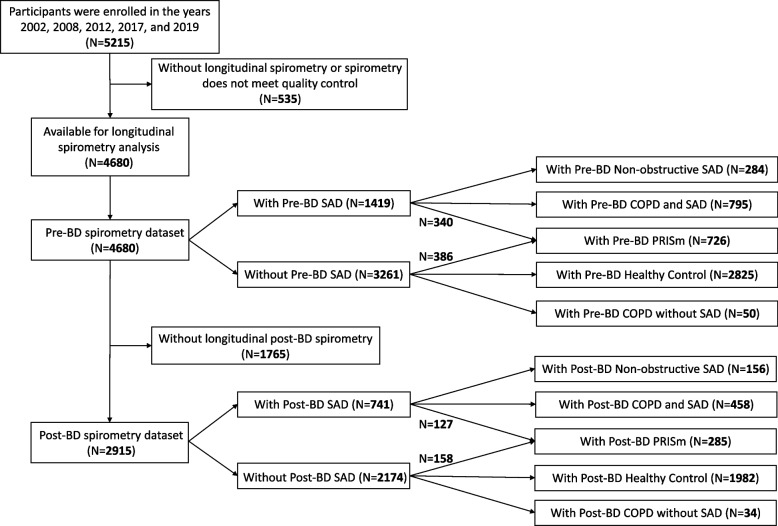
Methods: It was a population-based prospective cohort study conducted in Guangdong, China. Participants were enrolled in the years 2002, 2008, 2012, 2017, and 2019, and those who completed baseline demographic data, a standardized epidemiological questionnaire for COPD, and spirometry were included. Follow-up visits were conducted every three years after enrolment, with a maximum follow-up time of 15 years and a minimum follow-up time of 3 years. Spirometry-defined SAD was defined as having at least two out of three parameters (maximal mid-expiratory flow, forced expiratory flow 50%, and forced expiratory flow 75%) below 65% of the predicted value. Non-obstructive SAD and obstructive SAD were further differentiated based on the presence of airflow obstruction (forced expiratory volume in one second [FEV1]/forced vital capacity [FVC] < 0.70). Pre- and post-bronchodilator spirometry measurements were analyzed separately.
Results: Pre-bronchodilator spirometry dataset included 4680 participants (mean age 55.3 [10.8] years, 2194 [46.9%] males). Participants with pre-bronchodilator SAD had a significantly faster annual decline of FEV1 % of predicted value (0.31 ± 0.05 vs. 0.20 ± 0.03 %/year; difference: 0.12 [95% confidence interval: 0.01-0.23]; P = 0.023), FVC, and FVC % of predicted value compared to those without pre-bronchodilator SAD. The annual decline of lung function in participants with pre-bronchodilator non-obstructive SAD was not significantly different from that in pre-bronchodilator healthy controls, but they were more likely to progress to spirometry-defined COPD (adjusted hazard ratio: 2.92 [95% confidence interval: 2.28-3.76], P < 0.001). Post-bronchodilator spirometry dataset yielded similar results.
Conclusions: Individuals with spirometry-defined SAD have a faster decline in lung function compared to those without SAD, and non-obstructive SAD is more likely to progress to spirometry-defined COPD.
Trial registration: Chinese Clinical Trials Registration ChiCTR1900024643. Registered on 19 July 2019.
Keywords: Chronic obstructive pulmonary disease; Lung function decline; Small airway dysfunction; Spirometry.
© 2025. The Author(s).
Conflict of interest statement
Declarations. Ethics approval and consent to participate: All participants provided written informed consent, and the study was approved by the Ethics Committee of the First Affiliated Hospital of Guangzhou Medical University (2018–53). This study was conducted in accordance with the Declaration of Helsinki. Consent for publication: Not applicable. Competing interest: The authors declare no competing interests.
Figures
References
MeSH terms
Grants and funding
- SRPG22-016/the Foundation of Guangzhou National Laboratory
- SRPG22-016/the Foundation of Guangzhou National Laboratory
- SRPG22-016/the Foundation of Guangzhou National Laboratory
- SRPG22-018/the Foundation of Guangzhou National Laboratory
- SRPG22-016/the Foundation of Guangzhou National Laboratory
- SKLRD-L-202402/the Clinical and Epidemiological Research Project of State Key Laboratory of Respiratory Disease
- SKLRD-L-202402/the Clinical and Epidemiological Research Project of State Key Laboratory of Respiratory Disease
- SKLRD-L-202402/the Clinical and Epidemiological Research Project of State Key Laboratory of Respiratory Disease
- SKLRD-L-202402/the Clinical and Epidemiological Research Project of State Key Laboratory of Respiratory Disease
LinkOut - more resources
Full Text Sources
Medical
