


The benefits of early palliative care on psychological well-being, functional status, and health-related quality of life among cancer patients and their caregivers: a systematic review and meta-analysis
- PMID: 40296046
- PMCID: PMC12036283
- DOI: 10.1186/s12904-025-01737-y
The benefits of early palliative care on psychological well-being, functional status, and health-related quality of life among cancer patients and their caregivers: a systematic review and meta-analysis
Abstract
Background: Patients with cancer and their caregivers experience significant psychological, physical, and emotional burdens throughout the disease trajectory which reduces their quality of life (QoL). Early palliative care (EPC) has been proposed as a strategy to alleviate physical, psychological and emotional burdens and improve health outcomes. While evidence generally supports the benefits of EPC, variations in reported outcomes highlight the need for a deeper understanding of its impact across different patient populations and healthcare settings.
Objective: The primary aim of this study was to evaluate the pooled effects of EPC on psychological, functional status, and QoL outcomes in both cancer patients and their caregivers. The secondary aim was to evaluate the satisfaction of the patients and their family caregivers.
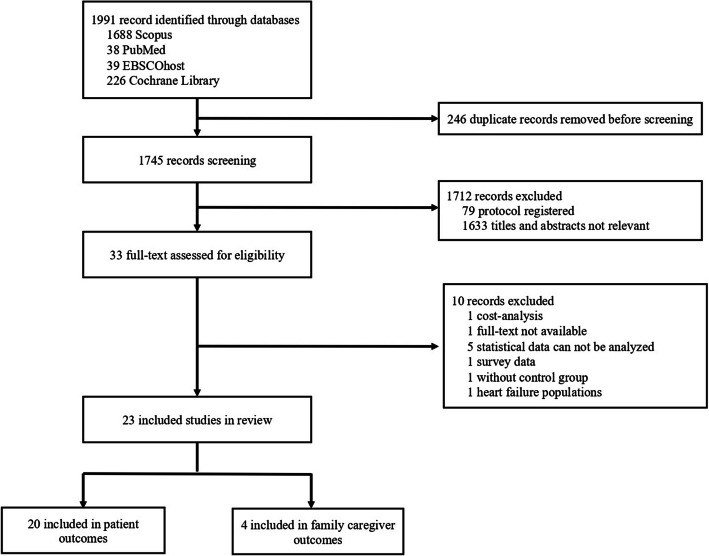
Methods: A systematic review and meta-analysis were conducted following the preferred reporting item for systematic review and meta-analysis (PRISMA) guidelines. Four databases, PubMed, Scopus, EBSCOhost, and Cochrane, were searched up to January 2024. This study included randomized controlled trial (RCT) and pilot-RCT studies reporting psychological outcomes (anxiety, depression), functional status, QoL, and satisfaction in cancer patients and their caregivers. Subgroup analysis was performed to explore the short-term (< 24 weeks) versus long-term (≥ 24 weeks) effects of EPC. Mean differences (MD) and standard mean differences (SMD) were calculated using a fixed-effects model according to the Mantel-Haenszel model and a random-effects model according to the DerSimonian and Laird method.
Results: A total of 24 studies met our inclusion criteria. For cancer patients, EPC significantly reduced anxiety (MD = -0.62, 95% CI: -1.02; -0.23, p = 0.002) and improved QoL (SMD 0.13, 95%CI: 0.06; 0.19, p = 0.0004). However, there was no significant reduction in depression (SMD -0.15, 95% CI: -0.36; 0.05, p = 0.14) and improvement in functional status (MD = 2.14, 95% CI: -0.78; 5.06, p = 0.15). Subgroup analysis revealed that long-term EPC significantly reduced anxiety and depression while improving QoL, but had no significant effects on functional status. For caregivers, EPC did not significantly impact either physical or mental QoL (Short form/SF-36 physical: MD = 0.81, 95% CI: -0.46; 2.09, p = 0.21; SF-36 Mental: MD = 0.53, 95% CI: -1.03; 2.08, p = 0.51). Moreover, satisfaction was more likely to be higher in patients and their caregivers who received EPC than in those who received usual care (MD 2.45, 95% CI: 0.90; 4.01, p = 0.002, MD 4.09, 95% CI: 0.60; 7.58, p = 0.02, respectively).
Conclusion: EPC reduces long term psychological burden and improve QoL and care satisfaction experience among patients with cancer. Therefore, EPC should be more broadly introduced into cancer care earlier to address patient's psychological burdens.
Keywords: Early palliative care; Family caregiver; Functional status; Psychological well-being; Quality of life.
© 2025. The Author(s).
Conflict of interest statement
Declarations. Ethics approval and consent to participate: Not applicable. Consent for publication: Not applicable. Competing interests: The authors declare no competing interests.
Figures
References
Publication types
MeSH terms
LinkOut - more resources
Full Text Sources
Medical
Miscellaneous
