This is a preprint.
To Tame a Songbird: The Genomics of the Domestication Syndrome in a Songbird Model Species
- PMID: 40297695
- PMCID: PMC12036474
- DOI: 10.21203/rs.3.rs-4921127/v1
To Tame a Songbird: The Genomics of the Domestication Syndrome in a Songbird Model Species
Update in
-
The genomics of the domestication syndrome in a songbird model species.Commun Biol. 2025 Jun 3;8(1):853. doi: 10.1038/s42003-025-08235-0. Commun Biol. 2025. PMID: 40461714 Free PMC article.
Abstract
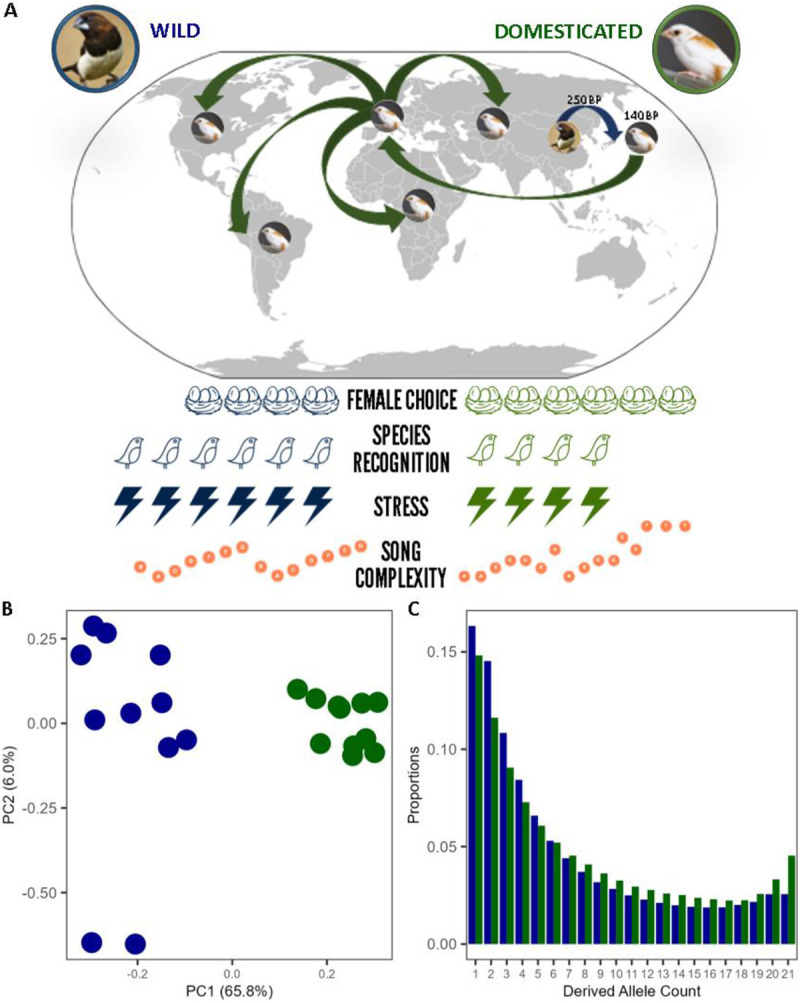
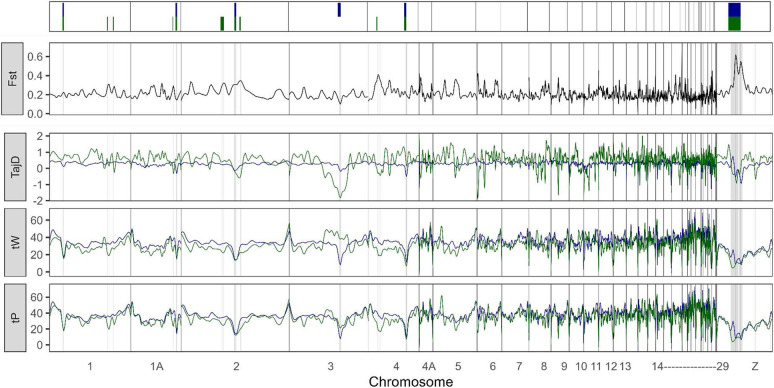
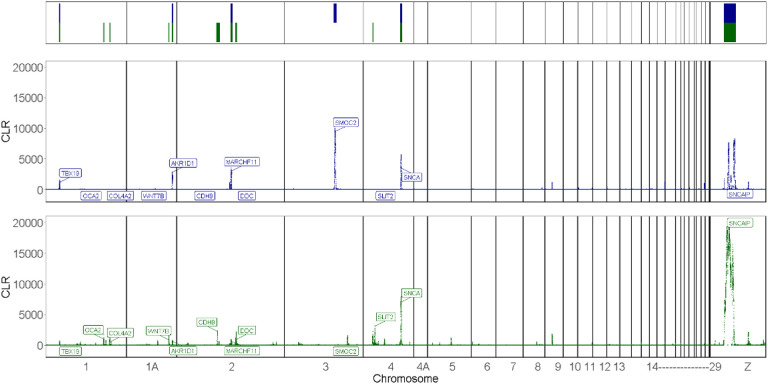
Many domesticated animals share a syndromic phenotype marked by a suite of traits that include more variable patterns of coloration, reduced stress, aggression, and altered risk-taking and exploratory behaviors relative to their wild counterparts. Roughly 150 years after Darwin's pioneering insight into this phenomenon, reasonable progress has been made in understanding the evolutionary and biological basis of the so-called domesticated phenotype in mammals. However, the extent to which these processes are paralleled in non-mammalian domesticates is scant. Here, we address this knowledge gap by investigating the genetic basis of the domesticated phenotype in the Bengalese finch, a songbird frequently found in pet shops and a popular animal model in the study of learned vocal behaviors. Using whole-genome sequencing and population genomic approaches, we identify strain-specific selection signals in the BF and its wild munia ancestor. Our findings suggest that, like in mammals, the evolution of the domestication syndrome in avian species involves a shift in the selective regime, capable of altering brain circuits favoring the dynamic modulation of motivation and reward sensitivity over overall augmented aggression and stress responses.
Figures
References
-
- Nimmo D.G., et al., Animal movements in fire - prone landscapes. Biological Reviews, 2019. 94(3): p. 981–998. - PubMed
-
- Price E.O., Behavioral development in animals undergoing domestication. Applied Animal Behaviour Science, 1999. 65(3): p. 245–271.
-
- Svanberg I., Towards a cultural history of the Bengalese Finch (Lonchura domestica). Der Zoologische Garten, 2008. 77(5-6): p. 334–344.
-
- Okanoya K., The Bengalese finch: a window on the behavioral neurobiology of birdsong syntax. Ann N Y Acad Sci, 2004. 1016: p. 724–35. - PubMed
Publication types
Grants and funding
LinkOut - more resources
Full Text Sources
Miscellaneous