


Nucleus Accumbens Proteome Disbalance in an Adolescent Mouse Model of Schizophrenia and Nicotine Misuse Comorbidity
- PMID: 40299488
- PMCID: PMC12025060
- DOI: 10.3390/biomedicines13040901
Nucleus Accumbens Proteome Disbalance in an Adolescent Mouse Model of Schizophrenia and Nicotine Misuse Comorbidity
Abstract
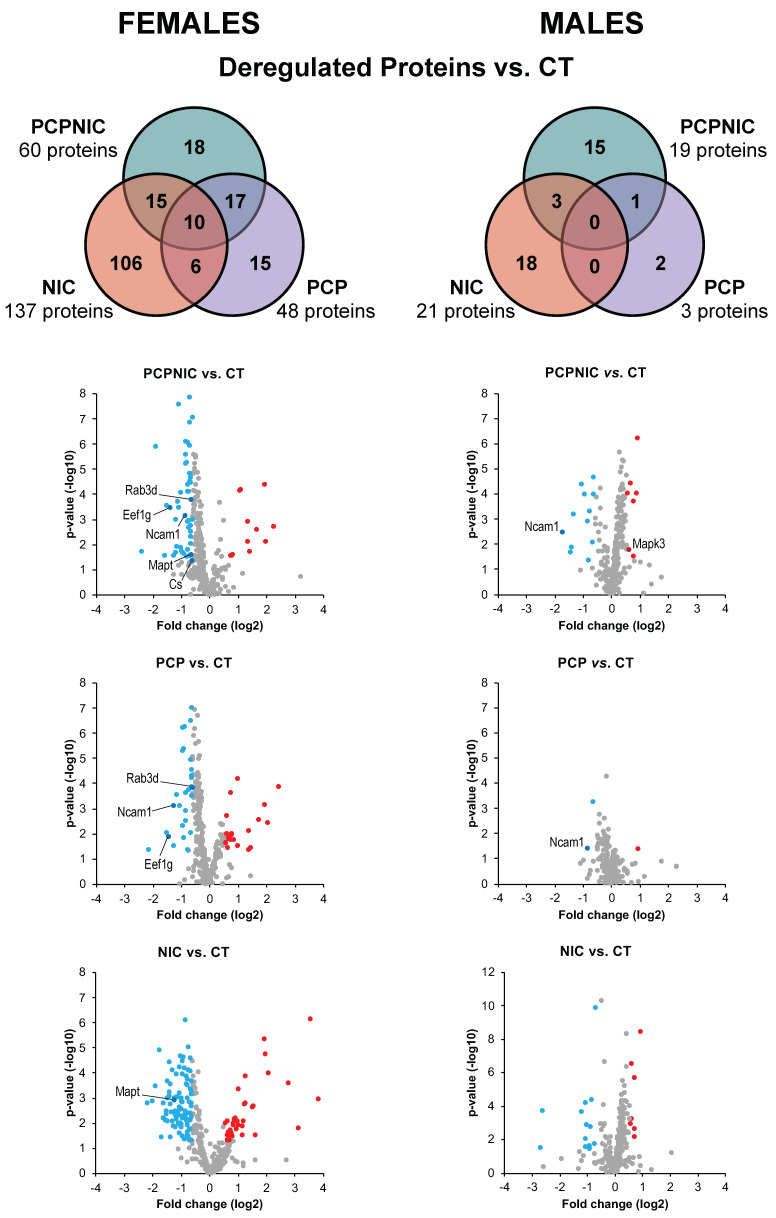
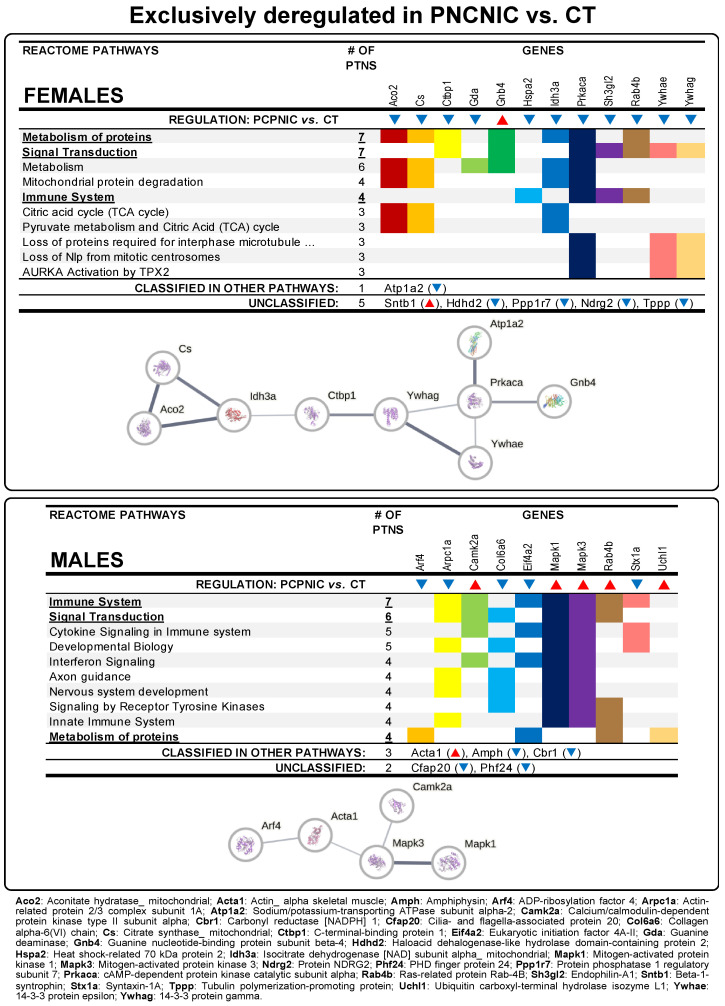
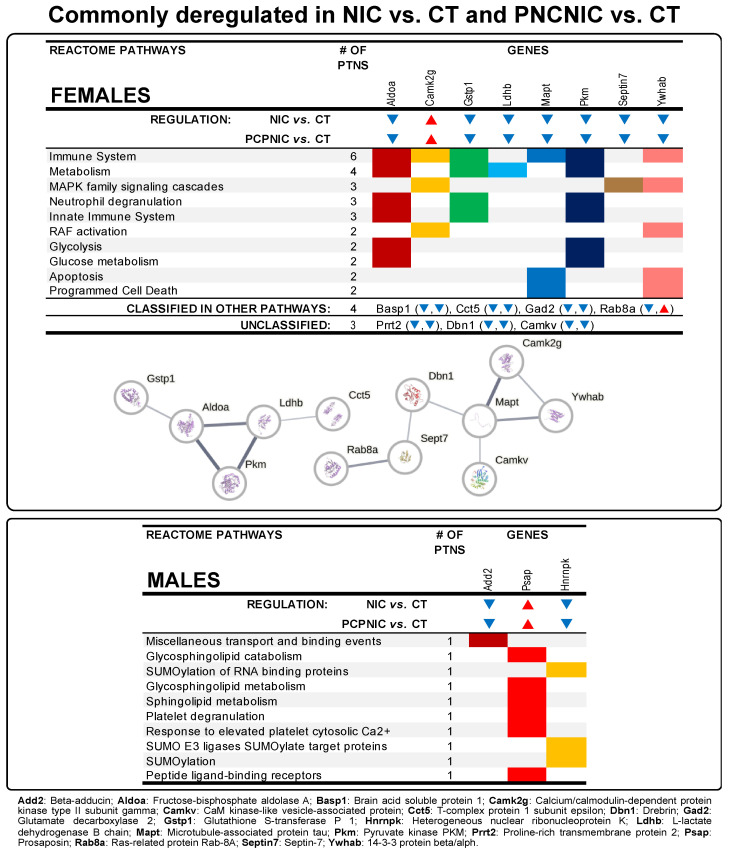
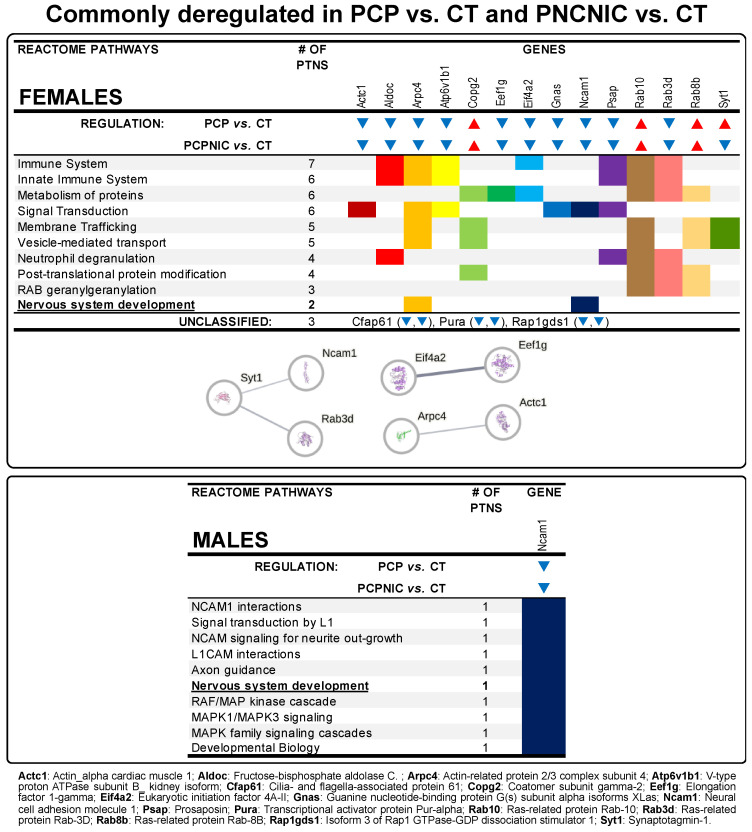
Background/Objectives: Schizophrenia and nicotine misuse are a comorbid condition that frequently develops during adolescence. Considering the role of the nucleus accumbens (NAcc) as a common neurobiological substrate for these psychiatric disorders, label-free proteomics was employed to identify NAcc deregulated proteins in male and female mouse models of schizophrenia with a history of adolescent nicotine exposure. Methods: Phencyclidine was used to model schizophrenia, and minipump infusions were used to model nicotine misuse. Results: Enrichment Reactome pathway and protein-protein interaction analyses showed that the cytoskeleton and associated synaptic plasticity mechanisms, energy metabolism, and nervous system development were affected in both sexes. In particular, Ncam1 (Neural cell adhesion molecule 1) could be of interest as a candidate marker of synaptic plasticity disbalance. Its deregulation in the NAcc of both sexes suggests that it lies at the core of the comorbidity pathophysiology. When considering sex-selective effects, Cs (Citrate synthase) and Mapk3 (Mitogen-activated protein kinase 3) were identified as exclusively deregulated in female and male mice, respectively. Since both proteins were previously shown to be exclusively deregulated in the medial prefrontal cortex of co-modeled mice, a common mesocortical and mesolimbic system effect can be inferred, supporting the role of aberrant energy metabolism and synaptic plasticity in the comorbidity model. Conclusions: The current data provide insights into the NAcc proteome disbalance in an adolescent preclinical model of combined schizophrenia and nicotine misuse, pointing to relevant pathways and early markers of the comorbidity.
Keywords: E-cigarette; co-exposure; mass spectrometry; mental disorder; mesolimbic system; nicotine addiction; prodrome; proteome.
Conflict of interest statement
The authors declare no conflicts of interest. The funders had no role in the design of the study; in the collection, analyses, or interpretation of data; in the writing of the manuscript; or in the decision to publish the results.
Figures
References
Grants and funding
- 001/Coordenação de Aperfeicoamento de Pessoal de Nível Superior
- 304368/2020-2/National Council for Scientific and Technological Development
- 308194/2023-3/National Council for Scientific and Technological Development
- SEI-260003/001135/2020/Fundação Carlos Chagas Filho de Amparo à Pesquisa do Estado do Rio de Janeiro
- E-26/200.957/2021/Fundação Carlos Chagas Filho de Amparo à Pesquisa do Estado do Rio de Janeiro
LinkOut - more resources
Full Text Sources
Research Materials
Miscellaneous
