ARBOALVO: A Bayesian spatiotemporal learning and predictive model for dengue cases in the endemic Northeast city of Natal, Rio Grande do Norte, Brazil
- PMID: 40300034
- PMCID: PMC12101852
- DOI: 10.1371/journal.pntd.0012984
ARBOALVO: A Bayesian spatiotemporal learning and predictive model for dengue cases in the endemic Northeast city of Natal, Rio Grande do Norte, Brazil
Abstract
Background: Urban arbovirus transmission is spatially and temporally heterogeneous. Estimating the risk of dengue through statistical models that consider simultaneous variability in space and time provides more realistic estimates of transmission dynamics, facilitating the identification of priority areas for intervention focused on surveillance and control. These models also enable predictions to support timely interventions for arboviruses like dengue, chikungunya, and Zika.
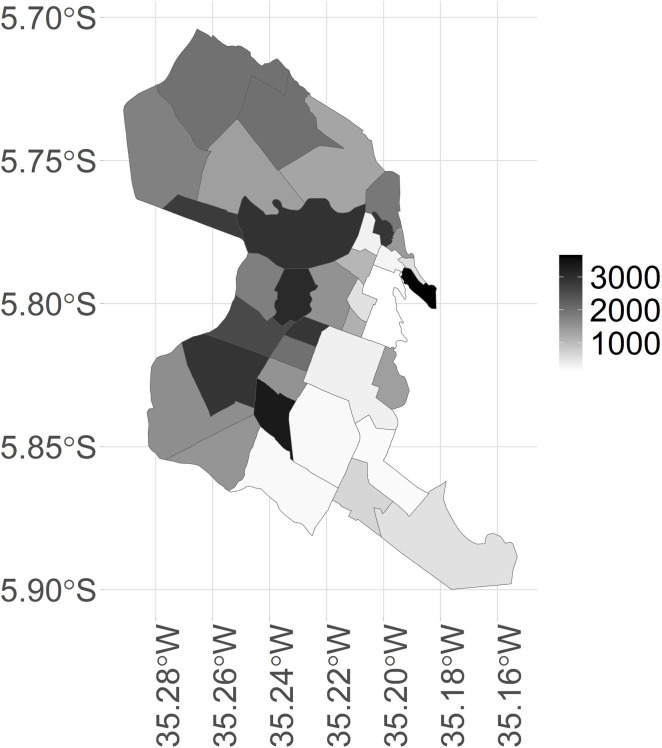
Methodology/principal findings: We analyzed dengue case reports by epidemiological week and neighborhood in Natal, RN from 2015 to 2018. Temporal conditional autoregressive models were fitted using the Integrated Nested Laplace Approximation method. The predictors included a set of entomological, climatic and sociosanitary indicators with temporal lags, along with structures of temporal and spatial dependence. Additionally, we used an offset term to represent the expected number of dengue cases per neighborhood at each epidemiological week, under the hypothesis of homogeneity in the occurrence of cases across the municipality. We forecasted dengue case counts for the subsequent four weeks, addressing both zero occurrences and fluctuations during non-zero periods. Weekly risk dynamics were visualized through predictive maps, enabling the timely identification of neighborhoods with high and persistent dengue risk, that is, areas consistently exhibiting a high number of dengue cases that remained concentrated in the same location for several weeks. The optimal model revealed a significant rise in dengue occurrence probability during the observation week, associated with increased cases in the previous week, the Aedes egg positivity index from the prior four weeks, and the mean daytime temperature 6-8 weeks earlier. Dengue risk also rose with a one-standard-deviation increase in the density of the impoverished population per occupied area and the mean Aedes egg density index from the preceding 3-5 weeks.
Conclusions/significance: The proposed Bayesian space-time analysis can contribute to the operational control of dengue and Aedes aegypti by identifying priority areas and forecasting dengue cases for the next four weeks. It also quantifies the effects of entomological, sociosanitary, climatic and demographic indicators on both the likelihood of dengue occurrence and the intensity of outbreaks.
Copyright: © 2025 Alves et al. This is an open access article distributed under the terms of the Creative Commons Attribution License, which permits unrestricted use, distribution, and reproduction in any medium, provided the original author and source are credited.
Conflict of interest statement
The authors have declared that no competing interests exist.
Figures




References
-
- Consoli R, Lourenço-de-Oliveira R. Principais mosquitos de importância sanitária no Brasil Rio de Janeiro. Fiocruz; 1994. p. 225.
MeSH terms
LinkOut - more resources
Full Text Sources
Medical