


Nasopharyngeal necrosis following intensity-modulated radiation therapy of primary nasopharyngeal carcinoma-incidence rate and predictors of risk
- PMID: 40301785
- PMCID: PMC12042485
- DOI: 10.1186/s12885-025-14086-z
Nasopharyngeal necrosis following intensity-modulated radiation therapy of primary nasopharyngeal carcinoma-incidence rate and predictors of risk
Abstract
Objectives: This study aimed to investigate the incidence of post radiation nasopharyngeal necrosis (PRNN) in primary NPC after intensity modulated radiation therapy (IMRT) and identify the predictors of risk.
Methods: Data of 5798 NPC patients who received IMRT-based treatment between April 2009 and December 2015 were retrospectively reviewed. PRNN was diagnosed by MRI or nasopharyngoscopy. Dosimetric factors were selected by the least absolute shrinkage and selection operator logistic regression and applied to Cox proportional hazards modeling with clinical predictors.
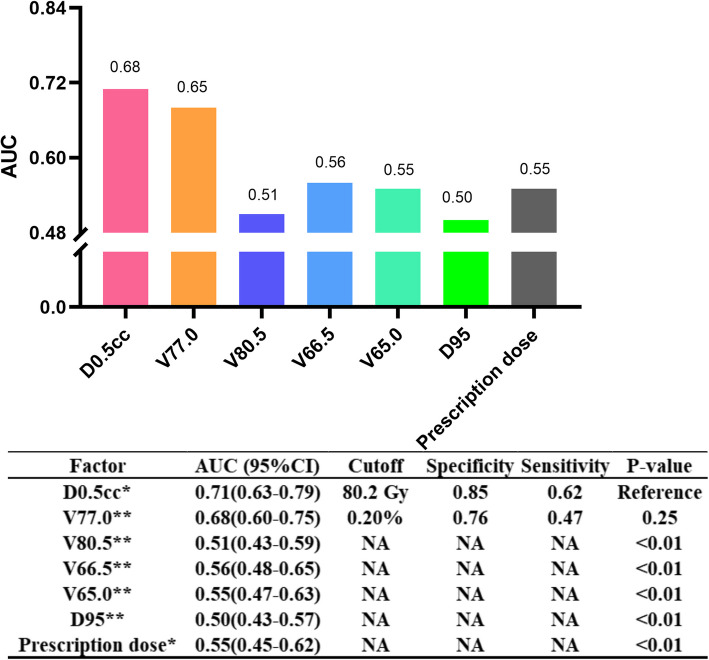
Results: Among the 5798 patients, 53 developed PRNN-an incidence rate of 0.89%. Age > 55 years, diabetes, LDH > 170 U/L, and tumor volume of nasopharynx > 60.5 cm3,were independently associated with risk of PRNN(all p < 0.05. Dosimetric analysis showed that D0.5ccEQD2 of 80.20 Gy might be the dose constraint for nasopharynx (sensitivity = 62.3%, 33 out of 53; specificity = 84.2%, 4897 out of 5925). Besides, the RTOG dose constraints of V110% (V77.0) should be less than 0.2% in case of increasing risk of PRNN(HR = 2.28, 95% CI: 1.26-4.41, p = 0. 01).
Conclusion: Nasopharyngeal necrosis is rare after primary IMRT. The independent risk factors for this rare complication include age > 55 years, diabetes mellitus, LDH > 170 U/L, tumor volume of nasopharynx > 60.5 cm3, D0.5ccEQD2 > 80.20 Gy, and V77.0 < 0.2% to the planning treatment volume of nasopharynx.
Keypoints: High radiation dose may lead to devastating nasopharyngeal necrosis after primary IMRT. Real world analysis will provide valuable information for prevention.
Findings: The aged, diabetes mellitus, large tumor volume, D0.5ccEQD2 > 80.20 Gy and V77.0 < 0.2% to planning treatment volume increased the risk of nasopharyngeal necrosis.
Clinical relevance: This real-world study provided valuable information for prevention of PRNN. Compared with RTOG protocol, D0.5ccEQD2 > 80.20 Gy is a reliable evidence-based new complement to dose constraint, especially for T3-4 disease, who received high prescribe dose in China.
Keywords: Dose constraint; Intensity modulated radiation therapy; Least absolute shrinkage and selection operator logistic regression; Nasopharyngeal carcinoma; Nasopharyngeal necrosis.
© 2025. The Author(s).
Conflict of interest statement
Declarations. Consent for publication: This retrospective study was approved by the Institutional Review Board of Sun Yat-sen University Cancer Center and The First Affiliated Hospital of Sun Yat-sen University in accordance with the Declaration of Helsinki, and the requirement for informed consent was waive. Competing interests: The authors declare no competing interests.
Figures




References
-
- Chen YP, Ismaila N, Chua MLK, Colevas AD, Haddad R, Huang SH, Wee JTS, WhitleyAC, Yi JL, Yom SS et al. Chemotherapy in Combination With Radiotherapy for Definitive-Intent Treatment of Stage IIIVA Nasopharyngeal Carcinoma: CSCO and ASCO Guideline. J Clin Oncol. 2021;39(7):840-859 - PubMed
-
- Hsiung CY, Yorke ED, Chui CS, Hunt MA, Ling CC, Huang EY, Wang CJ, Chen HC, Yeh SA, Hsu HC, et al. Intensity-modulated radiotherapy versus conventional three-dimensional conformal radiotherapy for boost or salvage treatment of nasopharyngeal carcinoma. Int J Radiat Oncol Biol Phys. 2002;53(3):638–47. - PubMed
-
- Hua YJ, Chen MY, Hong MH, Zhao C, Guo L, Han F, Luo W, Sun R, Chen YY, Liu H. Short-term efficacy of endoscopy-guided debridement on radiation-related nasopharyngeal necrosis in 20 nasopharyngeal carcinoma patients after radiotherapy. Ai zheng Aizheng Chin J Cancer. 2008;27(7):729–33. - PubMed
MeSH terms
Grants and funding
LinkOut - more resources
Full Text Sources
Miscellaneous
