


Association between triglyceride glucose-waist height ratio index and overactive bladder: based on NHANES 2005-2018
- PMID: 40303634
- PMCID: PMC12037367
- DOI: 10.3389/fendo.2025.1541218
Association between triglyceride glucose-waist height ratio index and overactive bladder: based on NHANES 2005-2018
Abstract
Background: The triglyceride glucose-waist height ratio (TyG-WHtR) index is a useful marker for predicting the risk of cardiovascular and metabolic diseases. Metabolic diseases are known to be high-risk factors for overactive bladder (OAB). However, no studies have explored the association between the TyG-WHtR index and the risk of developing OAB.
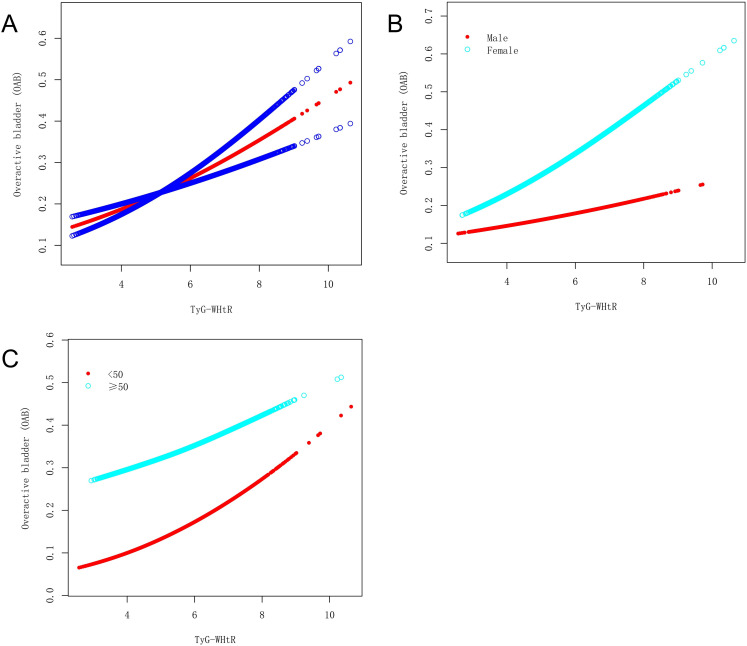
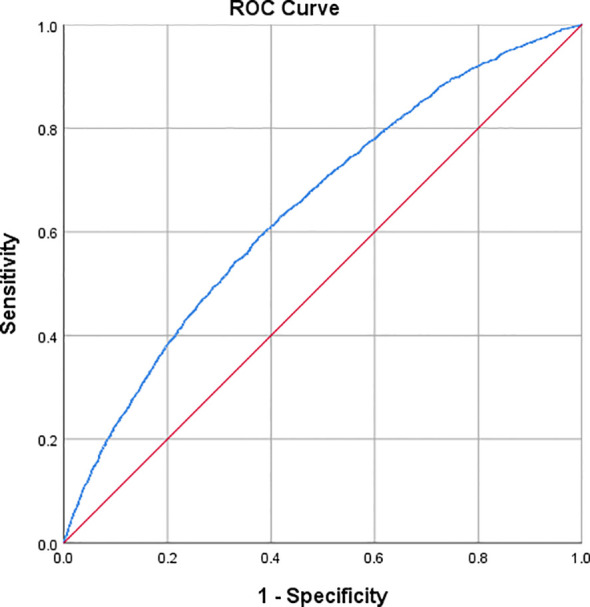
Methods: Data from the National Health and Nutrition Examination Survey (NHANES) was utilized, and a weighted multivariate logistic regression analysis was conducted to investigate the relationship between TyG-WHtR and OAB. Subgroup analyses and interaction tests were also performed. Additionally, sensitivity analyses were conducted to validate the robustness of the findings. A smooth curve fitting and threshold effect analysis explored the nonlinear relationship between TyG-WHtR and the risk of developing OAB. The predictive value of the TyG-WHtR index for OAB was assessed using Receiver Operating Characteristic (ROC) curves, and the area under the ROC curve (AUC) was calculated.
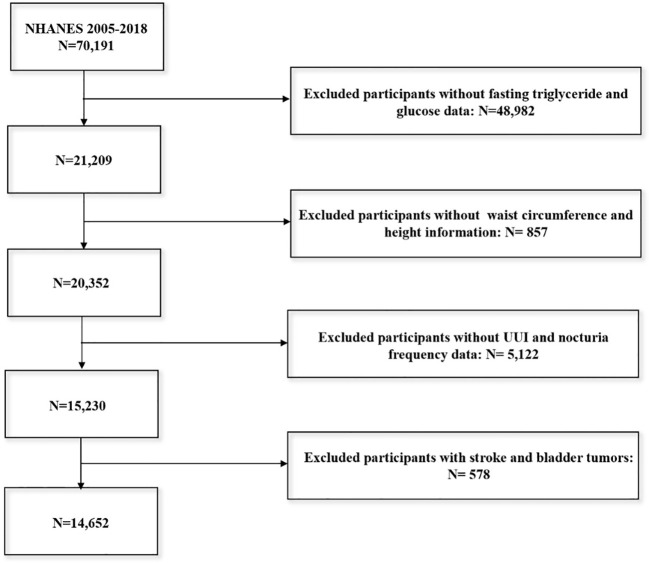
Results: A total of 14,652 adults aged 20 and above were included in this study. After weighting, the population size was estimated to be 197,598,146.7, among which 37,872,284.55 individuals were diagnosed with OAB. The median TyG-WHtR for the entire population was 4.98, while it was 5.44 for those with OAB. Weighted logistic regression analysis revealed a significant positive association between TyG-WHtR and the occurrence of OAB (OR=1.646; 95% CI: 1.562, 1.735; P<0.001). This positive association remained significant even after adjusting for confounding factors (OR=1.310; 95% CI: 1.157, 1.484; P<0.001). Sensitivity analysis demonstrated the robustness of the results. Subgroup and interaction analyses indicated that the impact of the TyG-WHtR index on OAB might be influenced by gender (OR=1.323; 95% CI: 1.138, 1.538; P<0.001) and age (OR=1.426; 95% CI: 1.180, 1.724; P<0.001). Smooth curve fitting and threshold effect analysis revealed a threshold of 3.579. ROC curve analysis demonstrated that the TyG-WHtR index has a good predictive ability for OAB (AUC=0.647; 95% CI: 0.636, 0.657).
Conclusions: The TyG-WHtR index is significantly positively associated with the occurrence of OAB and could potentially serve as a novel risk predictor for OAB. Future research is needed to validate findings, explore causality, and improve early detection through multifactorial models across diverse populations.
Keywords: NHANES; metabolic disease; overactive bladder; retrospective study; triglyceride glucose-waist height ratio.
Copyright © 2025 Mao, Lin, Huang, Xie and Chen.
Conflict of interest statement
The authors declare that the research was conducted in the absence of any commercial or financial relationships that could be construed as a potential conflict of interest.
Figures
References
-
- Haylen BT, de Ridder D, Freeman RM, Swift SE, Berghmans B, Lee J, et al. . An International Urogynecological Association (IUGA)/International Continence Society (ICS) joint report on the terminology for female pelvic floor dysfunction. Int Urogynecol J. (2010) 21:5–26. doi: 10.1007/s00192-009-0976-9 - DOI - PubMed
MeSH terms
Substances
LinkOut - more resources
Full Text Sources
Medical
