


Causal relationship between gut microbiota and laryngeal cancer: a mendelian randomization analysis
- PMID: 40305979
- PMCID: PMC12118545
- DOI: 10.1016/j.bjorl.2025.101634
Causal relationship between gut microbiota and laryngeal cancer: a mendelian randomization analysis
Abstract
Objective: Laryngeal cancer incidence is rising globally; the role of gut microbiota remains underexplored. This study aimed to establish a causal link between gut microbiota and laryngeal cancer to inform preventive and therapeutic strategies.
Methods: Gut microbiota data from GWAS conducted by the MiBioGen consortium served as the exposure variable, with laryngeal cancer as the outcome variable. the exposure variable and the outcome variable were analyzed using Mendelian Randomization. The primary method was Inverse Variance Weighted analysis, with heterogeneity and pleiotropy assessed through Cochran's Q test, MR-Egger regression, and MR-PRESSO.
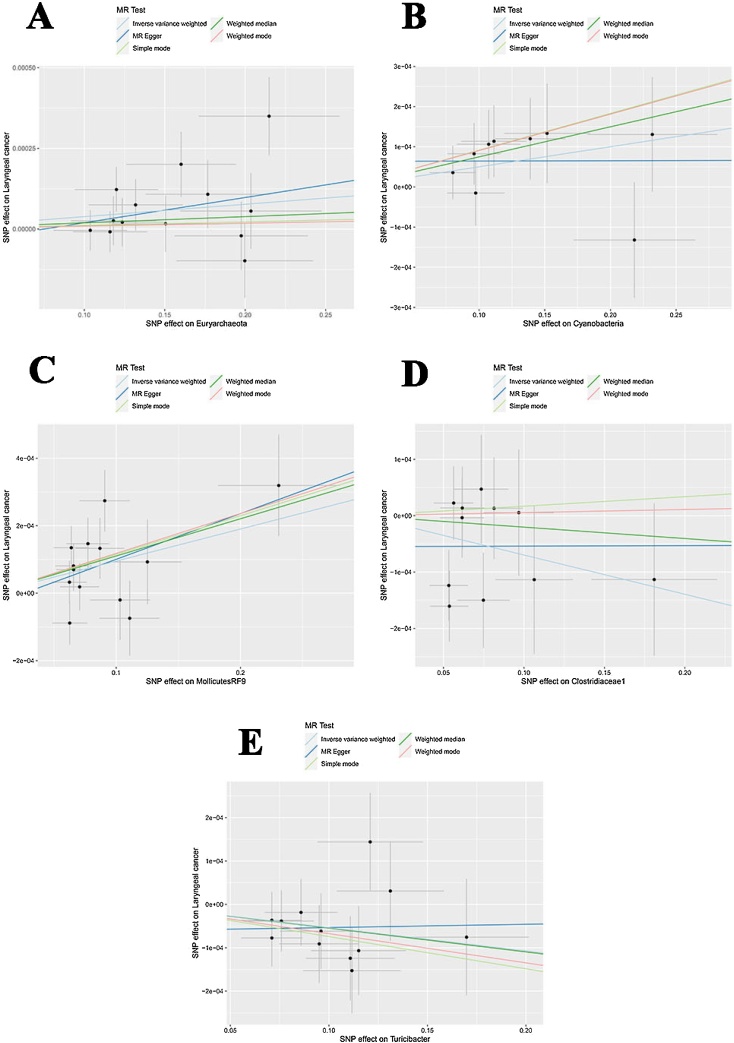
Results: In the study, we identified five bacterial taxa with potential causal relationships with laryngeal cancer risk: Higher levels of Clostridiaceae1 (OR = 0.9993, 95% CI 0.9986-0.9999, p = 0.0463) and Turicibacter (OR = 0.9995, 95% CI 0.9989-0.9999, p = 0.0384) were linked to reduced cancer risk, while Mollicutes RF9 (OR = 1.0010, 95% CI 1.0003-1.0016, p = 0.0027), Euryarchaeota (OR = 1.0004, 95% CI 1.0001-1.0007, p = 0.0234), and Cyanobacteria (OR = 1.0005, 95% CI 1.0000-1.0009, p = 0.0464) were associated with increased risk.
Conclusion: Our findings suggest a causal relationship between gut microbiota composition and laryngeal cancer risk. Clostridiaceae1 and Turicibacter may play a protective role, while Mollicutes RF9, Euryarchaeota, and Cyanobacteria could contribute to increased cancer susceptibility. These insights highlight potential microbiome-based strategies for early detection, prevention, and therapeutic intervention in laryngeal cancer.
Level of evidence: Level 5.
Keywords: GWAS; Gut microbiota; Laryngeal cancer; Mendelian randomization; The causal association.
Copyright © 2025 Associação Brasileira de Otorrinolaringologia e Cirurgia Cérvico-Facial. Published by Elsevier España S.L.U. All rights reserved.
Conflict of interest statement
Declaration of competing interest The authors declare no conflicts of interest.
Figures


References
-
- Siegel R.L., Miller K.D., Fuchs H.E., Jemal A. Cancer statistics, 2022. CA Cancer J Clin. 2022;72:7–33. - PubMed
-
- Liu J., Sun Q., Zhao J., et al. Early death in supraglottic laryngeal squamous cell carcinoma: a population-based study. Ear Nose Throat J. 2024;103:650–658. - PubMed
-
- Li Z., Wang Q., Huang X., Fu R., Wen X., Zhang L. Multi-omics analysis reveals that ferroptosis-related gene CISD2 is a prognostic biomarker of head and neck squamous cell carcinoma. J Gene Med. 2024;26 - PubMed
-
- Steuer C.E., El-Deiry M., Parks J.R., Higgins K.A., Saba N.F. An update on larynx cancer. CA Cancer J Clin. 2017;67:31–50. - PubMed
-
- Liu J., Zhang M., Sun Q., et al. Construction of a novel MPT-driven necrosis-related lncRNAs signature for prognosis prediction in laryngeal squamous cell carcinoma. Environ Sci Pollut Res Int. 2023;30:77210–77225. - PubMed
MeSH terms
LinkOut - more resources
Full Text Sources
Research Materials
