


DdRAD sequencing of the endangered species Primula Palinuri Petagna reveals high levels of inter-population diversity
- PMID: 40307346
- PMCID: PMC12044078
- DOI: 10.1038/s41598-025-98334-z
DdRAD sequencing of the endangered species Primula Palinuri Petagna reveals high levels of inter-population diversity
Abstract
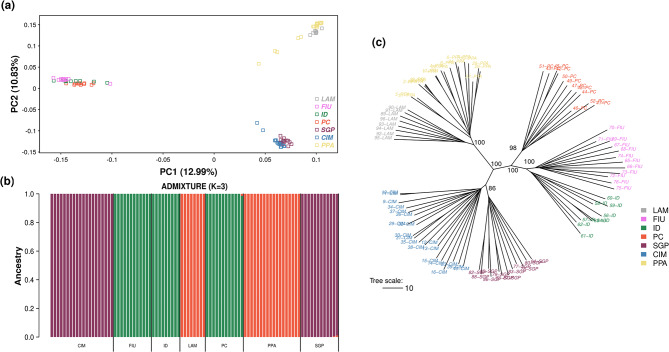
Population genetics studies provide information regarding genetic diversity and genetic structure of populations. This information can in turn be used to inform conservation strategies. In view of programmed conservation efforts, we aimed at investigating the genetic composition of Primula palinuri Petagna, an endemic vulnerable species in Southern Italy. Ninety-one individuals of P. palinuri from seven populations were investigated using double digest Restriction Associated DNA sequencing (ddRAD-seq) and a total of 99,014 Single nucleotide polymorphisms (SNPs) were identified. Low levels of heterozygosity (0.08-0.12) and high levels of kinship (0.20-0.30) and inbreeding (0.34-0.49) were detected in all study populations. Kinship computed irrespective of population was low, suggesting that the level of inter-population relatedness is low. Analysis of the genetic structure showed that the populations were differentiated from each other and formed three major clusters, broadly corresponding to the geographic sampling locations. We identified the SNPs mostly contributing to the separation in population clusters, and we identified a reduced set of 40 SNPs that can successfully discriminate between the three population clusters. In conclusion, our study shows that the sampled P. palinuri populations have low heterozygosity, low intra-population variability and high inter-population variability.
Keywords: Admixture; Endemic species; Genotyping; Population genetics; Population structure.
© 2025. The Author(s).
Conflict of interest statement
Declarations. Competing interests: The authors declare no competing interests.
Figures



References
-
- IUCN/SSC. Guidelines on the Use of Ex Situ Management for Species Conservation. Version 2.0. (2014). www.iucn.org/about/work/programmes/species/publications/iucn_guidelines_...
-
- Zimmer, H. C., Auld, T. D., Cuneo, P., Offord, C. A. & Commander, L. E. Conservation translocation - An increasingly viable option for managing threatened plant species. Aust J. Bot.67, 501–509 (2019). - DOI
-
- Van Rossum, F., Le Pajolec, S., Raspé, O. & Godé, C. Assessing population genetic status for designing plant translocations. Front. Conserv. Sci.3, (2022).
MeSH terms
Grants and funding
LinkOut - more resources
Full Text Sources
