


Heteronymous feedback from quadriceps onto soleus is influenced by limb loading and task context
- PMID: 40307384
- PMCID: PMC12043819
- DOI: 10.1038/s41598-025-98220-8
Heteronymous feedback from quadriceps onto soleus is influenced by limb loading and task context
Abstract
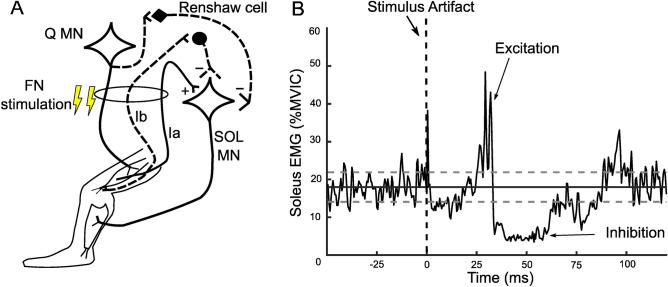
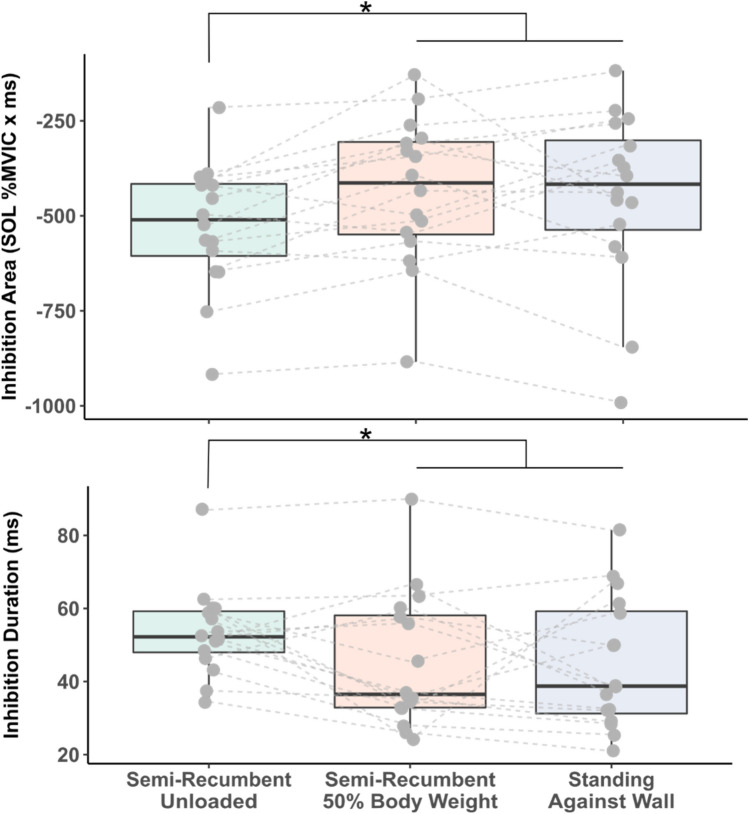
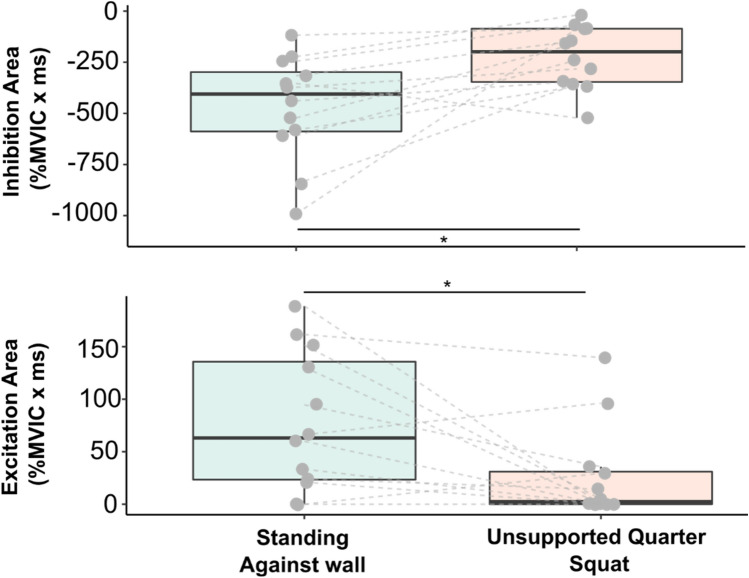
Heteronymous reflexes from quadriceps can increase and/or decrease soleus activity; yet few studies have examined factors influencing reflex strength. This study examined the independent influence of limb loading, posture, and task context on heteronymous feedback from quadriceps onto soleus. The influence of limb loading and posture was determined by comparing femoral nerve elicited heteronymous excitation and inhibition of soleus in a semi-recumbent position with and without 50% body weight limb loading and while standing with back support (n = 16). Task context was examined by comparing heteronymous reflex magnitudes while standing with back support to maintaining an unsupported squat posture which requires tonic soleus activity to maintain the posture (n = 12). Heteronymous inhibition decreased by 20% with limb loading in both semi-recumbent and standing postures, while excitation remained unchanged suggesting that limb loading, rather than postural orientation, independently modulates heteronymous inhibition. Inhibition decreased by 50% and excitation by 90% when maintaining the squat posture compared to supported standing. The pronounced suppression of both excitation and inhibition during the squat is considered a task-appropriate reflex modulation that aids in maintaining the posture. The results of this study highlight an important modulatory influence of limb loading afferents and task context on heteronymous reflex circuits.
Keywords: Femoral nerve; Heteronymous reflex; Limb loading; Proprioceptive feedback; Task modulation.
© 2025. The Author(s).
Conflict of interest statement
Declarations. Competing interests: The authors declare no competing interests.
Figures
Update of
-
Heteronymous feedback from quadriceps onto soleus is influenced by limb loading and task context.Res Sq [Preprint]. 2024 Nov 25:rs.3.rs-5314064. doi: 10.21203/rs.3.rs-5314064/v1. Res Sq. 2024. Update in: Sci Rep. 2025 Apr 30;15(1):15237. doi: 10.1038/s41598-025-98220-8. PMID: 39649168 Free PMC article. Updated. Preprint.
References
-
- Mazzaro, N., Grey, M. J. & Sinkjaer, T. Contribution of afferent feedback to the soleus muscle activity during human locomotion. J. Neurophysiol.93, 167–177. 10.1152/jn.00283.2004 (2005). - PubMed
-
- Abelew, T. A., Miller, M. D., Cope, T. C. & Nichols, T. R. Local loss of proprioception results in disruption of interjoint coordination during locomotion in the cat. J. Neurophysiol.84, 2709–2714. 10.1152/jn.2000.84.5.2709 (2000). - PubMed
-
- Mazzaro, N., Grey, M. J., do Nascimento, O. F. & Sinkjaer, T. Afferent-mediated modulation of the soleus muscle activity during the stance phase of human walking. Exp. Brain Res.173, 713–723. 10.1007/s00221-006-0451-5 (2006). - PubMed
-
- Rossignol, S., Dubuc, R. & Gossard, J. P. Dynamic sensorimotor interactions in locomotion. Physiol. Rev.86, 89–154. 10.1152/physrev.00028.2005 (2006). - PubMed
MeSH terms
LinkOut - more resources
Full Text Sources
