


Self-Directed Learning Activities Implemented by Undergraduate Dental Students in King Saud University, Saudi Arabia: A Cross-Sectional Study
- PMID: 40308382
- PMCID: PMC12042828
- DOI: 10.2147/AMEP.S509568
Self-Directed Learning Activities Implemented by Undergraduate Dental Students in King Saud University, Saudi Arabia: A Cross-Sectional Study
Abstract
Aim: This study aims to explore the self-directed learning activities implemented by dental students to support their education, and to assess the effect of gender and different academic level on student engagement with different self-directed learning activities.
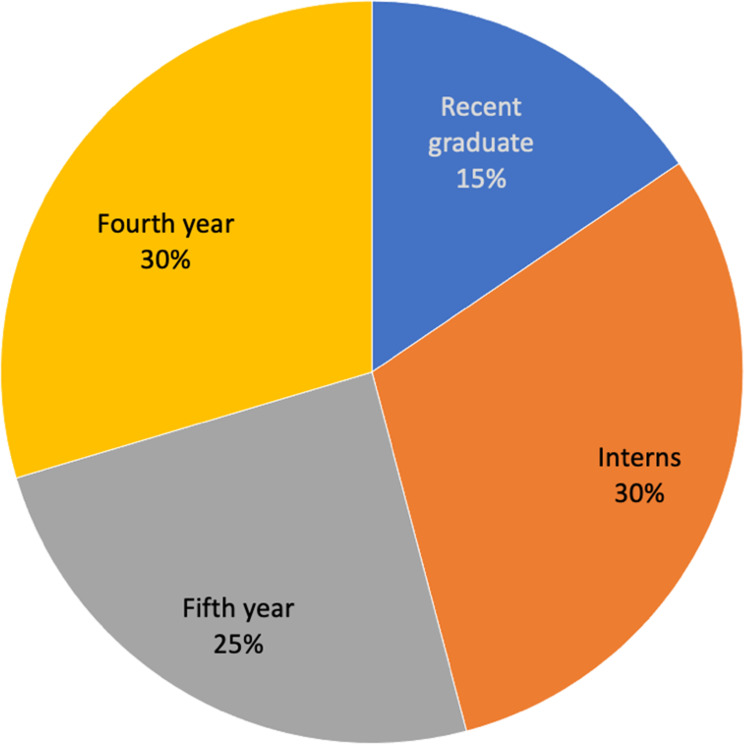
Methods: A cross-sectional study was conducted on undergraduate dental students at King Saud University, Riyadh. All fourth- and fifth-year dental students, interns, and recent graduates were invited to participate in a 16-item self-administered questionnaire distributed through an online survey platform. Descriptive statistics were presented. Differences among different academic levels and between gender were tested using nonparametric tests. P < 0.05 was considered significant.
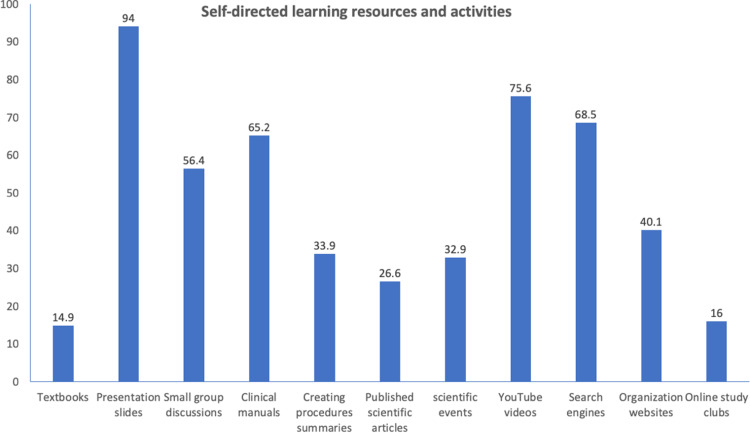
Results: The response rate was 71.5%. More than half of the participants (59.3%) reported actively engaging in self-directed learning activities, with the most common activities being learning from presentation slides (94%), utilizing YouTube and social media accounts (75.6%), and searching for information online (68.5%). Conversely, textbooks were the least frequently used resource for self-directed learning (14.9%). Significant differences in self-directed learning activities utilization were found between male, and female (P < 0.05), and between different academic levels (P < 0.05).
Conclusion: The study highlights willingness of undergraduate dental students to support their learning and the diverse self-directed learning activities employed. Learning from presentation slides, YouTube videos and looking for information on search engines were the most commonly implemented activities among students to support their learning, suggesting a shift towards digital learning modalities. These activities can be further encouraged in dental curriculum to enhance students learning experience.
Keywords: YouTube; dental education; dental students; self-directed learning.
© 2025 Almufleh et al.
Conflict of interest statement
All the authors declared that they have no conflicts of interest to disclose for this work.
Figures
Similar articles
-
The Association Between Emotional Intelligence and Academic Performance of Dental Students at King Saud University, Riyadh, Saudi Arabia.Cureus. 2024 Aug 8;16(8):e66431. doi: 10.7759/cureus.66431. eCollection 2024 Aug. Cureus. 2024. PMID: 39247020 Free PMC article.
-
Inappropriate use of beta-blockers among medical and dental students at King Saud University, Riyadh.J Family Med Prim Care. 2020 Aug 25;9(8):4391-4395. doi: 10.4103/jfmpc.jfmpc_696_20. eCollection 2020 Aug. J Family Med Prim Care. 2020. PMID: 33110866 Free PMC article.
-
Learning style preferences of first-year dental students at King Saud University in Riyadh, Saudi Arabia: influence of gender and GPA.J Dent Educ. 2013 Oct;77(10):1371-8. J Dent Educ. 2013. PMID: 24098042
-
Learning preferences among dental students using the VARK questionnaire: A comparison between different academic levels and gender.J Pak Med Assoc. 2018 Jan;68(1):59-64. J Pak Med Assoc. 2018. PMID: 29371720
-
The effects of flipped classrooms to improve learning outcomes in undergraduate health professional education: A systematic review.Campbell Syst Rev. 2023 Jul 7;19(3):e1339. doi: 10.1002/cl2.1339. eCollection 2023 Sep. Campbell Syst Rev. 2023. PMID: 37425620 Free PMC article. Review.
References
LinkOut - more resources
Full Text Sources
